Chris Cacavas & Edward Abbiati. Me And The Devil. Harboursong Records.

This album is somewhat of a summit meeting of two (plus two) of the most interesting characters in Americana music today. Chris Cacavas is of course the keyboard player for the troubled troupe that was Green On Red way back in the eighties before releasing a series of essential recordings with his band Junkyard Love. Edward Abbiati is the UK born leader of Italian Americana band Lowlands who have intrigued since their first release, The Last Call, in 2008 with the essence of Bruce Springsteen, Woody Guthrie and Richmond Fontaine in their DNA. Cacavas guested on Lowlands’ debut album and last year he travelled from his current domicile in Germany to North Italy to record Me And The Devil with Abiatti picking up a crack rhythm section along the way, Winston Watson on drums, one of Dylan’s Never Ending Tour stalwarts (as well as past duties with Giant Sand and Warren Zevon) along with Mike “Slo Mo” Brenner, a multi instrumentalist who has played with Marah and Jason Molina who carries out bass and lap steel duties here. Cacavas and Abbiati huddled together and wrote the songs which the band then recorded in a two day burst in a barn close to Abiatti’s hometown of Pavia.

The end result of this “barnstorming” stream of consciousness approach to the record is surprisingly good given that it had all the elements present that could have resulted in an aural equivalent of an essay on “what we did on our holidays.” Instead the ten songs here are all robust with the band firing on all cylinders (with additional input on tenor Sax, cello and harmonica on some cuts) with at least one of the numbers achieving epic status. They open with the rumbling blues of Against The Wall, bass thumping and organ and harp (Richard Hunter) wailing while tenor Sax (Andres Villan) parps away. Like a Native American war dance sung by Morphine this is best experienced cranked up to full volume as the slab of sound hits in the chest and heart. A terrific opener. A chunky guitar rips into the introduction of the title song, a classic heat blasted slice of American music with a sludge like bottom topped by harmonica acrobatics from Hunter and a fierce guitar solo from another guest musician, Stefan Roller. Oh Baby, Please has Cacavas let loose on the organ while the sax drives a sixties garage punk riff that snarls with a pout not heard or seen since The Fleshtones, a song waiting to be discovered by hipsters on dance floors all over Tarantino land, again, play loud and just surrender to the dumb beat.
The Week Song is unfortunately titled as it palls in comparison to its predecessors but the opening chords of Hay Into Gold with a cello abetting the powerful bass and drum highway drive take us back into a dark Americana underbelly, lanced by shards of lap steel as the song creeps along in a disturbing stalking fashion. Long Dark Sky maintains this haunting, even threatening menace. Although it opens with a mighty mid sixties Who like thrash it soon unravels into a neon lit David Lynch nightmare lyrically while at the end the band bring it back to The Who with a mischievous morse code guitar stutter and thrashing Moon like drums. Can’t Wake Up is another dark tale with an acoustic slide driven push but The Other Side then sails into sight, towering above its compadres. Harking back to Cacavas’ early albums it employs a Neil Young slow burn as the guitars roil and boil churning up a menacing stew with Watson’s cymbals crashing away while the song ebbs and flows in magnificent fashion. The only complaint here is that it ends far too soon. I’ll See Ya in comparison is understated. Acoustic and tender it affords a ray of light in comparison to the devilish mayhem that precedes it while the closing song, Rest Of My Life, is another plea, plaintive this time, to be released from the shackles of the heart and given an uplifting feel with some winsome lap steel.

Overall Me And The Devil is a cracking album while the excellent cover art by Deborah Maggioncalda adds to the attraction. Very highly recommended.
Harboursongs website

Book Review #2. Dan Stuart. Barcelona Blues. Padre Lindo Press.

Barcelona Blues

Dan Stuart wears an alter ego, Marlowe Billings, in his “false memoir” The Deliverance of Marlowe Billings that relates his formative years and rock’n’roll life before his eventual deliverance to a psychiatric institution. Barcelona Blues, a book of poems by Stuart, ditches this conceit and nakedly opens with an introduction that details his Spanish wife’s infidelity in 2010 which led to another short spell in care before he headed to Barcelona for a prearranged gig in the midst of what he calls “a severe depressive episode.” So far, so fun. In Barcelona Stuart is supposed to play at a testimonial show arranged for a sick member of his wife’s cousin’s band. Paranoid and wasted he describes it as the worst night of his life. He stays on in Barcelona for a time, seeking refuge among Andalusian immigrants and in the red light district while falling for a local femme with whom he has “a short but intense affair.” His introduction ends “these poems are really for her.”

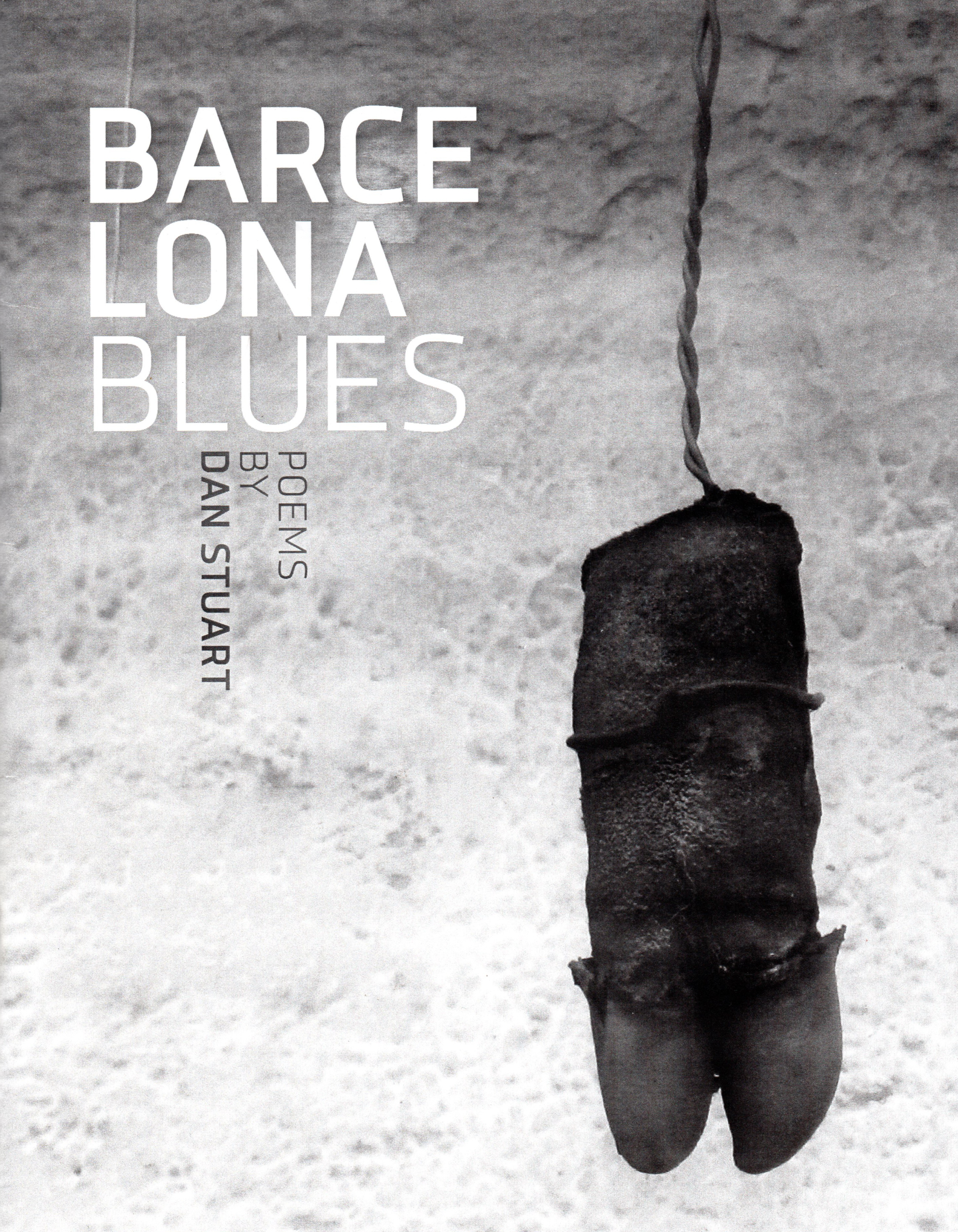
Stuart has written candidly about his marital problems in the sleeve notes for the magisterial reissue album, Arizona: 1993-95. Barcelona Blues catches him with the wounds raw and weeping, seeking solace and anonymity in a Barcelona tourists wouldn’t recognise. The cover features an ugly blackened pig foot that resembles a deformed penis strung on a wire found hanging outside a garage in a gypsy quarter. The poems feature Stuart for the most part in cafes and bars observing life around him, police assaulting suspects, young mothers with push up bras pushing baby strollers, sullen teenagers on the cusp of sensuality, oafish men whose primary pleasure is “futbol.” Odours of food and tobacco are vividly captured and there’s an overall sense of menace with Stuart, the outsider, having to tread carefully amongst these bruised people while frequent use of Spanish colloquialisms reinforce the sense of alienism. When he gets personal he tells us that his anti depressants cause impotence leading him to rely on a “blue pill” while overdoses and domestic violence cloud those he gets close to.

The book is a visceral rush urging the reader to pursue it to the end where Stuart seems to accept the scuzziness around him as preferable to the frigid Catholicism and brutality of the Franco regime While the title recalls Kerouac’s Mexico City Blues Stuart’s poems are not set out in verse form and there is none of Kerouac’s Zen mysticisms here. Instead Stuart captures the documentary style of a Kerouac poem such as Bowery Bums while Hemingway’s poems such as Montparnasse may be another influence. Another Hemingway piece, his recollection of his Paris days in A Moveable Feast might be more apposite to reference while Stuart’s current domicile in Oaxaca, Mexico inevitably leads one to recall Malcolm Lowry’s Under The Volcano. Stuart sets the poems in sections which appear to be named after geographical districts in and around Barcelona although each one can stand separately from the others. As with Beat poetry there is a sense that the words were written to be read aloud and fortunately Stuart has provided an example which you can hear below.

Barcelona Blues is just another piece of the jigsaw puzzle that is Dan Stuart these days. His Green On Red days are well documented, thereafter he seems to have had periods of calm and some very turbulent times. His recent reappearances, on record, live and by written word hopefully signal that he is coming to terms with the past and looking to the future.

Book review: Dan Stuart. The Deliverance of Marlowe Billings. Cadiz Music.

Rock autobiographies are big news these days with bookshelves groaning under the weight of confessional (and often redemptive) tomes from almost everyone who’s ever committed music to plastic. We get the up and downs, the trials and tribulations, the dirt is dashed ( after the lawyers are asked) and the reading public have their vicarious thrill. OK, for every dozen ghosted epics there’s a genuine nugget and it’s fair to say that Dylan (as usual) tops the list for critically acclaimed memoires with Chronicles offering a very slight insight into his head. For the most part however it’s the lesser known artists, the cult favourites, who have delivered musings that have opened up the often grimy and dreary life of rock’n’roll with the likes of Luke Haine and Mark E Everett stamping their personalities on their respective tales.

Dan Stuart, Ex Green On Red front man, who has only recently resurfaced after a decade or so of personal turmoil has now put pen to paper with his “false memoir,” The Deliverance Of Marlowe Billings.” Billings is the alter ego adopted by Stuart for his 2011 comeback album of the same name as the book. The album followed a marital and mental breakdown that eventually found Stuart moving to Mexico with the avowed intention to top himself. Instead he found a second wind, recording the album, touring Europe and writing this book.

As Billings, Stuart introduces us to a sun blasted weed smoking minor delinquent who starts a band in the emotional wasteland of Tucson. Snot nosed and foul mouthed, glam rock then punk and Patti Smith fire him up in a milieu reminiscent of the kids in Alex Cox’s Repo Man. Overdoses, petty crime and rude sex only threaten to divert this weird messiah’s collection of disciples until he has a rag tag band that outgrows Tucson’s sin bins and decamps to LA. DIY recordings lead to record deals and label rip offs before Billings and crew set out to conquer the world only to find that the craziness follows them until the band falls apart. Intending to start afresh he’s fucked by legal shenanigans forcing him to retain the band name screwing his pals and hurtling forward into an ever increasing maelstrom of mental indignations. The book ends with Billings in a psychiatric institution.

If the above appears to be a conventional retelling of the Green On Red story then you’d be right apart from the conventional element. Stuart tells the story in short, staccato bites. Each chapter is no more than two or three pages delivered in a hard boiled, almost voyeuristic fashion. Like a fusion of Hemingway, Bukowski and Jim Carroll Stuart is bare boned in his reportage with no shying away from the misogynism of the times while drug fuelled embarrassments are described with a particularly debauched Edinburgh visit detailed. For a “rock” biography there’s little about the music itself within the pages. The set ups, the producers, the screw ups and legal crap are all here but unless you know the band you wouldn’t have a clue as to what they sound like. In addition Stuart (in fine roman a clef fashion) doesn’t name names for the most part but this adds to the attraction of the book as I was scouring album sleeve notes and googling like hell to pin down the cast list.

It’s rough, raw and rude but according to Stuart and others who were there that’s what it was really like. Stuart himself describes the book as “it’s just words and shit” but as a portrayal, not just of Stuart and Green On Red but numerous others in the post punk LA scene , it’s a visceral slice of life, warts and all.

Buy it here

Southside Americana: The John Hinshelwood Band/Jack Law. The Glad Cafe. Sunday 29th June.

Hinshelwood

Law

Hot weather and world cup football on the telly aren’t particularly conducive to promoting gig attendance. So a big hurrah to those who turned out to see some local musicians in the intimate surroundings of Shawlands’ Glad Cafe.

John Hinshelwood has just released his excellent third album, Lowering The Tone and tonight (accompanied by guitarist Tim Black and bassist Ed McGlone) was a welcome opportunity to hear many of the songs from the album live albeit in a stripped down fashion along with a few selections from his previous albums. The opening Dangerous Journey (from Shattered Pleasures) immediately introduced us to the care free relaxed seventies LA vibe that Hinshelwod captures so well with the acoustic guitars strumming us along a desert highway, a feeling that was maintained on Radio Angel and A Few Shallow Moments. The band took a side step into Western Swing, no mean feat for a three piece (with Hinshelwood lamenting the lack of a fiddler here) on Tell Me Something with Black delivering a blistering solo (despite Hinshelwood’s “not too fast” aside to him as they launched into the song). American Lifestyle is one of Lowering The Tone’s highlights and tonight it proved to be one of the highlights of the set. With Black on mandolin it recalled Steve Earle’s Copperhead Road in its stompalong country delivery with an edge and had the requisite clapping and foot stomping from the audience.

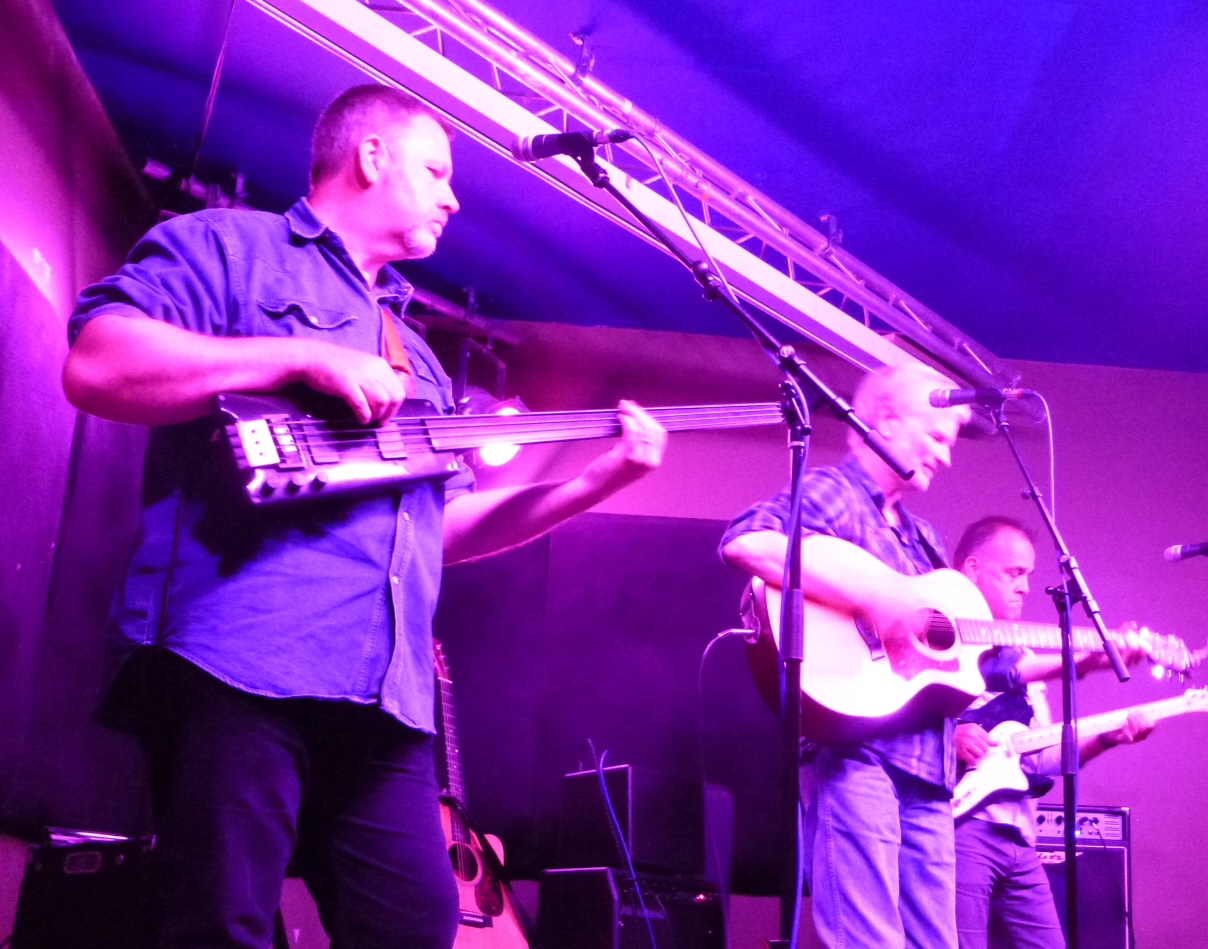
While guitarist Black had the opportunity to shine on several of the songs with his Ry Cooder like slippery tone excelling on the JJ Cale groove of No Hiding Place (mixing too many musical metaphors here I know) bassist McGlone was a rock, anchoring the band and perplexing the audience when he strapped on his Chapman Stick, a wondrous looking contraption that offered depth and a woody warmth to the bass playing on several of the songs. Chapman

They had great fun duelling each other on the crowd-pleasing cover of Junior Brown’s My Wife Thinks You’re Dead whith Hinshelwood giving a fine deadpan delivery while the closing song, a cover of Smokey Robinson’s Tracks Of My Tears featured some very fine harmony vocals and a fine performance from Hinshelwood.

Support act Jack Law is a new name to Blabber’Smoke but it turns out he’s something of a veteran having been in a band called Greenmantle back in the seventies who appeared on a couple of occasions at the legendary Apollo. Now silver haired (and resembling Charlie Rich at times) Law has revived Greenmantle but tonight he was performing under his own name accompanied by Dougie Harrison on guitar and J.C. Dante on bass and mouth harp with the pair introduced by Law as “The No Spring Chickens.” Law’s roots in the past were evident from the opening when he offered a song written some years ago as a protest against the Iraq war. Powerful and polemic Law delivered it with gusto, veins a popping. He also railed against the Beeching cuts on Railroad Man, a bit late one might think but as he explained the railroad network has never recovered from this sixties butchery and the song itself was a fine railroad ballad with some neat slide guitar work from Harrison. There was more protest on As Any Fool Would Know which targeted the late and unlamented Maggie Thatcher recalling Lindisfarne in their heyday while the melody borrowed from Dylan’s You Ain’t Going Nowhere. Away from protest Law proved to be a fine writer with his paean to middle age romance, Heartache Ain’t For The Young a tremendous song with lyrics worthy of Loudon Wainwright III. With another country stomper delivered again on mandolin with some fine harp playing from J.C. on Old Glass Jar Law proved he still has plenty to deliver.

I think that Southside Americana is taking a summer break but Blabber’n’Smoke will post any news of forthcoming shows as they come in on the wire.

John Hinshelwood website

Jack Law website