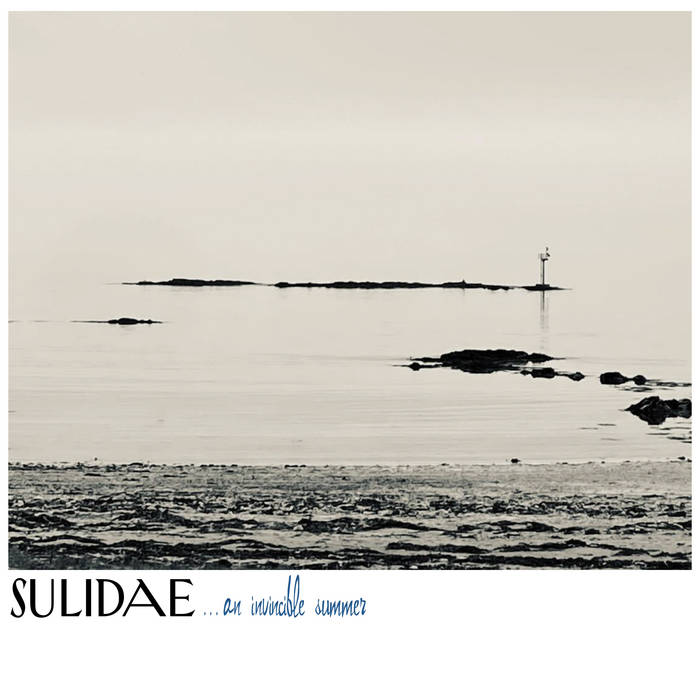
Sulidae, the solo project of musician, writer and photographer Bobby Motherwell, impressed all who heard their debut album, Kitchen Sink Dharma, released almost exactly two years ago. That album was warm and engaging and steeped in the human condition (and all that entails). …an invincible summer (all lower case) finds Motherwell still engrossed in the minutiae of life, be it the benefits of communing with nature, the strength of family and friends and traversing the inevitable tragedies which must befall all of us from time to time. It’s both more personal and more open with Motherwell sharing some writing duties with his musicians.
As on Kitchen Sink Dharma Motherwell is supported by an excellent group of musicians. Kirsten Adamson returns on vocals and Andy Lucas and Duncan Lyall are retained from the debut album while another Blue Rose Code alumnus, Lyle Watt adds his guitar skills. In addition, James Grant, Fraser Speirs and Bobby Bluebell all appear and Seonaid Aitken plays violin. They’re well picked as their skills allow the songs to shine throughout the album, be they heroic songs of steadfastness or spoken word tales of couthy behaviour. The album flows wonderfully with sounds of nature often included adding a fine bucolic (and yes, a healing) feel to it.
Motherwell opens the album with the bustle and sounds of wide open spaces on the spoken word The Wild Garlic And Bluebell Way with Lyle Watt’s guitar adding a grand ambient sense of serenity. Motherwell practises “walking meditation,” and here he captures the peace and joy one can experience through the simple act of walking in the wild. There is a sadness to the song as Motherwell’s faithful pal on many of his walks, his canine companion, Dennis, has sadly departed this world. There’s more contemplation on the following song, Wind And White Horses, which is borne aloft by Aitken’s violin and Lucas’s buoyant keyboards as Motherwell hails the western isles with Adamson wonderfully singing along with a breathy whisper. Speaking of whispers, there’s a slight hint of Dylan in both the lyrics and the delivery of Save You All My Blues and Healing Light positively resonates with the most yearning aspects of songwriters ranging from Van Morrison, Jackie Leven and Ross Wilson. This song is the pulsating heart of the album but it’s closely followed by the irresistible heartfelt memories and final farewells which fuel Why Are All The Good Guys Gone? Aside from Motherwell’s canine companion, the album is dedicated to three of his friends who have recently passed on and also to their respective partners. Three Women, a companion song to Why Are All The Good Guys Gone? is a moving tribute to them. Here Adamson and Motherwell’s voices are joined at the hip while Aitken’s emotive violin tugs at the heart.
There’s a nod to local history on Wilson’s Lament, a song inspired by the life of a man considered as the father of American ornithology. Alexander Wilson came from Motherwell’s home town and had to flee Scotland in 1794 after publishing what were considered to be libellous poems about local mill owners. Motherwell brings this story to life with an arrangement which is quite stunning with the ensemble sounding as if The Band had come from Paisley. An absurd claim perhaps, but listen to the song and tell me that claim is not at least half true. Whatever, it’s a glorious performance and it’s followed by another. The words of Ordinary Day are by Liz Kentish who was a participant in a letter writing project for those living with cancer. Motherwell takes her words and weaves them into a gorgeous song which, and we’re running out of superlatives here, deserves to held in the highest regard. Again, the players are exemplary as they gingerly support this fragile song, piano and violin especially so and there’s a sublime moment towards the end, a key shift, a slight flourish as Motherwell repeats the mantra of “What you’ve heard and what you’ve seen, what you’ve done and where you’ve been.” The title track follows, a short instrumental showcase from guitarist Lyle Watt which adds a transcendent shimmer to the previous song.
Dotted throughout the album Motherwell looks back on his past with several spoken word interludes which pitch him firmly in a flinty Scottish hinterland. Fraser Speirs’ earthy harmonica underpins these narratives while Watt’s spectral guitar allows one to imagine that if Paris Texas was set in the west of Scotland that it would be Motherwell instead of Harry Dean Stanton striding out. Van Morrison once asked “did ye get healed?” Sulidae do their best here to answer in the affirmative.
The release of …an invincible summer will be celebrated at two album launch gigs in Glasgow (October 4th at The Glad Cafe as part of the Glasgow Americana Festival) and Edinburgh (October 7th at The Thistle Bar). Glasgow tickets are available here, Edinburgh tickets here.
