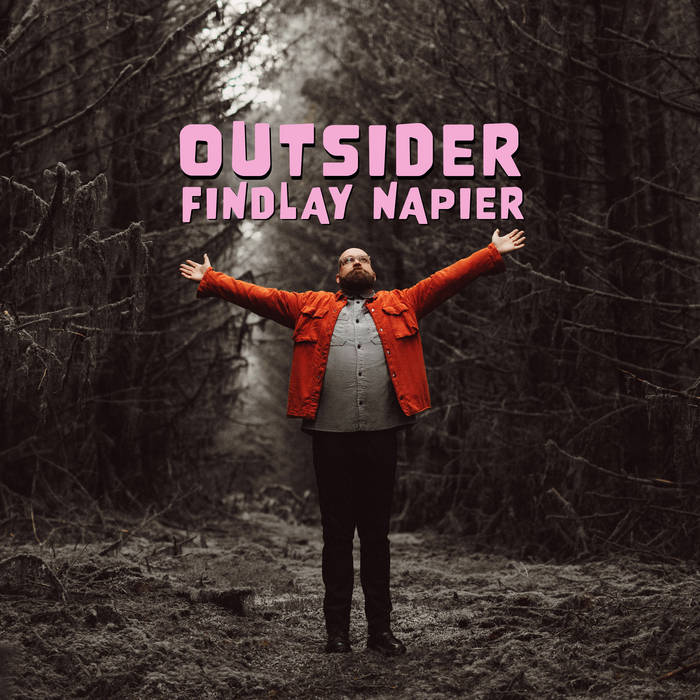
Findlay Napier. Outsider. The Bothy Society

Judging from his regular newsletters Scotland’s Findlay Napier is a busy, busy man. He has a finger in many pies, his work in the folk supergroup that is The Magpie Arc, an ongoing commitment to song writing workshops, a lecturer on traditional music at Scotland’s Conservatoire (formerly the Royal Scottish Academy of Music and Drama, the institution he attended), along with being a sometime stand-up comedian, it’s surprising that he has the time to consider his solo career.

Somehow he’s managed to find the time to record his third fully fledged solo album, some ten years after VIP: Very Interesting Persons, his debut album but only eight years after the follow-up, Glasgow. Both of these albums were quite superb and it’s fair to say that on Outsider Napier has maintained the quality one hoped for. The album is packed with striking songs, all played with flair and determination.

Given the length of time since his last album, Napier had a plethora of songs to choose from for Outsider and he eventually whittled them down to the 12 on show here with the assistance of his long time collaborator Boo Hewerdine, who produced the album and has two co-writing credits here. The album title is, in part, down to the Scottish accent Napier sings with – despite the success of The Proclaimers it’s still relatively rare to hear an accent out with the truly traditional folk scene. In addition, many of the songs are about or inspired by people who considered themselves “outsiders”   in one way or another. Napier explains much of this in a companion “coffee table” book which has in depth notes on each of the songs along with music tabs, essays, pictures and access to four more songs. Unfortunately Blabber’n’Smoke doesn’t have the book so we’re relying on the songs.

And what songs they are. Napier relates that some of the sounds he and Hewerdine strived for came via listening to Richard Thompson, in particular the albums Mirror Blue and Mock Tudor. That’s apparent from the rock’n’roll rumble which kicks off Running The Light, the opening song here which has guitarist Neill MacCall turning in a great approximation of Thompson’s Celtic come Nashville guitar strokes. The title track is another rock rumble, almost rockabilly in fact, while An Extensive List Of Lost Things, a fantastic litany of unimportant trivialities which are compared to the singer losing sight of his relationship is not only whip smart but is infused with the spirit of Richard Thompson’s occasional kitchen sink dramas. Another spirit, that of Gerry Rafferty, back in his Humblebum days is recalled on the back lane testament which is Oh Amy.

There’s a coruscating memory of working as a waiter in a fancy diner on Silver Service, a song which is almost vaudevillian but has a sting in its tail. Inky Fingers is much more intimate as Napier describes the intimate thoughts of a potentially devilish schoolboy in thrall to a would be sweetheart while Amberola Blue is, quite simply, the result of a song writing challenge to write a song about an appliance. Napier, fittingly enough, writes about an early record player, designed by Edison to play wax cylinders. Here he harks back to the yearning songs of VIP and that album is again evoked on the wonderful Fidel Castro Five Years Gone. This is a tremendous song which conflates childhood memories and various CIA plots to assassinate Castro and there’s a lovely whiff of Michael Marra in Napier’s delivery. It’s the icing on the cake here as Napier delivers an album which is both exciting and intriguing. 
Website

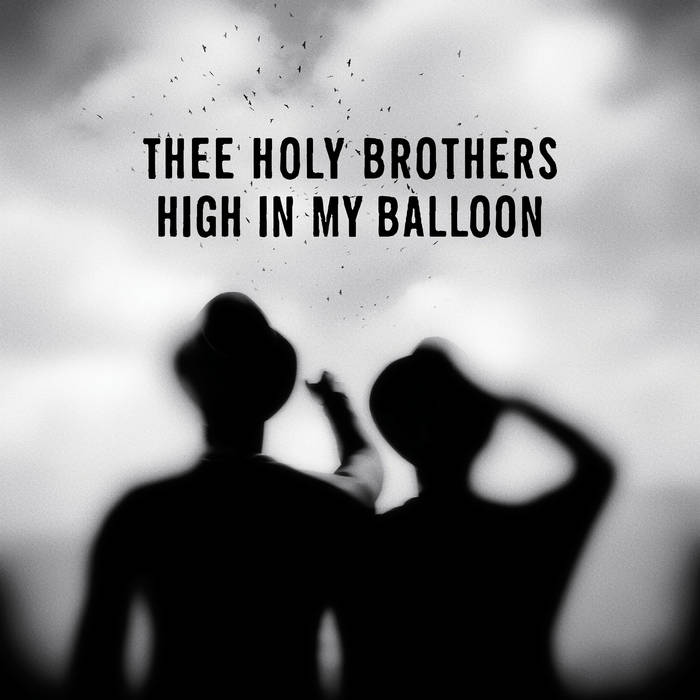
Thee Holy Brothers. High In My Balloon

Back in 2020 Thee Holy Brothers sparked into view with their excellent debut album My Name Is Sparkle. The duo -Marvin Etzioni (ex Lone Justice) and Willie Aron (of The Third Mind) – were so named by the rabbi at their local synagogue , Mordecai Finley, who described them thus, a moniker which was heartily endorsed by another member of the congregation, Leonard Cohen.  My Name Is Sparkle was kind of a psychedelic and trippy audio update of Candide, the protagonist an innocent in search of enlightenment, seeking Jesus but eventually finding Elvis instead.

High In My Balloon is the second instalment in a proposed trilogy of Sparkle’s adventures but it’s not perhaps the album thee brothers initially expected to record as the blight of cancer reared its ugly head during its recording. Etzioni was diagnosed with cancer and, sadly, Aron’s spouse died of the disease. Etzioni was eventually given the all clear after treatment and the album’s title is a nod to his reaction as he says that “I was so elated at the news, I felt like I was levitating, like I was high in a balloon. I did what I always do, I wrote a song about it.” Not just one song however as Etzioni takes Sparkle on a ten track odyssey from doubt, travails and eventual elation, approximating his own trajectory as he fought his illness.

Despite its harrowing gestation the album is quite uplifting, at times almost ecstatic. The pair’s vocals are brotherly harmonies of the first degree and they gleefully inhabit the cloaks of acts such as The Everlys, The Beatles and The Beach Boys on several of the songs. In addition, they cleave to the first album’s sometime off kilter approach giving the whole affair a singular identity, unique to these two somewhat battered brothers who have achieved a degree of excellence in the face of adversity.

The album opens with  a rousing, almost Spector like flourish, on the powerful chimes of Born Torn as our Sparkle, cognisant from the off, sees the world and his future as a series of binary choices and this black and white confusion is maintained in the Beach Boys like reverie which is The Holy In Everything. Here, daily dismal distractions such as war bulletins on TV lead to a sense of ennui but on occasion there’s an opening in which our protagonist can see what he describes as The Holy In Everything. There’s a cacophony of car horns tooting throughout the grungy Guru Honk, a song which is the flip side of George Harrison’s mysticism, the addition of a mellotron towards the end a nod perhaps to those vainglorious days.

Sunshine In My Veins is a startling pop song of the first degree but, such as is thee brothers wont, it’s slightly out of tune, creating a woozy feeling in the listener. It’s somewhat apt as Etzioni says he wrote it in an attempt to portray his experiences on chemotherapy. Magic Jacket meanwhile comes across like an undiscovered psychedelic Who track, left off The Who Sell Out. It’s the breakout song here, the protagonist, just like The Who’s Tommy, unbound and able to conquer all adversity, in fact almost in charge of all as is proposed on the philosophical thoughts contained on the following I Am Time, another glorious song.

Emily Parade comes across as a slight interlude, a whimsical song in the manner of Robyn Hitchcock, it meanders well before the horn ridden I Can See From My Window Now stomps into view, another song which swells with optimism, “A new day for everyone” they sing. Ode To Harry Cell is presumably a farewell to the cancerous cells which Etzioni conquered and is given a delightful almost bluegrass treatment and the album closes with the title song which, as mentioned above, Etzioni wrote on getting the all clear. Over a stabbing Hammond organ riff, the brothers get again all Beatles like on a triumphant song which has a wonderful coda.

Forget the concept and revel in the sounds here. Steeped in harmony history and given an idiosyncratic twist, High In My Balloon is, quite simply, quite brilliant and we sincerely hope that these Holy Brothers carry on and deliver the third instalment of their Sparkle trilogy.   

Website