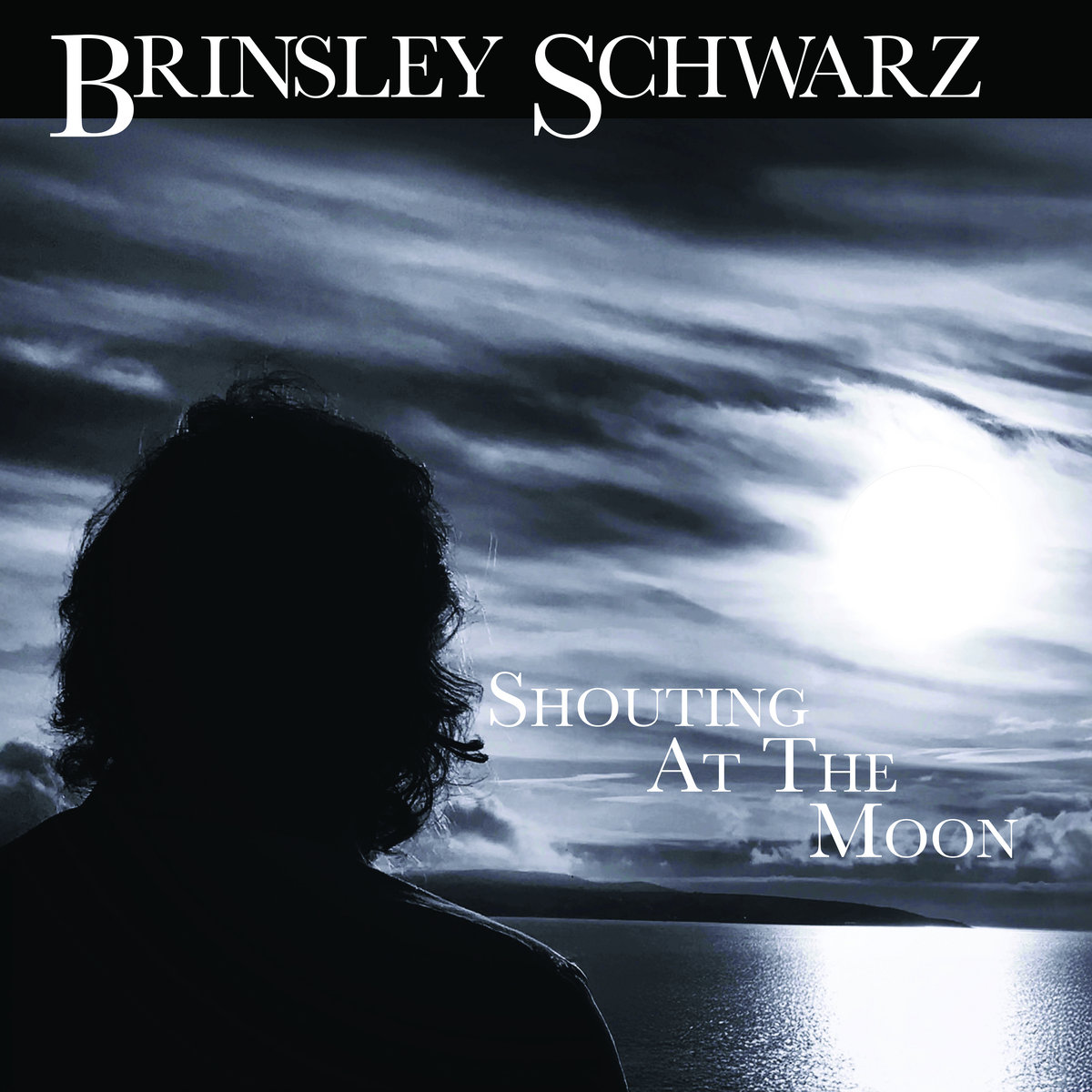
A third solo album from the legendary “pub rocker” who gave his name to perhaps the premier “pub rock” band and who was an integral member of The Rumour who started off as Graham Parker’s backing band finds this veteran in a soulful and bluesy mood. Shouting At The Moon follows in the footsteps of its predecessors, 2016’s Unexpected and 2021’s Tangled when Schwarz returned to recording after a lengthy lay off. It’s rooted in a laid back, almost world weary, nod to classic rock music, the good stuff mind you, the laid back grooves of Van Morrison, Peter Green’s brief return to recording, snatches of J.J. Cale and a brief nod to the sly funk of Steely Dan.
The combination of Hammond organ and Rhodes piano (played by album producer James Hallawell) and Schwarz’ fluid guitar are the bedrock of the album, heard to best effect on The Chance, a gloriously infectious slice of funk although it’s almost eclipsed by the Little Feat like syncopation on Hard To Change (About Things Not Likely To Ever Happen), a political fable which imagines foes finding common ground.
The album opens with a song which captures the sunnier side of Van Morrison on Every Day, a fine strum along song with some inspired sax solos from Simon Taylor while the following What In The World is the song which has inspired the Steely Dan comparison we noted above, However, we’d add that there’s a fine hint of Mose Allison and also Ben Sidran in its groove. Falling Over Backwards warms the soul with its hint of sophisticated blues, think of B.B. King with The Crusaders and you are halfway there.
As on Tangled, Schwarz covers a song by his long time companion Graham Parker. Watch The Moon Come Down. Warmer than the original, Parker’s original sense of isolation is now somewhat elegiac and graced with a fine dose of nostalgia. The album closes with It’s Been A Long Year, a yearning guitar and organ inflected elegy which addresses the issue of climate change in a heartfelt manner.
This is an intriguing album. On the face of it it’s a collection of expertly played songs which hark back to singer/songwriter folksiness of the seventies in their manner and delivery. Indeed, there are occasions when the ghost of Jake Thackray seems to be hidden within the grooves although much of the album tackles fairly heavyweight themes including identity, race, immigration and empire.
Glen Peters is an Anglo Indian who was born in Calcutta. His family moved to England in 1967 just as Enoch Powell was igniting racial hatred with his infamous rivers of blood speech. The 17 year old Peters was fortunate enough to make friends with a pal who told him “Don’t worry, we’re not all like Enoch” and introduced him to the then cosy world of folk clubs, a world Peters has inhabited since then, initially as a performer and then running various clubs himself while also establishing a successful career as an advocate for and pioneer in eco friendly green energy.
A latecomer to recording (Where Do You Come From? Is only his second album) Peters proves himself a more than able writer while his voice is calm and laid back, none more so than on the rolling Caribbean lilt which suffuses the opening song My Face Don’t Fit. Sounding somewhat like Jeb Loy Nichols, Peters here pays tribute to a man called Paul Stephenson, a Trinidadian born native of Bristol who organised a Rosa Parks like boycott of Bristol’s buses back in the early 60s as the bus company refused to employ black or Asian staff. He won that war and his boycott helped pave the way to the 1965 Race Relations Act, the UK’s first attempt to address racial discrimination.
It’s an arresting opener, made all the better for the quality of the musicians Peters has employed. The album was recorded in Glasgow with Boo Hewerdine producing and the cast of players is a roll call of top notch Scottish musicians including Kris Drever, Euan Burton and Yvonne Lyon while Sweden’s Gustaf Ljunggren plays several instruments throughout. Hewerdine himself plays guitar and piano throughout and even disinters Ivor Cutler’s harmonium on a couple of occasions.
It’s Cutler’s wheezy harmonium which introduces Patel’s Corner Shop, a celebration of the ubiquitous local corner shop, many of them set up by Asians fleeing Idi Amin’s Uganda in the early 70s. From then the album seesaws between songs with a historical bent and several which are more personal. Of the former, Khan Of the Wire is based on the true story of Noor Inayat Khan, a Muslim woman who joined the Special Operations Executive and was killed by the Nazis in occupied Europe. Based around Peters’ visit to her memorial statue in Bloomsbury Square it’s affectionate and moving and a reminder that it wasn’t only white males who fought the fascists. Sepoy’s Lament meanwhile imagines the conflict experienced by an Indian soldier commanded to participate in the murderous Amritsar massacre. It’s the most “folk like” song here, sung to a martial beat and quite rousing.
On the personal front Peters introduces a note of jollity on the music hall like Oh To Be An Aries, a nod to the astrological influences to be found in India (much more profound than here) but he is more serious on his reflection of what home means on Home Is, a plaintive piano led ballad with a gorgeous string arrangement. When You’re 16 is perhaps the most autobiographical song on the album as Peters, singing along to a 50s like rock’n’roll pop backing, recalls the uncertainty and excitement which coexisted within him when he migrated to London. That melting pot of east and west, the collision of cultures and the eventual realisation that, to use a Scots term, “We’re all Jock Tampson’s bairns” is summed up in the closing song Where Do You Come From? Jettisoning his backing players, Peters begins the song by singing “57 flavours in my family tree,” perhaps making the point that we are all just human “beans.” Anyhow, here he takes to task the essential absurdity of the question posed. After all, who of us really knows where we truly come from?
Packaged in a sumptuous manner with notes to all the songs in a 64 page booklet, Where Do You Come From? is not only very entertaining but thoughtful and provocative and well worth a listen.
An inspired grouping of three like minded characters, Geckøs features the line up of Howe Gelb (Giant Sand), M Ward and McKowski (Mark McCausland of The Lost Brothers). Gelb has collaborated with Ward and McKowski over the years but it was an invitation to a mutual friend’s wedding in Tucson that led to the trio’s formation. Invited to compose and perform a wedding waltz, Gelb and McKowski felt their effort was just too low key so Ward stepped in and added, as Gelb says, “That guy, he’s got celebration up the ying yang. He added all this wonderful melody and spark to it.”
Galvanised, the trio recorded several more songs in Tucson with Gabriel Sullivan producing before going their separate ways but the project continued with ideas pinging back and forth before recording sessions in Ireland, London and Bristol with producer John Parrish eventually tying all of these into this singular album. According to McKowski “I recorded the bulk of the backing tracks in my home studio in Ireland and then we met up in various places and finished the songs off together. The main formula was Matt and/or Howe would take one of my instrumentals and write to it, adding their vocals and instrumentation. It was all done very quick and fun!”
The album opens with that self same Wedding Waltz which kicked off the project. It’s a gorgeous tune, redolent of the romance of the Tex-Mex border, Ward’s voice perfectly pitched amidst the bustling stringed instruments, saloon piano and Mariachi horns. Indeed, most of the album inhabits a space which is undoubtedly indebted to the sounds of the USA/Mexican borderlands but McKowski, who arranged much of the music, speaks of a semi mythical world which he calls The Boneyard, and which allows many of the songs to sound as if they exist on a spectral plane, a borderland without borders if you wish. Having said that, Ward, who is of Mexican heritage, sings in what he calls “Spanglish” on several of the songs. There are elements of Leonard Cohen, gypsy music and ambient sounds all in the mix and, quite inspired, all eleven songs run seamlessly into each other with short instrumental bridges connecting them.
While there’s a whiff of Giant Sand on the Gelb helmed songs (Dance Of The Gecko, Black Diamond and Blame It On The Ocean) he certainly doesn’t hog the limelight. Lo Hice is a spindly slice of Mexican romance with Ward’s light voice tender and loving in contrast to his rich gravel on El Techno, a superb song which begs translation. There’s a cinematic quality, Morricone like, on the fabulous fable which is River Song while Botos Negros is like Leonard Cohen traversing the Mexican border. The album closes with Red Spade, a languorous and delicate border lament, reminiscent of Ry Cooder’s music for Paris, Texas, which features lyrics spoken in Japanese by Kiki Ohara (who did the album artwork), adding another layer to the worlds within worlds atmosphere of the album and closing it in a gloriously magnificent manner.