Kinky Friedman. Bi Polar Tour Live From Woodstock

What is there to say about Kinky Friedman that doesn’t sound as if it’s been dreamed up by a John Waters type screenwriter hoping to capture a warped vision of the American dream? Riding on the first wave of country rock in the early seventies he formed the Texas Jewboys, an outfit that thrilled and offended folk in equal manner. He toured and recorded with Dylan and was named male chauvinist pig of the year in 1973. His songs lampooned many of the shibboleths of the day be it racism, feminism, rednecks and he delivered all of this with a biting sense of irony and a huge helping of humour.
Since then he’s branched out into writing hard boiled crime stories (featuring investigative sleuth Kinky Friedman), ran for the governorship of Texas (unsuccessfully) and launched a range of products that celebrate his own legend. He continues to perform and nowadays is in the position of being a state treasure for all Texans who believe that the heart of Texas is in Commander Cody and not the Alamo. He is a raconteur, singer, songwriter, cigar smoker and all round dude.
All of this (bar the cigars) is on display on this his latest disc. Recorded live it’s a fine mixture of his songs, his introductions, reminiscences and some readings from his books. Armed only with his guitar (and undoubted charm) there’s a nostalgic sense to most of the songs as they reflect the issues and attitudes of the late sixties and early seventies and are delivered in the singer/songwriter style of those times. Nevertheless Friedman did write some fine songs and Sold American, We Reserve The Right To Refuse Service To You, Get Your Biscuits In The Oven and Your Buns In The Bed and The Ballad of Charles Whitman stand the test of time. But the primary reason for seeing “The Kinkster” these days is for the stories and ad libs as he delves into his colourful past and remarks on modern life with a fine wit and these are well captured on the disc with Waitret, Please Waitret the best example.

Kinky Friedman plays Glasgow this Thursday at St. Andrews in The Square courtesy of the Fallen Angels Club , His last appearance here in the Tron Theatre was an immediate sell out, in this larger venue there might still be a chance to grab an opportunity to see what ultimately is an Americana legend.
website

Jim Dead Live

dead

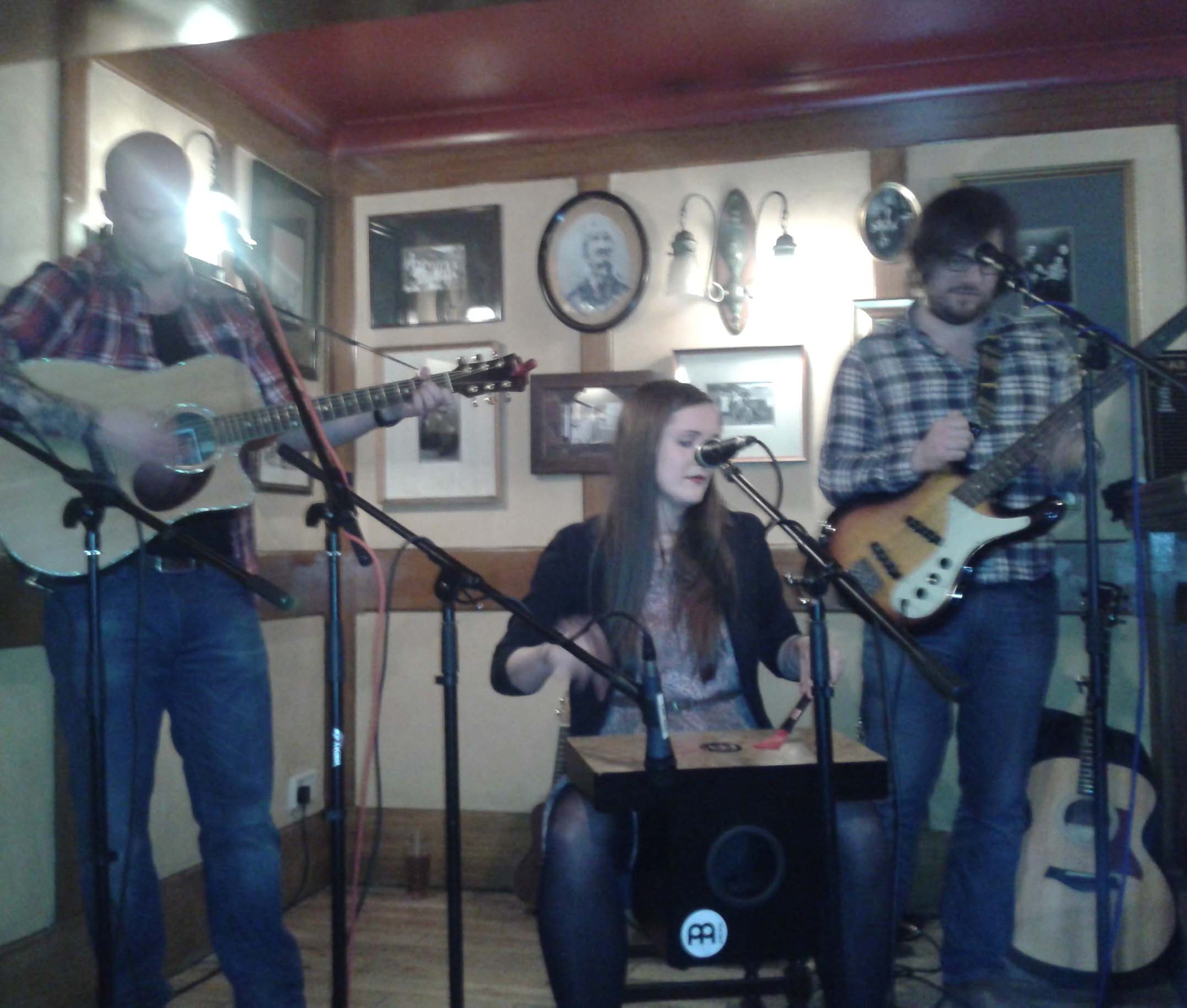
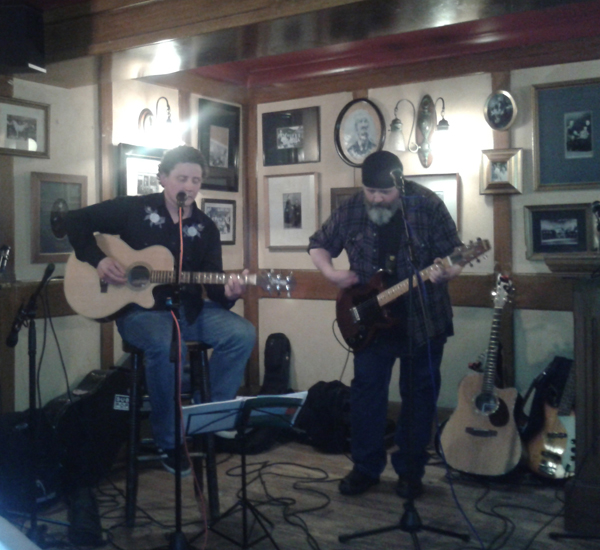
Local purveyor of “gulch” rock (dryer than that desert variety) Jim Dead had a rare outing on Friday night at The state Bar. Accompanied by his head honcho, Craig Hughes on growling electric guitar he transformed this Glasgow cellar into a flyblown pueblo for an all too short set. With a song list fairly evenly balanced between the Ten Fires album and his recent I’m Not Lost E.P. Dead sang with a gravid authority while Hughes provided all manner of sonic embellishment ranging from spooky bottleneck to scattershot bursts of noise.
The songs from Ten Fires stood well on their own two feet without the rhythm section present with Hughes pulling out all of the stops particularly on the epic Untitled while Coffee and Cocaine was chilling in its intensity. From the I’m Not Lost E.P. (which Dead recorded with Hughes) Stealing A Mile was the standout, a perfect example of their musical simpatico as it swept over the audience like a dire wind, a dustbowl of despair amplified by Hughes’s menacing guitar rumblings. Although the gig was plagued by some chatterboxes at the bar this song seemed to silence all.
Dead has another gig in Glasgow at Pivo Pivo on 21st May and on the strength of this he really should be seen. His discs are all available here

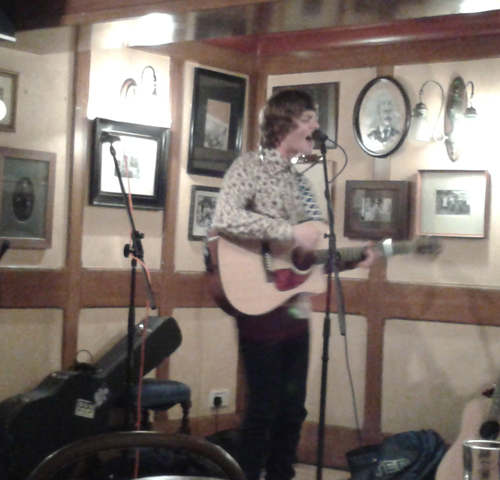
Dead and Hughes were bookended by two other acts, Ryan Morecambe who has a neat early Dylan vibe about him and Firebugs, an Edinburgh based trio who have an attractive bluesy folk sound and when mandolin was employed even reminded us a little bit of Lindisfarne.

morcambe
firebugs

The evening was hosted by The Vagabond Social Clubwho have regular nights at The State Bar and if they are all as good as this then We’d recommend keeping an eye out for future events.

Michael Rank and Stag. In The Weeds

Blabber’n’Smoke described Michael Rank’s previous album, Kin as a set of wonderfully ramshackle country leaning rock songs…..straight from the Stones’ country songbook. A double album, it had a tremendous swagger with switch-blade guitar and fiery fiddles blazing away. With In The Weeds Rank, a stick thin rock’n’roll ragamuffin staring defiantly from the album sleeve, delivers another blindingly good set of songs that again have a wasted elegance, a cosmic American sloppiness that strips away any studio polish and replaces it with genuine feeling. It’s not lo-fi or primitive with the production sounding crystal clear but the emotion bleeds from the speakers in spades as Rank and his band Stag lurch wonderfully from song to song.
A single disc, In The Weeds is obviously not as expansive as its predecessor and there is less of the fire and fury present. These ten songs are for the most part countrified laments with Rank accompanied on many of them by the vocal harmonies of Emily Frantz. The blistering guitar solos are for the most part abandoned and the overall feel is of a back porch session of musicians schooled in the ways of The Band and Nikki Sudden and The Jacobites. There remains however one guitar fuelled epic, The River Cross, a passionate and churning song that inherits Neil Young’s Stray Gators’ mix of banjo, pedal steel, slow burning guitar and clattering drums. Epic indeed.
The ragged acoustic numbers that predominate here might lack the gravitas of The River Cross but Rank’s (and Frantz’s) vocals allied to his ability to write songs rooted in the idiom as the band seesaw away more than make up for that. ‘Round My Head opens the album in fine style with sawing fiddle, rippling mandolin, chunky guitar and sweet pedal steel interlaced around the vocals and eventually taking over in a great melange by the end. This wonderful instrumental recipe underpins all of the songs here with a depth and complexity that belies the apparent ramshackleness of the opening song. Rifle Days ripples with regret while Topo crackles with anxiety and foreboding. Some of the songs however have a more bare boned approach with the band tiptoeing around while the listener half expects all hell to break loose. This Town is the best example as Rank is accompanied by a solitary banjo until the massed guitars occasionally hum into life and then fade away while The Surrender strips the instrumentation back and then allows a menacing guitar rumble to intrude. Lyrically the album is pretty dark and this is concentrated in the quieter musical moments. Field Song is a desolate ballad with stark fiddle and mandolin circling a grim tale of a suitor burying his would be lover and the opening words on All The Rope have all the ingredients for a home-made gallows.
A tremendous follow up to Kin, In The Weeds is a magnificent collection and deserves to be heard. Rank writes with the best of them and the sonic slurry he conjures up is nothing less than mesmerising.

website

Jenny Ritter. Bright Mainland


Jenny Ritter is a new name to us at Blabber’n’Smoke although she appears to be a mainstay of Canada’s west coast folk scene having been a member of the all female band The Gruff before they split in 2010. Bright Mainland is her first solo release and reflects a period of soul searching and a relocation from Vancouver Island to big city life on the mainland. While The Gruff were primarily an acoustic band Ritter here surrounds herself with a fine bunch of musicians to achieve a warm country tinged sound that is replete with some excellent pedal steel guitar. the eleven songs featured (all penned by Ritter) are bursting with a vitality that is refreshing and to top it all she delivers them with a voice that is almost immaculate.
Ritter’s acoustic guitar and voice supported by a lonesome pedal steel introduce the first song They Can’t Tell where a separation crisis highlights the gulf between her island and the mainland. Pretty soon the band stomp in with a driving percussive beat and the songs builds a momentum that is pretty thrilling. Not for the last time the listener is reminded of fellow Canadian Kathleen Edwards as Ritter swoops and soars throughout. Five Nights captures some of her early experiences of life in the city with the band capturing a late night feel while Ritter has a sense of wonder and yearning in her voice. There’s an uplifting sense of joy and happiness in the following We Must Sing as banjos flutter, guitars soar and the lyrics celebrate the power of song. Resolute is another opportunity for the band to cut loose with a fiddle to the fore and while Ritter is singing of a lost love again the overall feel is optimistic. You Missed The Boat has an almost doo woppish 50’s rock’n’roll swing and according to Ritter is another “breakup” song written during that time when one is getting over the emotional upheaval of a failed romance. again Ritter transforms what could have been a lament into a redemptive song casting aside the ex lover and again celebrating the power of song, literally so in this case as a massed chorus swells up at the end. Throughout the album the playing is exemplary with producer Adrian Dolan playing several instruments while Lucas Goetz of The Deep Dark Woods delivers incendiary pedal steel and also drums. Ryan Boeur and Bear Erickson add electric guitar on some songs and Elise Boeur plays viola. In addition there is a host of backing singers most of whom are members of the Kingsgate Chorus, a “rock’n’roll” vocal collection of local Vancouver musical luminaries. The band shine brilliantly on the enigmatic Ghost, a song that is central to the album as it ponders the duality of the duplicitous male and realises that a girl’s best friend is ultimately her mum. The music churns and boils along with some fine guitar effects to create a fine musical conundrum. Scattered through the album are a few songs that reflect Ritter’s folkier roots as accompanied by guitar she delivers a childlike set of beliefs in It Is What It Is while Weathervane shows that even without her musicians she can deliver a rousing message.

website

Dave Arcari and The Helsinki Hellraisers. Whisky In My Blood.

Dave Arcari and whisky seem to go together like ham and eggs. Sometimes we reckon he only started off in his quest to be Scotland’s premier blues artist in order to get offered dram after dram from adoring fans. It seems that after almost every feral delivery on stage someone comes up, glass in hand to offer homage and it’s somewhat fitting that he finally admits it in the title of his latest album, Whisky In My Blood. It’s something of a departure for Arcari who is renowned for his blistering solo performances live and on disc. Here he’s accompanied by the Helsinki Hellraisers whom he encountered on his regular trips to Finland, proof indeed that the Blues are universal. The Hellraisers (Juuso Haapasalo, upright & electric bass and Honey Aaltonen, snare drum, cymbal, washboard) actually appeared on a few songs on Arcari’s last album but here they clatter, batter and boom along with the main man allowing him to indulge in some rockabilly and skiffle.
It’s a great set that adds that extra dimension to Arcari’s usual sound. It allows him to come across as a demented swamp dwelling version of Led Zeppelin on Travelling Riverside Blues where his particularly lascivious slavering on the notorious squeeze my lemon lyric should be X- Rated. He revisits Robert Johnson on Preachin’ Blues which is given a tremendous run through and despite the great slide guitar playing it’s the singing which impresses most, a whisky soaked preacher indeed. Aside from another cover, Bukka White’s Jitterbug Swing which swings mightily Arcari penned all of the songs here. The title song is a classic celebration of the amber nectar and by all rights should have been recorded by The Dubliners if they had come from Alabama rather than Dublin. Third Time Lucky hits the same spot with Arcari on banjo and raising the ghost of Ronnie Drew. Tell Me Baby is a cracking rockabilly roustabout and this pell mell gung ho blues abandon is the primary feature throughout the album but Arcari and the Hellraisers do take some time to catch breath and deliver a few slower numbers. Still Friends has him picking on banjo and gruffly reminiscing on younger days while Wherever I Go is a boastful swagger of a song that stumbles along wonderfully. Cherry Wine is perhaps the best example of the synergy of the band with Aaltonen’s brushed drums, Haapasalo’s solid bass and Arcari’s fine slide playing and vocals coming together on what is an excellent song.

website

Have a look at this video on the making of the album which tells all much more eloquently than we can manage.

You can catch Dave this weekend at Broadcast in Glasgow. Other tour dates here

Rita Hosking. Little Boat.

Some years ago we heard Rita Hosking’s Come Sunrise and were pretty much blown away by it. Its simplicity, the tales of hard life and Hosking’s vocal delivery were all well above par and invited comparisons to Gillian Welch and Rachel Harrington. So it’s very nice to report that her latest offering Little Boat maintains and even improves on the quality shown on the earlier release.
It’s a simple affair with little or no frills. Hosking plays acoustic guitar while her husband Sean Feder adds Dobro and banjo and producer Rick Brotherton supplies guitars, bass and hammer dulcimer. Making it something of a family affair Hosking and Feder’s daughter Kora Feder co writes one song and plays some banjo while Kathy Brotherton is called upon to add some accordion. The end result is a beautifully played set of songs that have a refreshing back porch feel, unhurried, relaxed, picking away at the end of the day to while away any worries. Hosking’s voice is wonderful, faintly reticent of Natalie Merchant’s, it’s warm and delivered effortlessly and the music suits the vocals perfectly. Topping it all Hosking has a poet’s way with words. She hymns the wonders of the Sierra’s singing
I’ve been around the world, to the countries of the East/ The halls of science have felt the soles of my feet/ And I got my start in the sweet Sierra range/ Where a grove of trees and the mountains call my name/ And I’d climb up in that old pine tree, with the sap on my elbow and a scrape on my knee/
And I’d read about the places I’d see when I climb down, but in my heart I’m always Sierra bound.

The opening song Parting Glass could be the deathbed thoughts of someone not raging against the dying of the light but accepting the inevitable while Nothing Left of Me is a bitter recrimination against a lover who has had his pleasure and moved on. Clean is a slyly humorous song that collects the thoughts of a student forced to clean for folk to pay for her education while Five Star Location, the one song here where the music shifts a gear up is a snapshot of a North Carolina community whose jobs have been shipped to China. The crowning glory however is the co write with Kora Feder, Where Time Is Reigning. Together they capture a wonderful and intimate childlike explanation of the wonders and mysteries of nature and science.

What did dinosaurs think? Says the kid in the dinosaur mask/And in her tar pit dreams, she pulls out a bottle of glass/And inside is a note, it’s a riddle of the treasure hunt type/And as she grows old, every year the peaches will get ripe/It’s the kingdom of the first and second hand/It’s an infinite and most enchanting land/Where rocks fly, old cars try, where everything dies but time.

With only seven songs and running in at around 27 minutes it’s over almost before it begins but it’s an album that grows in stature listen after listen and as we said before perfect to listen to at the end of the day to lighten the load.

Website

Great Peacock. E.P.

Reading a bio of this duo especially on April First might lead one to think someone’s playing a joke here. Their name for example, Great Peacock? What on earth? Easily explained however by Andrew Nelson, “We kept noticing this hilarious trend of bands with names like Fleet Foxes, Deer Tick, Vulture Whale—they all had two names,” Nelson says, “one of which was always an animal.” What about the perennial poncho worn by the other member of the duo, Blount Floyd? Well he seems married to it stating in an interview when asked what he’s never leave home without he responded “my poncho.” It might make him look like a dyed in the wool hippy but then Clint Eastwood looked cool in a poncho and god forbid that anyone would pull him up for that.

So poncho wearing Floyd and smart guy Nelson have known each other for years and shared some bands together but eventually they’ve realised their voices sit together as smugly as a bug in a rug and having ditched their amplified guitars they’ve recorded a sublime E.P that sits firmly in the tradition of two man vocal harmonies with a line traced from the Everlies to the Lost Brothers. They do add some muscle to the songs with some fine backing (Dan Fernandez – Pedal Steel Guitar, Jeremy Byrd – Drums, Nathan Roland – Bass, ,Adam Stewart – Fiddle) and at times there’s a tendency to sound somewhat like the aforementioned Fleet Foxes and the Avett Brothers. The opening songs, Take Me To The Mountain and Desert Lark are the primary culprits here as they get an almost anthemic delivery, soaring at times but the guys sound great, fully fledged and confident. They shine however on the remainder of the songs. Sailing is a beautiful ballad with acoustic guitars and vocals to the fore while a keening pedal steel billows in a plaintive manner. It segues wonderfully into Family Home where the pedal steel hums and soars over a sumptuous pillow of acoustic guitars and piano. The sound conjured up is reminiscent of David Crosby’s If Only I Could Remember My Name and one could imagine that good old Jerry Garcia is piloting this one. They close the E.P with the gentle Bluebird which has a fine campfire feel and showcases their fine harmonies.

website

Peter Stampfel & The Ether Frolic Mob. The Sound of America. Red Newt Records

Peter Stampfel at 72 might be the grand old man of American string band music but anyone who has seen him play recently will attest to the fact that he is one of the “zingiest” characters you could ever hope to meet. He wears his years well and his infectious bonhomie and general zest for life and for music puts many younger musicians to shame. He is a bona fide Blabber’n’Smoke hero having accompanied, enlightened and thrilled us over 40 years of listening to music and he has a list of achievements which are way too numerous to mention here. We did list some these when we wrote about his last Glasgow gig here where he filled the room with a sense of joy. Over the past decade he has seemed revitalised with a slew of albums with various co conspirators and The Sound of America takes us bang up to date while offering Stampfel an opportunity to revisit his roots.
Never a man (in his youth) to swerve various intoxicants ( and the first to include the word psychedelic in a song, Hesitation Blues in 1964), Stampfel has named his latest line up after the habit in the 19th and early 20th centuries of performers using ether to enhance their and the audience’s enjoyment of their shows. Although he states that the current line up has “no druggies, alkies, people with major character flaws, ego problems, or douchiness of any variety” they manage to capture the essential irreverence , bawdiness and general mayhem that has characterised the best of Stampfel’s recordings which from the very beginning sounded as if they were being played by folk coming at you from another universe where oxygen was only one of the gasses they needed to live on. If you think that freak folk is the domain of Devandra Barnhart then a listen to Stampfel should dispel that notion forever. As he says he’s always taken great joy in bending and twisting traditional material.

The Sound of America is essentially an opportunity for Stampfel to visit the alternative American songbook surrounded by his latest conglomeration. The Ether Frolic Mob are a shape shifting bunch, a moveable feast depending on who is available and who turns up on the night. While their ages range from the twenties to the eighties they all buy in to Stampfel ‘s medicine show elixir which guarantees a good time for all with no hokum. Stampfel writes several songs while others are credited to Ether Frolickers John Cohen and Walker Shepherd (the latter a co write with his dad, Sam Shepard). The rest are either traditional or penned in the backwoods or tin pan alley. Stampfel mentions Harry Smith’s Anthology of American Folk Music as a touchstone while also acknowledging his supreme collaboration with Michael Hurley, Jeffrey Frederick and others on the fantastic Have Moicy album (indeed he promises in the album notes that the Frolics are in the process of creating Have Moicy 2). While his is the dominant voice and he is undoubtedly the driver here there this is a democratic show with various members taking lead vocal and all joining in on fiddle, banjo, percussion and general mayhem. It’s random, at times thoroughly unhinged with Memphis Shakedown and New Fortune marginally sharing the prize for out there wackiness. Stampfel howls and wails on the former as only he can do and listening to it one is transported back to the mid sixties and the Rounder’s Indian War Whoop. While there are several wonderful instrumentals that lurch and sway excellently as displayed on Wild Wagoner the songs allow the Mob to shine and particular mention must be made of Hubby Jenkin’s masterful interpretation of Charlie Patton’s Shake It Break It. Stampfel himself offers a hilarious mea culpa on Back Again while Gonna Make Me with John Cohen on vocals zips us back to the very first Holy Modal Rounder recordings in its simplicity. Hey-O is another comparatively uncluttered song where Stampfel inhabits a childlike innocence able to deliver insults that no one could take offence to.
The Ether Frolics Mob might embody an anarchic principle where it seems everyone can do what they want and there’s always the possibility of falling into chaos but at their heart they employ their talents to enhance the whole and when the full ensemble launches into Golden Slippers or Deep In The Heart of Texas there’s an exhilarating effect even without resorting to a sniff of ether. Such wild shenanigans are unlikely to ever bother the BBC playlists but Stampfel and The Ether Frolic Mob mine a fascinating vein of American music and deliver it with a passion that is inspirational and above all else enjoyable.
For further information on the songs check out the extended liner notes here while you can buy the album here

Simone Dinnerstein & Tift Merritt. Night.

Mention of marrying rock or pop music with the classical world tends to conjure up versions of caped and costumed prog rockers playing at demons and dungeons with strings attached. however there is a more refined strain that has a fine pedigree and which ditches the pomposity for a genuine desire to build bridges twixt the two, witness Phillip Glass’s album Song’s From Liquid Days or Elvis Costello’s link up with the Brodsky Quartet. Correct me if I’m wrong but I’m not aware of many Americana styled artists dipping their toes into this rarefied world but Tift Merritt has taken the plunge with Night, an album in collaboration with classical pianist Simone Dinnerstein. The pair met in 2008 and over the years have built up this collection of songs that feature some classical compositions (by Schubert, Purcell and Bach), Merritt originals and some specially commissioned pieces. The end result is a brave and on the whole, successful, listening experience that leans toward the classics while Merritt’s offerings are gracefully adorned by Dinnerstein’s impeccable playing. Merritt sings wonderfully with Dinnerstein on occasion abandoning the keys to hammer at the piano strings adding a dulcimer type effect. The glacial purity of these songs reminds one of Joni Mitchell at times while their version of an old Billy Holiday number, Don’t Explain has Merritt invoking the spirit of Holiday and Lotte Lenya on an arrangement that could have come from the pen of Kurt Weill. Merritt’s vocal contributions to Henry Purcell’s Dido’s Lament and Schubert’s Night and Dreams are hushed and reverent and if one was unaware of their provenance you could assume that she penned the lyrics. Dinnerstein has the opportunity to shine on the brief instrumental Prelude In B Minor from the Clavier Buchhlein (something I never thought I would type here) by Johann Sebastian Bach while her performance of The Cohen Variations, a solo piano piece based on laughing Lenny’s song Suzanne is, quite simply, sublime. They add a very fine version of Wayfaring Stranger and an excellent rendition of the traditional song I Will Give My Love an Apple that is so fragile that the listener is afraid to breathe in case it breaks. This sense of fragility pervades the album but it avoids being a clinical exercise or a demonstration of musical technique. The closing song, a cover of Johnny Nash’s I Can see Clearly Now is the only let down, perhaps because of its familiarity but it’s a song that cries out for some abandon and here it’s tightly reined in.

buy it here
Tift Merritt
Simone Dinnerstein

Gene Clark. Here Tonight: The White Light Demos


Gene Clark was the first Byrd to fly the coop, long before the band became a byword for ever-changing line ups. Back then he was considered the primary songwriter and front man of the band by many eclipsing the ringing Rickenbacker and nasal tones of Roger McGuinn and the caped (eventual super star) Davis Crosby. He was well placed to take pole position in the late sixties singer songwriter grand prix and got off to a flying start on his collaboration with the Gosdin Brothers and then revved up a pace with The Fantastic Expedition of Dillard & Clark, perhaps the best of the early country rock albums. Critically acclaimed the albums were commercial failures and Clark never again troubled the headlines despite the spectacular albums he released in the seventies, White Light (aka Gene Clark) and No Other. Even a much anticipated Byrds reunion album turned out to be a damp squib although general opinion is that Clark once again overshadowed his companions with his contributions. Although he continued to record (with and without fellow ex Byrds) Clark’s hard drinking took its toll and he died of a heart attacked aged only 46 in 1991.
Clark’s first album as a solo artist was White Light, released in 1971. A printing error left the title off of the cover art, another example of the bad luck that dogged his career. Composed after he left the pressure pot of L.A. for the serenity of Mendocino it featured another significant pairing (following that with Doug Dillard), this time with guitarist Jesse Ed Davis who produced the album. An introspective, poetic singer songwriter styled album it is perhaps the highlight of Clark’s work but once again it sank almost without a trace (apart from in Holland where it was voted album of the year). To listen to White Light today it has one failing, that it is firmly rooted in its time with the burbling bass of Chris Ethridge in particular sounding somewhat dated on the more upbeat songs such as the title track. However some of it is timeless with the soul tinged organ ballad Because of You standing out while the simple acoustic guitar arrangements of With Tomorrow and For a Spanish Guitar allow Clark to do what he does best as his mournful voice rings clear and uncluttered and his lyrics rival Dylan, stripped of symbols and allusion.
News that Omnnivore recordings were releasing Here Tonight, a collection of demos for the White Light album created a frisson of delight amongst the myriad Gene Clark sites on the old interweb thing and now that it’s arrived we can confidently state that the anticipation is matched by the delivery. Naked and unadorned, Clark sings and accompanies himself on guitar and harmonica allowing the essential beauty of the songs to shine through. Six of these songs appeared on the original release of White Light while two others turned up as bonus tracks on the 2002 CD reissue. The title song eventually saw the light of day with Clark backed by The Flying Burrito Brothers on the Dutch Roadmaster album and three of the songs are previously unreleased in any form. While the guitar work is fairly rudimentary, the harmonica Dylanesque, the voice and lyrics are mesmerising. Those steeped in Clark lore will spend hours comparing these songs to the final versions but anyone with an ear for good music should be able to engage with and be bewitched by Clark’s intimate version of Cosmic American music.
Of the songs that made it on to the album Because of You is the only one to suffer in comparison missing the superb arrangement of the official release. For a Spanish Guitar stands up on its own two feet and remains one of Clark’s masterpieces while The Virgin is stripped of its poppy arrangement allowing the Dylan like lyrics to come to the fore. White Light itself is taken at a brisk pace but again benefits from the stripped down sound. Here Tonight remains a beautiful song, proof, if needed, that solo or with a band he was up there in the pantheon and here one is reminded of his authorship of the magnificent Train Leaves Here This Morning which was covered so successfully by the Eagles.
Of the unreleased songs Please Mr. Freud is a (very) Dylan like dream song, Jimmy Christ is a short vignette that recalls Townes Van Zandt and Clark’s own The American Dreamer. For No One is the major find however as Clark picks gently at his guitar on what is presumably an unfinished song and his melancholic voice rises eventually with a brief two verses that encapsulate his poetic style, somewhat like a Zen version of Tennyson or Byron. Lovely.
Overall this album is a must have for any Gene Clark completist but it does stand up on its own. After listening to it several times there was a thought that if Clark had gone on the road and continued in this vein he would have rivalled Townes Van Zandt as the last doomed troubadour and be mentioned as such as opposed to being known as the Byrd who couldn’t fly.

Omnivore Recordings