John Murry/Grum Gallagher/Bobby Deans. Fallen Angels Club. The Admiral Bar, Glasgow. Thursday 5th November

murry live

John Murry sure picked a fine night to revisit Glasgow. Richard Hawley was playing up the street, it was bonfire night and local team Celtic were playing a European fixture. Never mind, the Murry afficiandos were having none of that and it was gratifying to see a full house turn out for the man whose album, The Graceless Age, is generally considered to be one of the best albums of the last decade.

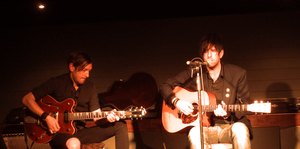
Currently residing in Ireland, Murry was accompanied by a musician he had met over there, Grum Gallagher. When Blabber’n’Smoke spoke to John a few months back he described Grum as “someone completely on the same wavelength (as me),” something that in an interview set up might be considered to be just PR puffery. Well, anyone who was at this show can attest to the fact that indeed the pair go together like the proverbial horse and carriage, Gallagher a perfect foil for Murry’s wounded tales. On past occasions Murry has been electrifyingly scary, his songs a catharsis of sorts describing past trials and tribulations including a near death experience. Tonight he appeared more comfortable, still spilling out with a passion but with a sense that he is playing the songs rather than reliving the past. He remains however a riveting performer; there’s blood and guts in his Southern Gothic, the songs still sting but tonight he nailed it balancing pain with performance brilliantly.

With Gallagher on guitar, a wonderful beat up Eastwood electric which he’s modified over the years, coaxing and caressing a variety of effects and sympathetic soundscapes Murry effortlessly captured the mesmerising pull of his records. As always the between song banter was a deadpan drawl of dark humour and self deprecation, at one point suggesting he and the audience pack it in and all go to see Hawley instead. There was no chance of that as he opened with a tender and heartfelt version of What Becomes Of The Broken Hearted and then covered The Afghan Whigs’ What Jail Is Like pitching some barbs at Greg Dulli in the introduction before launching into his own songs. While there were magisterial readings of some of The Graceless Age’s gems including California, The Ballad Of The Pajama Kid and Southern Sky, all graced with Gallagher’s sonic grumblings Murry unveiled several new songs that are equally as haunting. The Stars Are God’s Bullet Holes (as Murry quipped, He’s shooting at us) was a powerful diatribe with some profane language and vivid imagery, Oscar Wilde celebrated the outsider and The Wrong Man continued his habit of his soul searching positing Murry as the last man to depend on with the delivery tonight challenging Springsteen as the blue collar troubadour; here the audience was rapt, hanging onto every word. Glass Slipper, a song co-written with Chuck Prophet was another show stopper, muddy as the Mississippi and as mesmerising as a death cell confession.

There were more covers, a fine medley of Tracks Of My Tears and Do You Want To Dance given the Murry treatment, Dylan’s contribution to the Wonderboys soundtrack, prefaced by Murry’s comment that anyone who really likes Dylan is diagnosable and, a nod to the location tonight, Abba’s Super Trooper which mentions Glasgow in the lyrics and which had the crowd singing along. Tonight Murry seemed less wounded, more on a roll.

Excellent guitar foil to Murry he may be but Grum Gallagher gave notice of his talent earlier with a short solo set that portrayed him as an excellent writer and performer. Playing guitar with a mellifluous dexterity, keeping bass notes throbbing throughout some jangled melodies, he is a troubadour in the Nick Cave fashion (at least this is one thought, much of the conversation after his set was regarding who exactly he reminded one of with several names, Momus, Tom Waits, Robyn Hitchcock and, yes, Richard Hawley, mentioned). In fact His baritone voice and his dark and strange lyrics (e.g. it’s not safe to steal the lamplight from the defecator’s mouth,” I think I heard this line) can bring to mind many of the above but it’s at least good company to be in. He gave us a grand sea shanty, played with a Brechtian gusto, a fine tale of a drink fuelled apparition of the Virgin Mary in his song Anthracite (along with a fine tale of Ireland being like Mexico, a land where statues move) and finally an excellently absurdist tale about doctors and pills, this song being the one which led to the Hitchcock comparisons. A very talented guy and Blabber’n’Smoke will be looking to return to him in the near future.

First support slot of the night was filled by local singer/songwriter Bobby Deans. Playing a nylon stringed guitar he was at his best on a song about the homeless called No Rest with some nice key changes and a refreshing lack of polemic. An engaging character he was brave enough to sing a song about his own past and his mother whom he never knew which was delivered in a restrained fashion until the end when he was wailing away at the ghosts he had conjured up.

Fiddle & Banjo. Tunes From The North, Songs From The South.

Seems like we haven’t had any old time music reviewed here for a while so it’s a pleasure to introduce Fiddle & Banjo AKA Karrnnel Sawitsky (fiddle) and Daniel Koulack (banjo), a Canadian duo who mine similar territory to Cahalen Morrison and Eli West but more closely resemble Appalachian scholars Anna & Elizabeth who we reviewed a few months back. They share the timeless quality that permeates traditional music, taking music from the past (some of it familiar to the listener from childhood songs or from the numerous visitations of musicians on albums over the past eighty years, and some not so familiar) and imbue them with a freshness, a new life, a new version for those musicians and listeners yet to follow.

The album title is derived from the duo’s stated intention of joining up the Canadian dance music they grew up playing with those age-old Appalachian songs and tunes that have influenced them and a host of other string players. The result is a superb (and superbly balanced) set of traditional numbers and their own tunes. Familiars such as Killin’ Floor, How Can A Poor Man Stand Such Times and Live and Arkansas Traveller rub shoulders with some fine inventions from the pair. Several of the tracks are medleys of traditional tunes (helpfully noted in the liner) and one cannot help but marvel at not only their dexterity but the telepathy in the playing, Koulack playing clawhammer style as Sawitsky fiddles creating a rarefied atmosphere that is just thrilling and at times spine tingling; whether playing a waltz time tune or setting up a reel they weave magnificently.

Excellent as these forays into an instrumental heaven are, the album is enhanced greatly by the presence of guest Joey Landreth who sings and plays Dobro on several songs here. His finely wearied delivery offers a touchstone for those who might find an instrumental album somewhat daunting. In addition the songs allow Sawitsky and Koulack freer rein to saw away in a less measured fashion than on the instrumentals as on the frenzy the whip up on Little Birdie. Landreth’s Dobro also provides some bluesy touches to Skip James’ Killin’ Floor and the closing magisterial reading of How Can A Poor Man Stand Such Times and Live. Finally, they get extra points for opening with a brief rendition of Pete Seeger’s Goofing Off Suite, a wonderful tune and going back to an original point one that will be familiar to fans of Raising Arizona.

Wrapped up in some fine packaging the album is a wonderful window into the past and will surely appeal to anyone who gets a nice chill when they hear that high lonesome sound.

website

Patrick Sweany. Daytime Turned To Nighttime. Nine Mile Records

Nashville based Patrick Sweany first came to Blabber’n’Smoke’s attention in 2013 with his album Close To The Floor, a fine collection of swampy blues and soul songs with some edge to them. Some of that edge was due to recent family bereavements, Sweany sounding angry and defiant. Two years down the line and he’s recently domiciled, settling into a new home with his wife and with the resultant music portraying a man who is more content with life, still digging the blues but with a skip in his step.

Sweany describes Daytime Turned To Nighttime as his “grown up record” and it does sound as if he’s a man who’s comfortable in his own skin. While recording the album he was also busy renovating his new home while listening to classic Southern sounds, Lee Dorsey, Bobby Charles, Bobbie Gentry; his choice of rhythm section here (Ron Eoff, bass and Bryan Owings, drums) reflects this, the pair having a pedigree including Tony Joe White, Levon Helm and Solomon Burke. With Sweany and producer Joe McMahon on guitars, Tyson Rogers on keys and Alexis Saski and Laura Mayo offering some sublime vocal swoops the album is a syrupy trip through the delta with some snarly rustbucket kicks thrown in for good effect.

There are ten songs here and all deserve attention. Sweany opens with the blue collar First Of The Week which recalls Bobby Bland and then heads into the acoustic blues swagger of Tiger Pride which struts like prime Taj Mahal. The loose limbed slow rolling feel is maintained on the following Here To Stay (Rock + Roll), tasty guitar licks over a slipping and sliding rhythm conjuring up a back porch cook out, the band playing and the pork slowly melting. The heart of the album however is a brace of slow burning numbers that gather together influences such as Gospel, New Orleans strut and Southern rock. Sweethearts Together is slowed down to a coma pace, wonderfully sluggish, barely perceptible flourishes from guitar and keyboards fluttering briefly. Afraid Of You sweeps in with a glowering majesty, guitars swooping and keening around a determined acoustic guitar motif in a manner reminiscent of the Allman’s Midnight Rider while Nothing Happened At All is stone cold Southern rock, fans of Lynyrd Skynyrd should tune into this.

Throughout the album Sweany’s voice is draped in the sweat of classic soul singers and he excels on the wonderful Too Many Hours which captures the classic meeting of sacred and secular which is at the heart of great soul music and for those who might long for his more rough hewn blues persona there’s a really dirty howling Wolf type workout on Back Home. Here Sweany delivers in buckets, fiery and feisty, howling at the moon.

website

Trevor Moss & Hannah-Lou. Expatriot. Anglophone Recording Company.

Erstwhile members of Danny And The Champions of the World, London husband and wife duo, Trevor Moss & Hannah-Lou have achieved something of a coup by scooping up acclaimed producer Ethan Johns to helm this, their fourth album release. Johns had toured with them and was somewhat enamoured of their sound and welcomed them into his home studio. The album, in the main consisting of the duo’s voices and Trevor’s acoustic guitar does sound great, crystal clear, the voices ringing out with the spare additional instrumentation given just the right amount of space and colour. The press release notes that the album has the couple moving on from their folk sound although there’s not a significant shift in their sound here. Instead there’s a confidence and assurance that might reflect the guiding hands of Johns at the desk and a year of solid touring supporting name acts at auditoriums across the world. In addition there’s a nod to an increasing American influence in the music, a hint of which is offered in the cover art which is a recreation of their pose on their 2010 single England. Instead of a George Cross painted behind them there’s now a stark black rendering of the album title. Do they feel estranged from the current version of Englishness or demonstrating that they’ve spread their wings?

There are certainly some comments on the state of the nation here, finger pointing songs as Dylan called them; the wheezing harmonica led The Relinquished, which bemoans factory working the exemplar here. The Dylanesque style here is repeated throughout the album especially on the opening title song and the declamatory Babe To Cradle with the latter’s opening lines “You callous kings and queens, it’s time to lay down your rusty crowns, they don’t impress us anymore,” reminiscent of Greenwich Village folkies and Broadside magazine. Much of the album indeed has a sixties glow, the tender Our Tryingest Hour rippling with echoes of Paul Simon and it’s tempting indeed to think of Trevor and Hannah-Lou as a modern version of Richard and Mimi Farina here. However there is a definite whiff of that dappled English folk sensibility on the mesmerising If only I Were The Kind where the vocals are shadowed by some nuanced guitar feedback. Again, there’s a retro feel here which in this case recalls the very early Fairport Convention when they were in thrall to Joni Mitchell and not yet folk rocking.

website

The Orphan Brigade. Soundtrack to a Ghost Story. Proper Records

Two Americans and an Irishman walk into a haunted house… No, it’s not the opening line of a joke but the punch line for the story behind The Orphan Brigade. The three (Neilson Hubbard, Joshua Britt and Ben Glover) have built an album around the tales and histories of characters from the Civil War period, notably Confederates housed in and around a plantation house named Octagon Hall in Franklin, Kentucky, sixty miles north of Nashville. The Hall still stands, spared from immolation by the Northern troops, an antebellum reminder of the horrors of war and slavery and reputed to be the “most haunted house in America.” With a wealth of historical documents to hand (letters, journals, poetry, some written by members of the titular Orphan Brigade, a nickname of the Confederate Army’s First Kentucky Brigade) the trio set up shop in the haunted house to write and record the album with assistance from Gretchen Peters, Kim Richey, Kris Donegan, Heather Donegan, Dean Marold, Eamon McLoughlin, Dan Mitchell, Barry Walsh, Carey Ott, Brad Talley, Zach Bevill, Jim DeMain and Ryan Beach.

It’s a fine back story and the cast tell tales of spooky happenings during the recording, much of it captured on a documentary directed by Hubbard and Britt. However, entertaining as this all is it’s much more than an Americana version of American Horror Story, the good news being that the album stands up to scrutiny whether the listener knows the origins or not. It’s not a retelling of the era in the vein of White Mansions although there are songs that refer directly to the experiences of the historical protagonists. Rather it’s an impressionistic capture of the spirit (sorry) of the times delivered in a variety of styles that gather in musical influences but are rooted in modern music. One could imagine that The Band or a solo Robbie Robertson might have made the album.

The war does loom large on the wheezy accordion tooled I’ve Seen The Elephant, the delicate harmonies of Last June Light and the martial numbers, The story You Tell Yourself, decorated with slight mandolin and throbbing guitar and We Were Marching On Christmas Day which captures excellently the tribulations of the foot soldier in a wintry waste. On a more optimistic note The Good Old Flag points to the reconciliation required after a bitter war and is delivered as an excellent mid tempo ballad buoyed on some fine guitar flourishes and sublime harmonies.

There’s a wealth of styles here, a sea shanty on Cursed Be The Wanderer, an Irish Lament with Paddy’s Lamentation and some slide driven Southern grit on Trouble My Heart (Oh Harriet). Whistling Walk appears at first to be an oddity, a whistled instrumental with a jazzy cornet and guitar it ambles into view with an unexpected jocularity but when one reads that it’s inspired by the fact that slaves carrying food from the kitchen to the table were ordered to whistle in order to prevent them eating any of the food then it falls into place.
As we said earlier, the album stands on its own two feet but there’s a wealth of information to be had for anyone wanting to delve, either into its making or the history it commemorates and is heartily recommended.

website

And just because it’s Halloween

Israel Nash – Reopening the Cosmic American Frontier

Fans of that old Hollywood hippie sound, the days of the blissed out David Crosby, tetchy Steve Stills and brooding Neil Young and the glorious nugget that is Gene Clark’s masterpiece, No Other, have recently had the opportunity to vicariously relive those days simply by purchasing a copy of Israel Nash’s latest album. Silver Season, released on Loose Records is a sun-blistered swathe of Topanga Canyon like songs, teased out on record, itching to be let loose live, the guitars crackling while pedal steel soars and swoops. Nash sings in a similar vein to a young Neil Young but it’s the music that is rooted in those bygone days, not a nostalgia trip but a feeling, espoused by Nash (who by the way is no relation to the fourth member of that supreme LA supergroup) that music can change, if not the world, then at least those who are listening to it. Recorded in his newly built home studio the album takes aim at gun crime (on Parlour Song) and delivers a wonderful hymn to the narcotic pull of Los Angeles on LA Lately and is a worthy follow up to Nash’s acclaimed 2013 release Rain Plains.

We caught up with Israel as he was heading to New York in the back of an RV. The phone line was tenuous to say the least but the following hopefully carries the gist of the talk which I opened by apologising in advance for the possibility of mentioning Neil Young et al ad nauseam. I asked him if he got fed up with the comparisons.

No, I’m alright with that. People like to talk about Neil Young anyway, he’s one of the big ones so go ahead.

Rain Plains and Silver Seasons seem to be much of a kin but Seasons is somewhat denser with a more psychedelic shimmer to it, would that be a fair enough description?

Well it wasn’t a major goal as such as it just developed that way. After Rain Plains we were playing the album live and it just got us into the way of looking at the album and taking it to another level so it’s like a transition. I look at the album and the music as a presentation. I think that I tried to blend myself as a listener and a writer with all the things I’ve been influenced by and that I’ve tried to grab the listener with everything I can – the artwork, the songs, the whole opportunity you have to suck a listener into this place for an hour.

It’s a huge sound, stratospheric one could say. I really dig the way the pedal steel plays around the electric guitars gliding here and there while the songs shimmer with a sort of heat haze.

That’s a big aspect of what we were working on, the balance between the melodic instruments, they just dance together throughout the record. Gram Parsons had this idea of cosmic American music and I guess the pilot’s just got a little more cosmic.

Parlour Song in particular reminds me of a couple of early Neil Young moments, the orchestrated Expecting To Fly from back in Buffalo Springfield days and towards the end the anger that was evident on Ohio with you shouting out. It’s quite visceral.

Yes, I think that over my years as a musician the songs have become more than just songs, I want to create a space that not only lets you listen to them but makes you go whoa! The beginning of that song is supposed to mimic a funeral precession and it’s really trying to get people in there and see what’s going on in their minds and what they feel like.

I was going to ask you about the introduction, it’s got a cinematic feel, like something from Morricone.

Well it’s inspired by The Godfather II. There’s a scene in it with young Vito in Sicily at his father’s funeral and Copolla does this cool shot with the sound of crickets and in the distance this rag tag band meandering through the hills. Those hills reminded me of the Hill Country in Texas and so I wanted to do something like that. So we recorded the crickets and then we tried to mimic the movie’s panned shot, we tried a bi aural set up, we put two microphones outside and played the track through speakers we carried as we marched about.

LA Lately is simply stunning and again there’s a short introductory passage which sets the scene.

That’s trying to introduce the emotional impact of leaving Texas and going to LA. It’s like, “where did all the hope go?” It’s trying to represent that feeling, a kind of brooding about getting ready to go out there but also the excitement of going away. And then LA represents that unease and unpredictability, again it’s an emotional journey. The song’s about our experience in LA. We played our first headline show there and we had a moment. It’s always exciting that I get to play music but I was overwhelmed that we had such a great show there. LA just has this thing, this history, like Steve Stills and Neil Young meeting on the freeway.

At the end of the album, on Rag and Bone you slip into a chorus of We Shall Overcome. Can I ask you why?

Well the rag and bone man, that’s a real British thing I read about. They seem to be like the least of us in society and to treat people like that, well for me there are a lot of themes across the album and one of them is the idea that there are so many things, man made conventions that we assume are important to society but which are actually not important at all in the grand scheme of things. Like money is made up, time is made up, all these things, they’re restraints that we’ve put on ourselves. The rag and bone men, well we just put them down but we should just change this with a little love, take a step back and make it a little simpler. It might seem like this is a hippie ideal but the older I get the more adamant I am about it, it’s not youthful foolish thinking because I’ve lived it. I’ve seen live shows with people around me catch this contagious atmosphere and as for the closing of the song the idea is that we can have a singalong at the end. I mean what’s wrong with a roomful of people singing we should love one another. It’s just another element of what I feel about music – it’s not just another guitar solo or some badass thing, it’s way bigger than that, it’s way bigger than just rock’n’roll, it’s relationships and it’s people

You recorded the album in your own home studio. Can you tell us about that?

Well we’ve got about 15 acres at Dripping Spring so that was always the plan to build a studio and it finally happened. I got a Quonset hut which is a metal building which has 20 arches and is held together by 3,500 bolts. The plan is to record my own music and produce other people’s records, a place where I can walk from my house straight to the studio to work on material.

That and your story of walking outside recording Parlour Song reminds me of Graham Nash’s story of Neil Young listening to the playback of Harvest using his house and his barn as speakers and yelling out More barn!

Yeah, that’s a cool Neil story.

I believe there are plans to come back over to Europe soon.

We’re going to go out, playing the album front to back, that’s what we have in store for Europe, playing the album as one full piece of music and we’re doing a London show early next year. Hopefully we’ll be back in the UK again after that.

Isreal Nash will be playing a set of European dates commencing in January 2016 with a London show on 15th February, all dates are here. Silver Season will be available on vinyl in November. You can read my review of the album here

Israel Nash website

Loose Music website

Texas Martha and the House of Twang. Long Way From Home

Texas Martha AKA Marty Fields Galloway is certainly a long way from home on this album which is probably the first honky tonk album to be recorded in Bordeaux, France. Sure enough, she’s Texan through and through but she has a hankering for France and spends much of her time there and, much like a country music magnet, she’s attracted a hot shot bunch of continental players who together make up The House of Twang. These are guys who’ve done their homework, the rhythm section of Serge Samyn and Hervé Chiquet stoke the beat solidly while Lionel Duhaupas bends and twists and twangs his guitars and plays a mean pedal steel. Together they’re a formidable outfit with Galloway belting out her roadhouse songs but able also to rein it in and deliver some soulful country.

The album gets off to a great start with the rip snorting Born To Boogie, Galloway’s powerful voice galvanised by the curling pedal steel and twang fuelled guitar bursts over a pile driving rhythm; even her transition into French lyrics midway through, initially a surprise, works. Take You Down is in a similar vein, again the music is punchy and defiant as Galloway hymns the South but there’s a change in gear on the following title song which takes us away from the honky tonk and onto the freeway. There’s a brisk acoustic thrust to the song with harmonica (from Christophe Dupue) threading throughout while the pedal steel hums like a train coming along the tracks, altogether the sense is of the wide open road. A Lover’s Lane is more countrified, the pedal steel keening away as Galloway sings of the tribulations of a young girl suckered into a tryst and then judged. It’s a great song but the vocals are just a mite too powerful for the tender playing and the song could be better if there was a sense of hurt instead of defiance in her voice.

No problems however with Johanna, another sad luck song which is boosted by the organ playing of Vincent Samyn while Strike is a sinewy blues number with Martha ballsy as hell while the guitars snarl. The album closes with another foot to the pedal barrel house boogie on Gotta Move but before that there’s a brief excursion into Southern Gothic territory on the tremendous Do As You Are Told which comes across like the Violent Femmes backing Bobbie Gentry in a story penned by Flannery O’Connor.

Hopefully with Texas Martha berthed just across the channel we can hope to see her and her crack musicians in the UK at some point, Blabber’n’Smoke will keep you posted.

website

Barbara Nesbitt. Almost Home

A native of Georgia who ran away from home aged 15 to join a band, Barbara Nesbitt is now firmly planted in Austin, Texas where she spends her time playing in two bands, The Whiskey Sisters, and Tim Flannery & The Lunatic Fringe in addition to her solo work. Almost Home, her third album, is a finely assembled collection of country songs replete with pedal steel, banjo and Dobro with one song, Like A Good Girl Should sneaking into the city for some low down blues. Originally released stateside in 2013 the album is getting a push here as Ms. Nesbitt this weekend commenced a UK tour taking in several Scottish dates.

There’s a grand sweep to the opening moments of the title song which kicks off the album in a classic manner. Nesbitt and drummer Bill Coomes are the star crossed couple desperate for their reunion on an achingly sweet and sad song that features fine pedal steel as the pair harmonise wonderfully. Coomes is featured vocally again on the Everly styled country lament of Graceless, written by Kasey Chambers and here the pair recall classic country duos such as George and Tammy. Nesbitt herself is a fine singer, able to be natural and clear, almost like Emmylou on Don’t Think Much, a fine Dobro driven lament while she can be forceful and dynamic as on the slow burning blues of Like A Good Girl Should. With the front porch knees up Never Been In Love complete with spritely fiddle and the tender country rock of All The Way adding to the quality the album is a fine listen.

Tour dates

Tuesday, Oct 27th – Quarter Folk club @ The Bully Inn, Quarter (near Hamilton)
Wednesday, Oct 28th – Backstage at The Green Hotel, 2 The Muirs, Kinross
Friday, Oct 30th – Aikmann’s Bar, Bell Street, St Andrews KY 16 9UX 9:30 – midnight Free entry
Saturday Oct 31st – Craigrossie Hotel, 1 High St, Auchterarder, Gleneagles Perthshire, Scotland
Sunday, Nov 1st – Rose And Crown in South Shields, Hill Street, South Shields
Monday, Nov 2nd – String Theory, Heart of Hawick, Tower Mill, Kirkstile
Tuesday, Nov 3rd – The Tap in Hull, St. Johns 10 Queens Road, Hull
Wednesday, Nov 4th, The Bedford, 77 Bedford Hill, Balham, London Free entry
Friday, Nov 6th – The Betsey, 56 Farringdon Rd, London Opening: Simon-Stanley-Ward

website

Phil Cook. Southland Mission. Thirty Tigers/Middle West Records

Who’s Phil Cook you may ask. Well, Blabber’n’Smoke saw him play to a packed ABC O2 this week in support of The Tallest Man On Earth. Dwarfed by the stage Cook and his electric guitar delivered a short but very sweet set of songs, his guitar playing reminiscent of Ry Cooder and even Pops Staples, riding and sliding a rural blues groove with ease. Turns out that Cook has been a busy guy over the past decade, a close colleague of Bon Ivor in Wisconsin before relocating to North Carolina playing in Megafaun and becoming a studio producer and session man for Hiss Golden Messenger, Matthew E White, The Blind Boys of Alabama and Alice Gerrard.

Southland Mission is touted as Cook’s debut album although apparently he released an album of solo songs a few years back. It is however a magnificent collection of blues soul and gospel grooves that packs a thump, swamp ridden, riddled with joy and despair. His guitar playing is a joy, warm and supple with added zest when required whether he’s picking or playing slide and throughout there’s a Southern feel be it the Allman’s on the slide guitar of Gone or the back porch picking of Belong.

The album opens with the breezy Ain’t It Sweet which recalls classic Little Feat, chugging guitar and bar room piano leading into the harmonies (added by Justin Vernon) before Cook delivers a stinging slide solo. 1992 is a cover of a Charlie Parr song that clucks and picks, again Cook’s guitar is sublime, adding layers within the song and sounding as if it’s been transported from the Depression era as the band whip up a mighty country blues thump. There’s a slide guitar intro into Great Tide, another song that reeks of Lowell George and there’s no finer compliment than that. The song clatters and burns, guitars glowering, voices hollered over a vital heartbeat from bass and drums reaching a crescendo before slowing down and massing for a final aural assault. It’s really quite magnificent.

Next up there’s a dip into acoustic country blues with Mandolin Orange’s Andrew Marlin and fiddler Bobby Britt expertly leading Cook down a dappled path on Belong before the Cooder like Sitting On A Fence weaves its way into view. A sinewy Gospel tinged country blues with some great female harmonies it shifts its shape with a sly sinuosity as the guitars snake and buzz. There’s more guitar excellence on the field holler Gospel of Lowly Road with Cook achieving a fine sense of thrum and throb on the strings; turn the volume up here and the song just reverberates, ably assisted by the vocal harmonies which are somewhat bewitching. Time To Wake is like a funky Daniel Lanois production, ambient but with some earth thrown in and Cook closes the album with his melodic duet with Frazey Ford on Anybody Else along with the grand Southern rock chug of Gone which, as mentioned earlier recalls The Allman Brothers Band in their heyday.

So lesson ended and by now you should be itching to hear some of Mr. Cook. You won’t be disappointed.

website

Woody Pines. Woody Pines. Muddy Roots Music Recordings

The spine of this CD has printed on it Country Blues – Rag Time – Viper Jazz and Woody Pines latest album pretty much does what it says on the cover. Pines honed his act initially as a street performer often in the company of Gil Landry and he has a sneaking affection for veteran folkies such as Baby Gramps and Peter Stampfel, guys who injected a healthy dose of sixties freakdom into folk music. He’s got a healthy run of albums under his belt including Counting Alligators which Blabber’n’Smoke reviewed here while his EP You Gotta Roll (reviewed here) is a regular favourite in the hacienda. Comparisons abound with that other arbiter of old time American music, Pokey LaFarge but Pines is altogether more laid back although it’s true that they drink from the same trough.

This latest self titled album is Pines’ best effort so far, a no frills collection of songs that are redolent of pre war hillbilly music and fifties hillbilly boogie tempered with some lyrics that slyly evoke more modern times. This is evident from the start with Anything For Love, a toe tappin’ dose of western swing with Woody declaring that he’d pinch Mike Tyson’s cheek if it got his gal’s attention before he goes on to seek advice from his Miles Davis and John Coltrane records. It’s a zippy start to the album and it recalls the dapper days of Dan Hicks and his Hot Licks with some hot fiddle playing from Billy Contreras. Contreras pops up again on fiddle on the Reinhart/Grappelli jive of Walking Stick but the bulk of the album is Pines along with Skip Frontz Jr on upright bass and Brad Tucker on guitar, a bare boned approach perhaps but the three of them do conjure up a fine stew.

There’s some scintillating syncopation on show here, the double bass snapping on Black Rat Swing and New Nashville Boogie while Tucker’s guitar humbucks and growls especially on the blues ridden Delta Bound. With covers of The Mississippi Sheiks’ Make It To The Woods, a skillet licking blues groove and Memphis Minnie’s Black Rat Swing Pines pays tribute to his forebears while his rendition of the old chestnut Junco Partner is an easy rolling gait with some fine country picking from Tucker. Finally Pines offers some tender moments, his sweetly delivered Little Stella Blue a breath away from Satisfied and Tickled Too but a beautiful moment. He closes the album with his salute to one of his heroes on Worth The Game, a Dylan like piece that bridges the gap between old time, sixties revival and present time. The song goes on.

website