
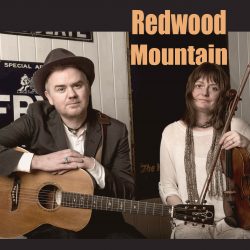
 Aside from his burgeoning career as a transatlantic bridge, linking Nashville to Leith Scots musician Dean Owens has delivered several projects over the past few years which have been more low key than his official solo albums. He’s recorded (and played live) tributes to Johnny Cash and Hank Williams with the albums available via his website and at gigs. Redwood Mountain follows this tradition but here Owens isn’t restricted to one artist, instead offering up his version of the great American songbook, not the one written by Gershwin et al but the songs that were first sung and handed on before they were written down. Songs that crossed the ocean with settlers and grew into the New World landscape, played on porches and at barn dances before they were eventually transcribed and then etched into shellac.
The catalyst for the recording was the gift to Owens of a book, Alan Lomax’s The Book Of American Folk Songs. First published in 1968 the book was a collection of 111 folk songs, ballads, sea shanties, work songs, cowboy songs and spirituals with Lomax adding chord charts and explaining the history and provenance of the songs. Intrigued by this wealth of traditional songs Owens set about rearranging some of them and in keeping with the sometime stark delivery of the earliest recorded versions decided to record them in a stripped down fashion. Thus was born Redwood Mountain, a duo of Owens and fiddle player Amy Geddes (with occasional double bass and piano from Kevin McGuire), the pair delving into the backwoods. Geddes of course is the fiddle player in Owens’ band The Whisky Hearts but here she’s riding point with Owens, her fiddle playing not only the second voice on the album but an essential connection to the Celtic roots of much of these Appalachian and high plains songs. This is evident on her rendition of the traditional Scots tune Amang The Braes O Gallowa, one of two numbers here not taken from the Lomax book but acutely delivered with an aching pull and which would not sound out of place on Nick Cave’s soundtrack for The Proposition.
They open with the devastating Katy Cruel, a song with strong Scottish roots and perhaps best known these days for Karen Dalton’s haunted version. Owens and Geddes are just stunning here, their delivery sending a chill up the spine and they capture this spectral aspect again on Fair Thee Well O Honey (also known sometimes as Dink’s song) with Geddes’ fiddle wraithlike at times. Owens’ lone voice on East Virginia (with Geddes adding an intermittent resonant fiddle) is another dark tale but that’s as murky as it gets as the remainder of the album, while still at times dwelling on misery, is somewhat more upbeat. Thus we get the waltz like Get Along Home Cindy and the slave runaway song Run Boys Run which finds Owens in fine voice and Geddes’ fiddle flying like Scarlet Rivera on Desire. Cowboys get a look in on the narrative of On The Range Of The Buffalo with Owens lowering into Cash territory with his vocals and there’s space for a railroad song (Railroad Man which roams into Woody Guthrie and big Bill Broonzy territory) while Rye Whiskey could be sung as easily in a Scots tavern as a hobo camp back in the thirties. Owens winds up the album with his own song, Take It Easy, But Take It which again is reminiscent of Guthrie as Owens adds some modern commentary as he sings, “The homeless should always have shelter, the hungry should always have food, the sick should be helped to get better and the misunderstood understood.”
Dylan was scrabbling around the Lomax collections on his albums Good As I Been To You and World Gone Wrong while more recently Ags Connolly offered his selection of Cowboy songs and Redwood Mountain continue in this tradition. But the album that most comes to mind when listening to this is Billy Bragg and Joe Henry’s Shine A Light, another collection of Americana folklore and I’d certainly recommend to anyone who enjoyed that disc to give a listen to Redwood Mountain.
You can buy Redwood mountain here
