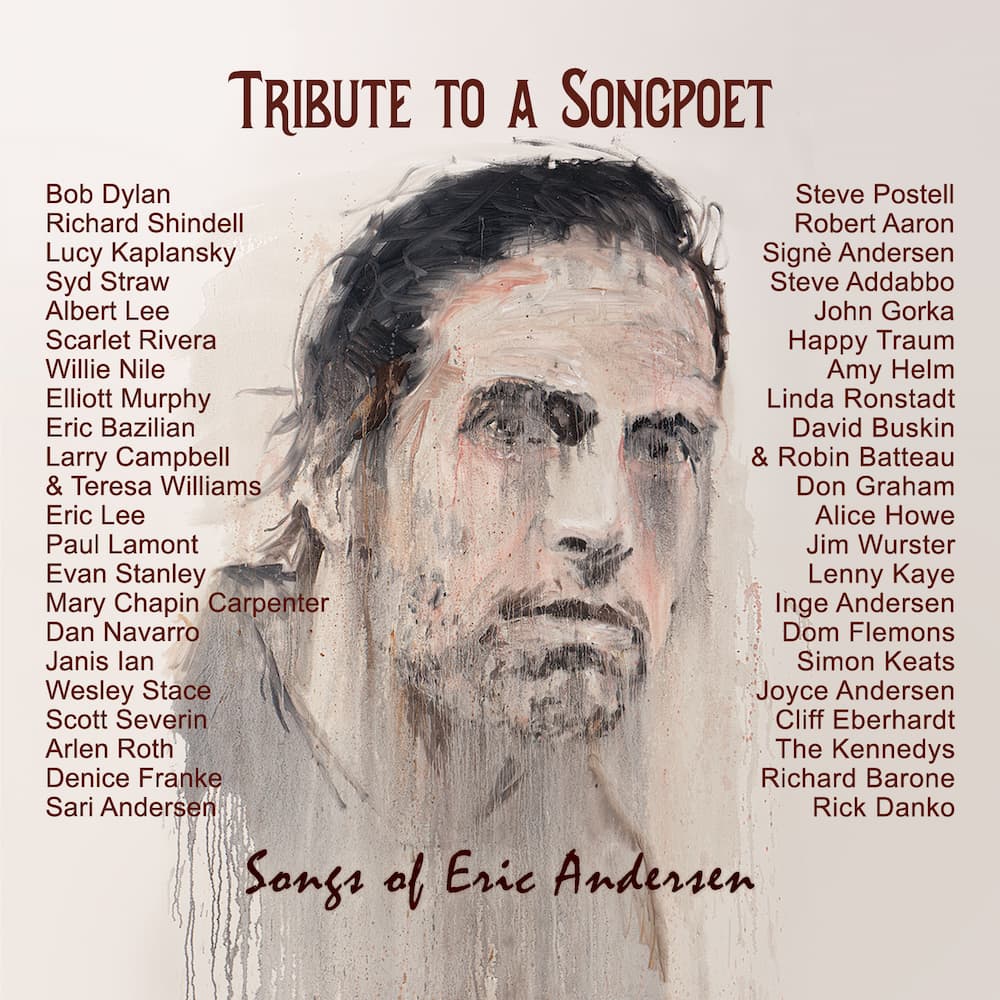
Most folk, including us here at Blabber’n’Smoke, aren’t too aware of Eric Andersen. He is perhaps THE cult artist of the Greenwich Village years, rubbing shoulders with his much better known contemporaries such as, well, Dylan, and the rest. His songs have been recorded by the likes of The Grateful Dead, Judy Collins, Fairport Convention, Gillian Welch, and Linda Thompson but, now aged 80, he remains pretty much a secret, perhaps in part because he’s never had that one killer song which rises above all others.
This album, a three disc affair on CD, does its best to remedy the situation as a host of famous fans perform his songs. Most of them have been recorded specifically for the album but there’s a clutch of vintage recordings included and it’s one of those which opens the album. From 1970, Bob Dylan sings Thirsty Boots, accompanied by Al Kooper on piano and David Bromberg on guitar with the song sounding as if it were an outtake from New Morning. It’s a swell start to the collection but not really indicative of what is to follow. The 1972 appearance of Linda Rondstadt (with her proto Eagles backing band) singing (I Ain’t Always Been) Faithful and Rick Danko’s live rendition of Blue River are most welcome, the latter particularly poignant, especially when it’s followed by Andersen himself singing Thirsty Boots at a club gig in 1982 which closes the album’s song cycle. Of the new recordings, they are much varied, several of them well removed from Andersen’s folkie perspective, but in the main they pay testament to his song writing skills.
Close The Door Lightly When You Go is perhaps the best known song here (thanks to Iain Matthews) and Richard Barone with Allison Moorer perform it quite deftly while Amy Helms delivers a soulful Blue River, the title song from his most successful album. Thereafter it’s pretty much a pick and mix affair as to what will capture one’s fancy but the doleful folk rock of Goin’ Gone by Richard Shindell stands out as does Foghorn by Larry Campbell & Teresa Williams along with Janis Ian’s powerful rendition of Hills Of Tuscany, a song which has a Dylan like intensity to it. Pick of the mix goes to Wesley Stace’s eight minutes of sparkling and jangled mystery on Time Run Like A Freight Train and Eyes Of The Immigrant by Lucy Kaplansky, a song written many moons ago but still relevant these days.
That leaves another couple of dozen songs we haven’t mentioned (and artists such as Willie Nile, Elliott Murphy, Happy Traum, Dom Flemons and Lenny Kaye) but, rest assured, all are worth exploring. What’s for certain is that this collection shines a welcome light on a mighty fine songwriter who has for too long has remained in the shadows.
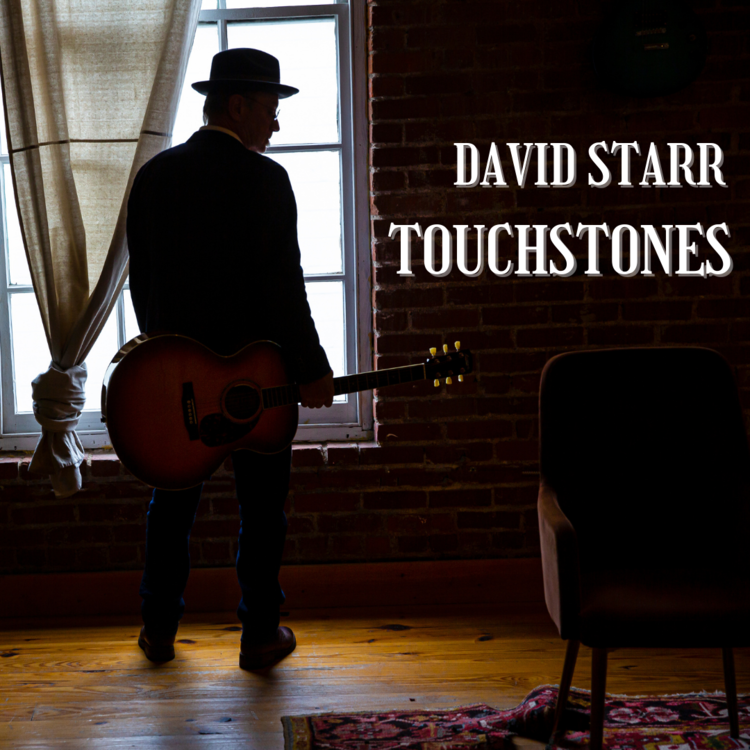
Colorado based David Starr was all set up to promote his latest album, Beauty & Ruin, when Coronavirus brought everything to a halt. That album, produced by John Oates, was inspired by Of What Was, Nothing Is Left, a novel written by Starr’s grandfather in 1972 and Starr’s last live gig was the album release show in Nashville in March (a show which turned into a benefit concert for those affected by the tornado which whipped through Nashville days earlier). As so many others did, Starr then turned to social media for a series of live streams to play the songs from the album accompanied by readings from his grandfather’s book but, when time and safety allowed, he returned to Nashville to record a new project called Touchstones where he covers some of his favourite songs from other writers, an immersion into what he has called, “musical comfort food”.
Blabber’n’Smoke caught up with David for a Zoom chat to discuss the project. He’s keeping his selection of songs kind of secret so we haven’t mentioned any song names but the more astute might guess at least one from the clues scattered. We started off by asking him why he had decided to record a bunch of cover songs.
The idea was really to try to keep the creative juices flowing while all this pandemic stuff has been going on. It was so soon after Beauty And Ruin and I didn’t have enough original songs to put together a new project. I’ve always enjoyed playing songs which I like and which have had an impact on me, like when I recorded Elton John’s Country Comfort on my South And West Album. Anyhow, the idea of recording a bunch of covers had been going around in my head for a while and I thought that this was as good a time as any to actually go ahead with it.
I believe that all of the songs have been recorded, but rather than release them as a collection you are going to issue them one at a time digitally.
That’s the plan for now, a digital release each month. I’d love to press them up and go out on the road to sell them but that’s not going to happen for a while. So, for the meantime I’ll release a song a month, for a year and I hope that folk will join me on Facebook, Instagram and Youtube as I release these songs and the stories behind them. I’m hoping that people will join in on the online conversations and we can share our thoughts on the songs. It’s also a way, hopefully, to keep up interest as if I released all of them at once it would be up and then down in a very short time. It was all recorded in Nashville, in the same studio I recorded my last three albums. It’s a studio that John Oates introduced me to and although he hasn’t produced any of these songs he came over to sing on a few of them. It’s a good band with a couple of guests coming in.
You released the first song, Robert Palmer’s Every Kind Of People a few weeks ago and it generated some conversation. I didn’t know that it was written by Andy Fraser, Free’s bass player, so that was new to me. Obviously, you know what’s coming next but you’ve said that you’re keeping the song’s identities close to your chest until they come out one by one.
I thought it would be good to try and keep it a secret so that each release is a bit of a surprise. However, that makes it just that little bit more difficult to talk about in public as we’re doing now. Maybe the best way is to just mention a couple of the artists I’ve covered and people can try and guess! Anyhow, I can say that the next one will be a Bob Dylan song and then later on there’ll be one by Jackson Browne. It’s either artists who have really meant a lot to me or songs that I’ve sang in the past and really enjoyed doing so. There is one original song in there which I did just to make the selection an even dozen so that the release schedule spans one year.
So, have you thought the sequence out?
Well I’ve already released Every Kind Of People and I know what the next three will be, but beyond that I’m not sure what order they’ll come out in. I can say that we recorded a John Prine song and I’m going to release that one on the anniversary of his death. I’ve been trying to look at making some rational of when to release each song. The first one, Every Kind Of People, seemed to me to be a good place to start what with all the discord and trouble we’ve had over here. It seemed like a nice sentiment you know. Most people associate Robert Palmer with his glossy pop videos with the girls playing guitars but to me he’s the guy who recorded with Little Feat and that makes him cool as far as I’m concerned.
How did you choose the songs?
Well, I made a list of about thirty and then I started to whittle away at them. Like I said, I thought that some of them just seemed more appropriate for these times, like Every Kind Of People, and the Dylan song I’ve picked seemed to me to be about choices and because we’re all being asked to make choices, like here we just had a very divisive election, it suits what’s going on right now. The Jackson Browne song is just a song I love, the words, the melody, the fact he wrote it when so young which tells me that if you dig deep you can write a song which lasts throughout the ages. There’s also a well-known blues song which I’ve always just found great fun to play. So, essentially the final list is a bunch of songs which all speak to me somehow. The funny thing about cover songs that I’ve always noted is that when I was playing my own songs solo, if people started to look as if they were drifting a bit then I’d play a cover and that would kind of bring them back into the fold. That Jackson Browne song always worked because if the audience didn’t like me then at least they liked the song.
Where did the project title, Touchstones, come from?
I was trying to think of a word which kind of spoke to the idea of things you pick up along the way. I toyed with the idea of calling it Breadcrumbs, you know like Hansel and Gretel, how do you find the way back to where you came from. And then, someone suggested Touchstones and that just stuck with me.
Is there any one particular song which stands out for you.
I have to say that it’s the Jackson Browne number. An interesting thing happened. I used to sing that song years and years ago but then left it behind, but a couple of years ago I was in Nairn, up in the highlands, and this guy came up to me and asked me if I knew that Gregg Allman had died that day and did I know any of his songs. I didn’t but I told him that I knew a song Gregg had covered and so I sang it that night and since then I’ve sang it at most of my shows. It’s a song that I connect with for whatever reason, there’s a sort of melancholy that goes with it although it becomes more hopeful towards the end and I just love the act of playing it. On our recording of it, Garth Brooke’s fiddle player, Jimmy Mattingly, added a lovely fiddle part and I was really pleased that he was able to do so.
So, while we’re all waiting for this miracle vaccine to come and save us, what are your plans for the future?
I’m writing all the time. I note down words and phrases as they come to me, like, in the middle of the night, I’ll think of something and write it down because, you know, by the morning it will be gone. I’ve got some songs started but, as I said earlier, not enough to be putting anything out so that’s why I’ve done these covers. I feel that I really haven’t finished with Beauty And Ruin as I’d just started to get off the ground with that before everything came crashing down. So, once we’re able to get back out on the road I’d like to pick up on that just where I left off and add in a few of these covers. I’d really like to get the whole band together in Nashville and play a big show just to get these songs out of our system when it all blows over. I’d love to get back to the UK but who knows when that’s going to happen again.
Will you be doing any more live streams?
I haven’t done one for a while. It seemed like all of a sudden everybody was doing them and it seemed like too much. Most of the ones I did were based on my record and the book where I sang a song and read from the relevant chapter but I also did a couple of others like the ones with Martha (Healy) and Al (Shields) and they were fun things to do and probably more therapeutic than anything else. But this has been a strange time and we’re all trying to find new ways of getting across to people.
Touchstones will be added to monthly with the second song coming this Tuesday. The songs will be available to stream and buy on digital platforms and David will release a video to accompany each song on his Youtube channel which you can subscribe to here.
Sometimes the story behind an album is just too slick, as if it’s pilfered from a film script – music moguls discover the next big thing by accident as he sings his songs in a late night bar – too Hollywood for real surely. Well, whether Daniel Gadd is the next big thing we don’t know yet but it’s true that this young South African was playing in a bar in London one night where two PR chaps happened to be. Impressed, they followed up and discovered that Gadd had an album already recorded and just waiting to be released here. The result of their talks is this release which Gadd had recorded by the ocean at Cape Town a few years earlier and it’s very impressive. A truly solo effort, just Gadd, guitar and harmonica, bohemian folkies and lovers of that Greenwich Village troubadour sound of the sixties will surely be queuing up to buy this album once they a whiff of it.
There’s no escaping the overall feel of early Dylan and Cohen which underpins the eight songs here. Gadd’s melodies are simple, folk based, reminiscent of the unadorned yet intriguing tunes which Dylan was pilfering in his early days. His guitar playing is quite accomplished, more akin to the UK folkies of the time while his voice is somewhat lonesome and beguiling, evoking both Tim Hardin and the nascent Cohen. Lyrically he hits all the spots. Deeply romantic in a bedsit fashion, the elements, nature, a restless highway urge, lovers lost, lovers remembered, they all feature here.
All eight songs are impressive but there’s something of a dichotomy here. When Gadd picks up his harmonica and forlornly blows into it, Dylan immediately springs to mind. Sleep Turns Her Face and Just Like The Road are prime examples, lovely songs but the harmonica breaks are just too Dylanesque. The closing song, Somedays Down a Highway, resolves this as the harmonica is fully woven into this quintessentially weary slice of folk existentialism. However when it’s just voice and guitar Gadd really shines. Siri Lynn, which opens the album, is as tender, poetic and romantic as Cohen’s Suzanne while Some Time Ago (On A Cold Winter’s Night) is a chilling song which harks back to Child Ballad tales of beguiling sea creatures with the stark melody and delivery recalling Lennon’s Working Class Hero, a strange mix but it works. Perhaps the best song here is The Trail I’m Tracking which manages to join the early romantic Dylan to his later work on Time Out of Mind, a simple guitar motif repeated as Gadd, sounding wonderfully weary, tries to find his way.
As If In A Dream I Drifted At Sea is an astonishing work coming, as it does, from a young unknown artist. It’s a late night reverie, a bedsit delight, and hopefully just the first from this very promising young songwriter.
Celtic Connections is a beacon of light in the dark days of January in what is generally a cold and damp Glasgow. The festival started in 1994 in an attempt to fill scheduling gaps in the city’s Royal Concert Hall. Since then it has grown to the point that this year there will be 2,100 artists (at 300 events in 20 venues) with major artists from Folk and World music appearing. There’s always been a strong Americana presence at Celtic Connections over the years and this year is no exception with Jeff Tweedy, Calexico and Lambchop appearing along with a host of others. One of the delights of Celtic Connections is the connection element as it draws together numerous roots traditions and styles, matching and pairing unlikely combinations for some astonishing “mash ups” while musicians will tell you that the late night Festival Club and the local hotels are fertile breeding grounds for jams that can see Scots’ fiddlers and African tin whistlers cosying up to Zydeco musicians or Appalachian foot stompers.
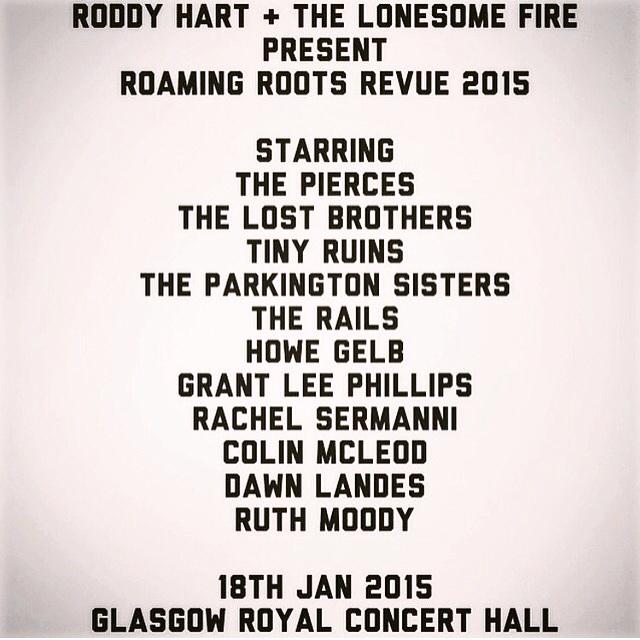
Roaming Roots is a relatively new addition to the Festival growing out of a 70th birthday tribute to Bob Dylan four years ago. Now firmly established as a highlight it’s a musical revue hosted by Scots musician Roddy Hart and his band The Lonesome Fire as a variety of guests join them in a celebration of music with each year having a different theme. Last year’s tribute to the music of Laurel Canyon was a blast and with that in mind Blabber’n’Smoke contacted Roddy and asked him about the concept and what to expect this year.
As far as I can see, the prototype for The Roaming Roots Revue was the 2011 70th birthday celebration for Bob Dylan while 2012 saw a tribute to the late Gerry Rafferty. The format has been yourself and The Lonesome Fire acting as the house band for various artists to interpret the songs. Roaming Roots itself came about in 2012 with a concert in memory of Levon Helm. How did the Dylan venture come about in the first place and whose idea was it to continue with the format?
Musically, I was at a real crossroads back in 2010. I had released three solo records in almost as many years, but I was finding it hard to get noticed as an independent artist and was becoming a little despondent. The band as it is now (The Lonesome Fire) was in its early stages of forming, and one thing I had absolute confidence in was just how musically talented these players were. In a way, I wanted to show them off! I’m a lifelong Dylan fan, and had noticed that he was approaching his 70th Birthday in 2011, but that no one was mooting any sort of celebration for it. That felt wrong to me. A few years earlier I had been involved in a Leonard Cohen tribute in Canada, which used a house band to anchor the show and back the diverse array of artists taking part. That format struck me as perfect because logistically these shows can be a nightmare – the artists are almost certain to be arriving only a day or two before the show and so rehearsal time is limited. It’s also really expensive to fly a whole band in. So it struck me as a good thing to do for the band: we could invite artists over as a solo act or a duo and – with proper organisation and rehearsal – learn up the Dylan songs they felt like tackling. I pitched that show to Donald Shaw at Celtic Connections and he told me that if I could get some artists interested in doing it then we had a show. I got lucky straight away: I had opened for Rosanne Cash the previous year and so chanced my arm by sending her an email to ask if she was interested. She said yes immediately and the whole thing just took off. Other artists came on board, and the event sold out really quickly: we were really fortunate that people just connected with the idea straight away.
The Rafferty night in 2012 was different in that it was organised by Gerry’s friend Rab Noakes – who had been a guest, and one of the highlights, at our Dylan show – and he kindly asked us back as house band. That proved a really useful show in the end, because other musicians were added to the mix and it was a really complicated set to navigate both musically and logistically. I learned a lot from both of those shows.
As a result, I talked with the band and we decided that we wanted to create a new show that would be about more than just paying tribute to music of the past. Part of the show would still have artists covering songs that you might not get to see or hear elsewhere, but we felt particularly strongly that their own songs should be in there too – it felt a bit of a shame not to celebrate the incredible music that so many of them make. We also thought there should be an emphasis on making the show about lesser known younger emerging artists who might not get the opportunity to play these kind of concerts every day.
Last year was a celebration of the spirit of Laurel Canyon. Was this an attempt to widen the net somewhat as opposed to focussing on one artist and why was Laurel Canyon chosen?
Definitely. We adored doing the Dylan concert and, as a fan, I loved pulling it all together and coming up with a set list. But there are certain limitations to using the songs of only one artist for a whole show: there’s only one Bob Dylan, and only a handful of artists who can match that songbook. Our first Roaming Roots was the exception because Levon Helm had recently passed away, and that felt like such an important thing to pay tribute to. His daughter Amy wanted to be there for it, and so that pretty much set the tone for our inaugural show. Because it was a new type of gig no one really knew it was going on – we didn’t even sell out the downstairs part of the Concert Hall – but it was one of the most special shows we’ve ever played as band. Beth Orton, Low Anthem, LAU and many others playing and singing their own music and doffing their cap to Levon’s music with The Band really provided the blueprint for the event and proved to me that the odd combination of original music and something from a themed songbook could work together. That was something I worried wouldn’t compute with audiences, but the opposite was true: they completely got the link between the music of the past and the music of the future, and just how important it is to celebrate both.
We chose Laurel Canyon to try and widen the net, and because we were conscious that we’d played two tribute shows in two years that had marked the death of a musician. That can be a difficult and emotionally charged thing to be a part of, and so it felt right to settle on a songbook that wasn’t about one artist. Laurel Canyon was so emblematic of that feeling of unique collaboration and togetherness that Roaming Roots is trying to create that it seemed perfect and we all had our own favourite artists from that era so I knew we wouldn’t struggle for songs. Happily, the show connected with the audience too.
Presumably, the preparation for the shows is complicated with upwards of a dozen other acts involved. Who’s involved in the planning and do you wait to see who’s playing the festival and then start to plan or do you have a wish list of folk you want to invite? I know that Dawes came over specifically for four songs at last year’s show.
It’s very complicated! Essentially, I “curate” the show. So, I’ll do the initial ground work: deciding on artists who I think might work for the concert, enquiring about their availability, talking with the confirmed acts about song choices, pulling together a set list that I think has a good dynamic and would work on the night. There’s always a wish list of artists – ranging from the sublime to the ridiculous – and Donald Shaw and the Celtic Connections team are always totally brilliant at trying to make that list happen (within reason). Even if the artists are interested in the theme, there can be a million reasons actually confirming them might be complicated – scheduling, money, or management/agent difficulties understanding what the format of the show actually is, for example – but quite often it’s solved by simply speaking to them directly. Once we have our artists confirmed it then moves to the band rehearsal stage. Although I’m involved in the hosting and all the admin for the event, it’s no understatement to say that when it comes down to it it’s all about the boys in the band: I couldn’t do it without their innate skill and ability to tackle such a diverse and constantly changing set of songs.
How much opportunity do you have to rehearse the show? I guess some folk are just off the ‘plane or have their own gig to worry about.
We score up music charts together as a band and after I get word from the artists as to the songs they’re happy to perform and the keys they’ll be singing them in, then we have a few tentative rehearsals in December before work begins in earnest in January. Christmas is always a difficult time to get people together, so it’s pretty much a write-off. I try to get the Scottish artists on the bill in for rehearsals in good time in January, because it’s always completely mental when the overseas artists arrive. If we’re lucky we get them all for an hour the day before the show, and then for a brief sound check on the day (maybe 20 minutes) and then it’sshowtime! It’s stressful and tiring, but completely worth it in the end.
Any particularly scary moments when it looked as something might not happen as planned?
We’ve had plenty of near-misses with artists we really wanted to take part but couldn’t quite confirm in the end for whatever reason. That’s always frustrating, because you can spend a lot of time chasing ghosts, but you can’t get too hung up on it. We’ll get them for a show in the end I hope! Ben Knox Miller from the Low Anthem was one of the highlights of our first Roaming Roots, but he almost didn’t make it due to a mix up with the offer. Beth Orton told us the wrong key for a couple of songs she was due to perform and we only had an hour to relearn them in the new key (which has happened quite a few times!). But for all the stress and worry, it always seems to come together on the night, and it adds a certain excitement to the whole thing. Last year was a voyage into the unknown with Dawes simply because we’ve never had another full band on the show – logistically it’s pretty difficult. But I really wanted them there to represent what’s happening in Laurel Canyon in a modern context, and so we went for it with a two-band set up on stage: turning round to see two drummers (Dawes’ Griffin and The Lonesome Fire’s Scott) playing on the finale alongside nearly 30 other musicians was pretty special made up for the pre-show headache.
Celtic Connections has always been a very broad church and from the start has embraced artists from all over the world. The Revue has featured local artists such as Edi Reader, Rab Noakes, James Grant, Trash Can Sinatras, Siobhan Wilson, Kris Drever and Lau along with US acts including Roseanne Cash, Jerry Douglas, Thea Gilmore, Cory Chisel and Dawes. As curator do you have in mind a particular balance, thoughts of interesting pairings? What input do the artists have in the song selection and who they will be playing with?
The bottom line is I don’t want the artists to have to sing anything they’re not comfortable with, so there is always an open dialogue with them right from the start. But I also have to think about the dynamic of the night and have a responsibility to the audience to create a show that has moments of both discovery and familiarity. They need to be able to respond to the show as a whole. When we decided on Laurel Canyon as a theme in 2014 that meant we could go for the obscure stuff like Judee Sill, but I also knew that we had to tackle some of the big songs like the Eagles’ Hotel California. I had to convince Cory Chisel that it was a good idea, because he was the only one with the range to sing it, and I’m glad he agreed –ubiquitous as that song may be, he nailed it and it was a complete thrill to play on the night. We all had huge grins on our faces for that one. This year we have a couple of collaborations taking place, but because of the theme most of the artists are already established acts
This year’s theme is harmony, as in singing and we’re promised selections from the Everlys, Simon & Garfunkel, The Beach Boys, The Beatles, Big Star and Teenage Fanclub. Is there any particular reason this theme was chosen, does it guide you to ask certain acts such as The Lost Brothers to participate?
There were a few ideas in the pot (some that we may return to in future if we do it again!), but after the death of Phil Everly this year we talked a lot about the magic of close harmony singing and just how special it can be. It’s a dark art. I thought it would be interesting to investigate the idea of a kind of history of close harmony. So, instead of being about a specific time and place, this would be more about a style of music. It excites me that as well as hearing some of the artists sing classic songs from Simon and Garfunkel or The Beatles, you may also get to hear them taking on something more recent like Teenage Fanclub. I think it’s an interesting road to go down, but we’re also well aware that it’s a challenge and so it definitely dictated the type of artist we approached to be involved. I was mindful of making sure we booked artists already well versed in the art of singing harmony together, because things can go spectacularly wrong if you team up artists that look good on paper but don’t work so well when they finally meet to rehearse the day before the show.
So far the line up includes Grant-Lee Phillips, Howe Gelb, Rachel Sermanni, Colin MacLeod, The Pierces, The Lost Brothers, Ruth Moody. Dawn Landes and Tiny Ruins. It’s a tantalising prospect. Will there be more names to come and, without spoiling any surprises for those attending, is there anything in particular that you are looking forward to on the night?
I’m really pleased with the line-up so far, and we’ve just confirmed The Rails who are a great male/female harmony group from England fresh from being named as MOJO’s folk album of the year. There may be a few more names to come, but it’s still a little uncertain and dependent on a few different factors. We certainly have some of my favourite artists of recent years with us, so it’s shaping up to be an exciting show. I’m currently working my way through the set list to make sure the balance is right – although it’s always liable to change right up until the day of the show – but as with any Roaming Roots Revue anything can happen and I’m just looking forward to that post-show beer!
Roaming Roots Revue is at The Glasgow Royal Concert Hall on Sunday 18th January.
Here’s a snapshot of last year’s Roaming Roots Revue
Dunfermline, a Scots town in Fife has a small claim to fame in rock circles with Nazareth and Big Country springing from its loins while Ian Anderson of Jethro Tull was born there. Stevie Agnew, son of Pete Agnew, bassist for Nazareth, now stakes his own claim to fame with this excellent collection of blue collar tinged tales that , like another son of Dunfermline, Andrew Carnegie, looks to the new world for inspiration. Agnew might have grown up with a bona fide seventies rock star dad but there’s no pretension or nepotism on show here as he eschews the hard rock path and instead explores the highways and byways of American songwriters with particular nods to Springsteen and Dylan while the likes of Steve Earle, John Mellencamp, Tom Russell and Johnny Dowds all seep in.
Although Wreckin’ Yard is his debut album Agnew has knocked around a bit playing for several years on the local circuit. The catalyst for the album was his meeting with producer, drummer and co-writer of the album, Chris Smith. Together they’ve forged as good an Americana album to come out of Scotland in the past few years that burns with a respect for the working man, be it a squaddie or muck encrusted labourer and marries this with some memorable and at times very commercial sounds. Wrecking Yard opens (and closes in an extended version) the album, a very smooth and polished medium paced rocker with sweet guitar tones that recall Mark Knopfler it’s tailor made for radio as the tale of a cuckolded labourer whose wife has left him for his boss dreams of vengeance. It’s an impressive song but more impressive is Agnew and Smith’s decision not to clone this airbrushed radio rock with the remainder of the album more dependent on acoustic instruments allowing Agnew’s very fine husk of a voice space to tell their tales. Pretend That You Love Me Tonight is Dylanesque (circa Blood on The Tracks) as Agnew seeks solace from a hooker while All That I Can See pairs Agnew with singer Kirsten Adamson (daughter of the late Stuart) on a country jaunt with Adamson sounding for all the world like a young Dolly Parton while Agnew sounds much older than his years. With banjo, Dobro, pedal steel and harmonica creating a fine backdrop it’s hard to imagine that this song originated in the Kingdom of Fife. Winter Rain is a wordy and spare backed narrative that recalls Steve Earle with Adamson again adding some sweet vocal harmonies on a grim and cold tale of a widower consoling himself with booze as he recalls his wife’s dying days, taking her to hospital and then taking her home with “her hair falling out into her hands and poison in her bones” and waiting for her to die. It’s a spectacular song that captures the protagonist’s pain without falling into sentimentality and its delivery is just as spectacular with the chorus reaching out to the listener. Agnew has another duet on Paid My Dues (Loving You) later on with Beth Malcolm replacing Adamson and again it’s a wonderful tale as two young lovers recall what went wrong. The Pugilist is another narrative, this time about a battered and bruised fighter reduced to vagrancy. Again it’s delivered well and is reminiscent with its Celtic tinge of Ron Kavana. The one caveat here is that the melody is very reminiscent of John Lennon’s Working Class Hero. Sub Prime however struts out on its own two feet with sleek Dobro and slide guitar driving this finger pointing song against the bankers along and Agnew continues to deliver the goods for the remainder of the album in much the same vein although he does deliver a mean and dirty blues stomp on the vicious Sixteen Years which you can imagine his dad’s band might have had some fun with. Mention should be made of the stark Heavy Duty. Dedicated to a soldier friend killed in Afghanistan it avoids finger pointing but does point out that “the old wage wars for the young to die in” and is a reminder of the situation where many young men might see a career in the forces as the way out of unemployment with little thought of the possible outcome.
Dave Van Ronk is perhaps a man more mentioned than listened to these days as the Greenwich Village folkies who preceded Dylan slowly fade into history. However Van Ronk’s profile has probably never been higher than in the past few months following the release of the Coen Brothers latest movie, Inside Llewyn Davis which is very loosely based on Van Ronk’s early career. Tying in with the film release Smithsonian Folkways have collaborated with Van Ronk’s widow, Andrea Vuocolo to produce this very handsome triple disc selection of his Folkway recordings commencing in 1958 until 1963 along with a brace of live recordings (some from the Harry Smith Anthology of American Folk Music reissue launch in 1997) ending with five studio recordings made in 2001 shortly before his death. Altogether there are 16 previously unreleased songs on the set.
A strapping figure of a man Van Ronk became a mentor to several notable figures on the folk scene (Dylan, Ochs, Paxton) and was a faithful proponent of old blues songs, folk ballads and ragtime tunes. The majority of the songs here are staples of the old American songbook with version of John Henry, Willie The Weeper, Please See That My Grave is Kept Clean, Hesitation Blues and Stackalee all present and correct. He might have been too authentic for the general Peter Paul and Mary audience back in the sixties but these days his rough hewn voice and singular guitar style would earn him a place alongside the likes of Charlie Parr and Otis Gibbs no problem. As it is the two discs of mainly vintage recordings here are as fine a primer to American folk, blues, shanties and spirituals as one could wish for with his rendition of Ya-Ya-Yas a particular delight. Included of course is Van Ronks’ rendition of House Of The Rising Sun which caused some friction with Dylan and eventually the Animals as to who first came up with this arrangement. Van Ronk’s version is unique however with his voice pushed up some octaves and almost sounding like Nina Simone.
Disc three continues with early recordings for the first five songs including a fine version of Hoochie Coochie Man and previously unreleased live recordings ending up with God Bless The Child which Van Ronk delivers with style, almost scatting at times. Thereafter we come up to the eighties and beyond with some Van Ronk penned tunes that stick to old themes although they’re updated for the times with Losers referencing John Wayne and cats with guitars. By now Van Ronk sounds gruffer (and somewhat similar to Shel Silverstein) but these live recordings show that he was a masterful performer with drama and pathos aplenty alongside being (yet again) a mentor for a later generation of performers. His final recordings portray him in a frailer manner, the voice, still dramatic but aging but again he retains the fire and belief he had back in 1958. Of the five songs four are covers of fairly old songs but a small treasure is unveiled with his arrangement of Dylan’s Buckets Of Rain. Fragile and venerable Van Ronk does sound in his twilight year but it’s a beautiful version of a wonderful song.
A handy compendium of Van Ronk then although it lacks his middle period where he tackled the likes of Brecht and recorded in a folk rock style. With informative liner notes on all of the selections and with the previously unreleased recordings it’s well worth seeking out as is Van Ronk’s own memoir of the period, The Mayor of MacDougal Street.
It’s always nice to open up an album from an unknown band and to be, well, blown away by the music therein. The Coals is perhaps at best a fairly nondescript name for a band with no real indication of what they’ll sound like (apparently they are named after a bar in L.A., weird name for a bar I think) and the cover art, a washed out picture of a naked woman sitting on a hillside close by a dog, seems to be, well, random and given the title of this mini album, mildly disturbing. Several days and several plays later we still think The Coals isn’t the greatest brand name in the world (although its growing on us) but the cover strikes us as a sly joke given the sense of humour apparent on the band’s website and their determination to bring a sense of laidback joy to their audience. The album title is from a Leonard Cohen poem, not one of his happiest called How We Approached The Book of Changes where he asks to be released from his human form in this “miserable and bewildering wretchedness” and be instead, “a happy animal,” presumably released from the cares, miseries and woes of the world, happy to just wag a tail and sit innocently beside a siren.
Enough already of the pseud’s corner analysis. After all there are only eight songs here clocking in at under a half hour but we can safely say that listening to A Happy Animal is a half hour you’ll not regret losing and indeed that many more will disappear under the mellifluous influence of The Coals. They’re from California and are led by singer and songwriter Jason Mandell whose laid back vocal delivery recalls the young Kris Kristofferson and Dylan’s brief baritone circa Self Portrait The band (Mandell, guitar, vocals, Darice Bailey, keyboards, Peter Hastings, bass, Greg Eklund, drums, Andy Tabb, guitar and Jack Arky, accordion) slip easily between styles with country folk, gospel blues and Mexicali all featured.
The album opens with a brief snippet of a street corner preacher warning that “destruction will come to Los Angeles, God will destroy Los Angeles for its sin” (echoes of the Burritos here folks) before Redeem Me, a free flowing country flavoured jaunt with Mandell almost purring the lyrics opens the album proper. Dirt Road is a rambunctious barrelhouse country song that sounds as if it was unearthed from The Basement Tapes and it’s over all too soon, a pity as the band’s playing is exuberant with fine piano and percussion driving it along. Let Me Down Easy lowers the temperature as Mandell sings a heartfelt love song over some striking Dobro playing. Maria takes us into Tijuana territory with Mexicali trumpet added to the mix, it’s a fine addition to the canon of Tex-Mex influenced California songs and one that we return to time and time again. Hand To Hold is a minor gem as Mandell visits the glory days of the LA troubadours and sings resignedly of the burden of relationships as rippling acoustic guitar and fine harmonies on the chorus recall the simplicity of James Taylor and the craft of John Prine. It’s an excellent song and encapsulates all that has to be said in less than two minutes, no fat here. Steal My Heart is a very laidback honky tonk number with barroom piano and a fine Dobro solo all delivered with a loping devil may care attitude. Another excellent song. Baseline Blues excavates the early Kristofferson along with a whiff of Cohen and even Lee Hazlewood as Mandell is accompanied on vocals by Sally Dworsky and the listener should be astonished at the quality of Mandell’s writing and the band’s delivery as this is as good a song as we’ve heard all year. Mandell sings “Tried to say I need I you without saying that I do, Tried to make you see what kind of hell you put me through, baby I just can’t help but wanting you” over a majestic piano led Muscle Shoals type melodrama that excites through and through. After this the ragtime Lord, Lord, Lord is almost an anticlimax but again the boogie piano and general bonhomie gives it a rousing feel. If we rated albums this would be a 10/10. The only quibble is its brevity as we could listen to this all night.
26 year old Will Varley is an author, artist and performer full of piss and vinegar, occupied with the Occupy movement and involved in the DIY ethos of his label Smugglers Records. To promote his first album he didn’t play the usual circuit, instead he embarked on a 140 mile walking tour playing to anyone who wanted to listen. As The Crow Flies is his second release and showcases his strong vocals, guitar dexterity and his fine song writing skills. Varley works in the folk tradition and he proves he can deliver in the traditional fashion with the powerful and chilling tale of a Shaman’s deception on Blood and Bone which could have graced the likes of Traffic’s John barleycorn album or any one of Fairport Conventions latter efforts. For the most part however he reflects the sixties singer/songwriter revolution and he succeeds spectacularly well in this with some songs that are wonderfully crafted. Where The Wild Wind Blows opens with a description of a bucolic Eden the singer has to leave for an uncertain future. Similar to the early poetry of Dylan with a nod to Roy Harper it’s a fine curtain raiser. Weddings and Wars continues down the same road as Varley sums up Man’s achievements over the ages and finds them for the most part destructive and deadly. His voice spits vitriol here and again one is reminded of the angry young Harper when he sang songs such as I Hate The White Man. Soldiers on The Wall is an apocalyptic vision of the future which envisions states from Morocco to New York policed by the titular guards. Delivered in a hazy fashion we’re unsure if this is a dream or a vision but it’s a powerful message.
There are several songs which sound more personal although political nuances are never far away. The title song is a wonderful piece of nostalgia as Varley recollects images and instances from his youth as he goes back home while She’s Been Drinking is the sorry tale of a promising life going down the drain due to addiction. His lyrics are evocative and engaging with some excellent imagery throughout while the accompaniment from fellow Beggars Records artists Cocos Lovers cocoons the songs with a delicate touch.
Finally we must mention two songs that offer some levity to offset the gloom that pervades the album ( although we must say that gloom is good). Both are in the vein of Dylan’s humoresque talkin’ blues with I Got This E-Mail a genuinely funny tall story where the protagonist is sucked into a Nigerian scam, eventually marches on Whitehall only to find that David Cameron has fallen for the same scam. The scabrous Self Checkout Shuffle will appeal to all who use these automated supermarket guardians and anyone who fantasises about supermarket romances.
It seems somewhat fitting that in the wake of last year’s rediscovery of the likes of Sixto Rodriguez and Bill Faye that Blabber’n’Smoke was sent this album of songs recorded (and only briefly released) in the eighties by an unknown musician. Were Billy Marlowe still on this earth it’s a fair bet that there would be a demand to see and hear him play these songs and catch up on the acclaim that’s been missing for so long. Unfortunately, unlike Rodriguez, Marlowe is gone, dead at the age of 53 after what appears to have been a troubled life although his sister’s description of him as an eternal optimist seems apt given the life affirming sentiments contained in these astonishing songs.
Having left home in the sixties Marlowe lived an itinerant lifestyle eventually going to Canada to escape the Vietnam draft. However on returning to the States he was jailed for two years. In 1983 he pitched up in response to a small ad in the Village Voice placed by Steve Satterwhite who was looking for an artist to test run his new recording studio and over the space of a year this album was built, released briefly on vinyl it soon disappeared.
With a sound that recalls a soulful Dylan or a metropolitan Butch Hancock Marlowe recorded these songs with a select few NY musicians (who have gone on to work with numerous artists including Dylan, Rod Stewart, Leonard Cohen). They provide some superb backing with inspirational fiddle licks and gliding steel guitar decorating the songs. In addition a freshly arrived in New York Shawn Colvin sings on several of the cuts. At the heart of it all however is Marlowe himself. It’s as if having struggled for years he has been let off the leash and grasps the opportunity wholeheartedly. His songs are bittersweet poems and he delivers them in a voice that can resemble Dylan’s at times although he carries a truckload of emotion compared with Dylan. In addition several of the songs are so sure of themselves, so perfectly formed that it’s hard to believe that they emanate from a man who had spent most of his life stumbling from one obstacle to another. Born Again (take that, Dylan fans) is a major work, a song that is almost perfect with a stately arrangement as Marlowe sings of being “ragged, tattered and torn, wishin’ I was born again.” There are several other songs that approach this summit. Mama Was Right tugs at the heartstrings as the violin soars into the blue. You Got My Heart is a simply sung simple love song that should be ringing out from radio stations galore. Finally the vibrant and driving Salvation Railroad is four minutes of soar away bliss where the steel guitar shimmers, Marlowe sings with a magnificent wearied abandon and the female voices flutter around him.
All in all an astoundingly good album that’s been unfairly buried for so long and which captures a lost innocence that was buried under so many wasted lives in the seventies and eighties. Read more about Marlowe including a fine testimony from his sister here
There was a movie years ago called “Support Your Local Sheriff” and I’m sure that over the years there have been numerous “support your local band” slogans thrown around. Well, here’s our turn to hold that banner high. While gig going and seeing your heroes on stage is as fine a thrill as can be had there’s much to be said for having a local band that you can drop in on and depend on for a fine night of well played and well selected songs. Cover versions perhaps but played with dexterity and a finely honed sense of homage to the masters. Best heard in a bar, an indulgence for the band (who probably all have day jobs) and for the audience (for whom beers will flow) but ultimately all part of the musical mindscape that folk who read blogs like this inhabit. The Chilli Dogs are one such conglomeration. They dwell on the classic Americana songbook (folk, blues, jazz, country, singer songwriter, L.A. canyon rock and all points between) and can usually be seen and heard in the folk and drinking dens of Edinburgh. Back in the days they would be so local as to be only available to local folk but due to the wonders of digital recording they’ve unveiled an album that shamelessly exposes them to the wider world, to their credit they avoid blushes and display their wares with a flourish.
Recorded in a living room the album features ten Chilli Dogs in various permutations on 15 songs written by artists as varied as Lowell George, Blind Blake, The Grateful Dead, John Prine and Sonny Boy Williamson. The basic sound is acoustic, string based music although there is some fine electric guitar from Jonathon Hearn. Fiddles blaze, guitars resonate and slide, accordions wheeze and over all this lead vocals are swapped from song to song. In fact the varied menu does its best to approximate a gig set list so that one minute you’re in Louisiana Cajun country and the next grooving to a nasty Chicago blues groove. With the opportunity to flesh out the bones of their acoustic pub sets there are some fine touches such as the organ on Help Me and the revivalist tent sounds on The Old Purple Tin, a tremendous demon drink sound (originally by The Alabama 3). With the majority of the songs covered here familiar to anyone with a decent record collection The Chilli Dogs don’t claim to improve on the originals but there’s no denying the sense of fun and joy they’ve had recording this. Songs like Before I Grow too Old, a Fats Domino song but here using the Tommy McLain arrangement from the tremendous Charlie Gillet compilation Another Saturday Night, show that they know their stuff. The best is the closing arrangement of No More Cane on the Brazos where the whole ensemble join in the singing bringing a fine little album to a fine end.
The album is a perfect souvenir for anyone who catches the band live and in the spirit of the opening sentence above well recommended for anyone wanting to support some local musicians. The album is available at their gigs, the next one at the Royal Oak this Thursday. Alternatively you can download it here
 Sometimes the story behind an album is just too slick, as if it’s pilfered from a film script – music moguls discover the next big thing by accident as he sings his songs in a late night bar – too Hollywood for real surely. Well, whether Daniel Gadd is the next big thing we don’t know yet but it’s true that this young South African was playing in a bar in London one night where two PR chaps happened to be. Impressed, they followed up and discovered that Gadd had an album already recorded and just waiting to be released here. The result of their talks is this release which Gadd had recorded by the ocean at Cape Town a few years earlier and it’s very impressive. A truly solo effort, just Gadd, guitar and harmonica, bohemian folkies and lovers of that Greenwich Village troubadour sound of the sixties will surely be queuing up to buy this album once they a whiff of it.