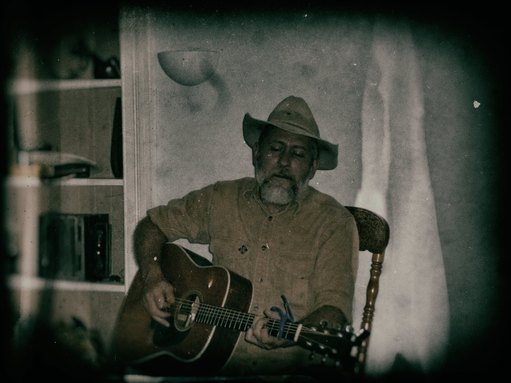
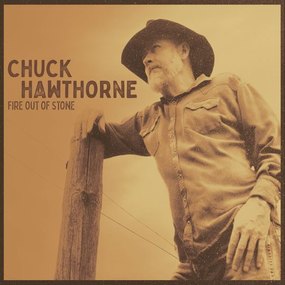
 A couple of years ago a record producer got talking to an imposing ex Marine from Texas, carrying a guitar case, while both were waiting for a flight in Chicago. The end result was Chuck Hawthorne’s impressive debut album, Silver Line, produced by Ray Bonneville, a fine instance of happenstance. Since that album came out Hawthorne has toured the UK twice, building up a fan base with his John Prine like delivery of folk Americana and finally he delivers a second album which will not disappoint those who have been waiting in expectation.
The opening song, Such Is Life (C’Est La Vie) pretty much sets the tone for what is to come as Hawthorne plants his feet firmly in the grand tradition of Texan singer songwriters, the song opening with this vivid portrait, “He smelled like marijuana, two finger cologne, he smoked his regal cigarettes through an ancient saxophone.” Rolling on to tell the tale of a biker’s last stand it’s Guy Clark, Kris Kristofferson territory for sure and Hawthorne inhabits this territory comfortably throughout the album. Bonneville sits out production duties this time although his impressive harmonica playing graces several songs, sounding for all the world like Mickey Raphael. Listen to his playing on Hawthorne’s tremendous elegy to war veterans, New Lost Generation, and just wonder at his playing.
New Lost Generation might be the most striking example also of Hawthorne’s songwriting but throughout the album he proves that he can capture a time, story or emotion in three minutes with unerring excellence. Amarillo Wind sends shivers up the spine as Hawthorne evokes a free frontier spirit while Arrowhead & Porcupine Claw, (spoken and sung in a similar manner to Guy Clark’s Texas-1947) is somewhat magisterial in its description of a native American’s rite of passage. Sara’s All The Way is a grim tale of an Austin woman in the gutter but still looking for stars, its forlorn delivery contrasting with the spritely fiddle laced Broken Good which gathers together a cast of “salty and sweet” ne’er do wells.
Graced with subtle backing from pedal steel, Dobro and fiddle and with Libby Koch adding some excellent harmony vocals, Hawthorne’s songs and words hit home time and time again. He chooses however to close the album with a cover of I Will Fight No More Forever, written by Richard J. Dobson. A member of the original outlaw country scene, Dobson passed away in 2017 and Hawthorne’s cover serves as a fine epitaph as Dobson’s elegiac song influenced the writing of Fire Out Of Stone.
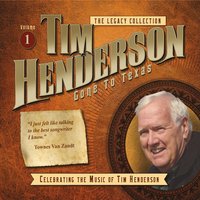 For anyone interested in Texan folklore and the songs of Townes Van Zandt, Butch Hancock and Guy Clark this album is an intriguing listen. Tim Henderson, who died in 2011, was from West Virginia but moved to Austin, Texas when in his 30’s. Influenced by his grandmother who played mountain dulcimer Henderson took up music at an early age but once in Texas he joined in the budding musical scene there releasing his first album in 1978. While his fame never expanded much beyond the State’s borders, at home he was feted with Townes Van Zandt championing him as he won a best song award at The Kerrville Folk Festival in 1977 while he was awarded a Lifetime Achievement Award by the Academy of Texas Music in 2011 for his “timeless contributions to Texas music.”