Bard Edrington V. Burn You Up

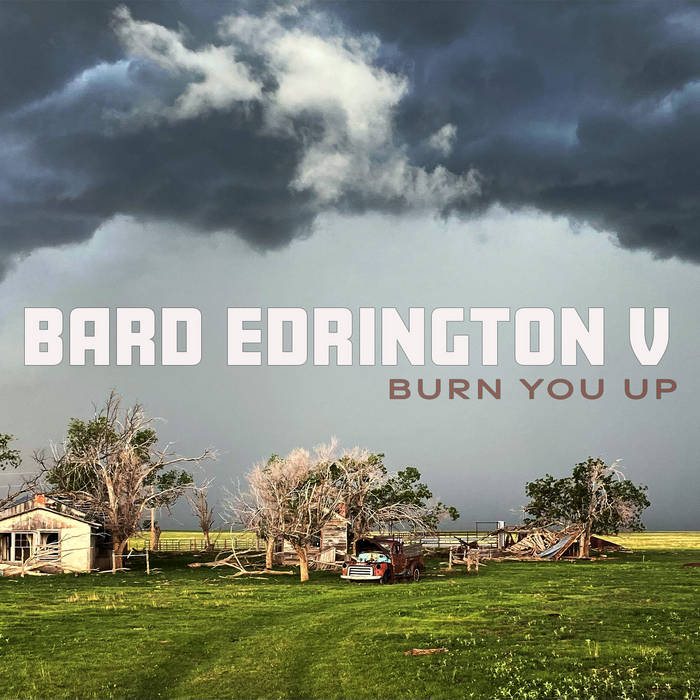
Fairly hot on the heels of his last release, the superb Two Days In Terlingua, Bard Edrington V returns with Burn You Up, a relatively slimmed down version of its predecessor which, nevertheless, is just as vital a slice of rural American folk music.

We say slimmed down as Edrington is here backed by a more straightforward line up than on Two Days In Terlingua. Basically it’s just him and The Blackbirds (brothers Bill and Jim Parker playing guitars, bass and drums) along with Karina Wilson on fiddle, a compact unit but one which can perfectly deliver tub thumpin’ country rock (as on All I Can Do) one moment and then lay down a song like the glistening Die Into It the next.

Edrington remains a master story teller whether singing of his father (“a truck driver and self made man”) on the opening song Sand And Gravel or recounting the role a bootlegged liquor played in 19th century New Mexico as it inflamed the settlers, leading to a revolt which resulted in the death of the then Governor of the state on Taos Lightning. He’s also acutely attuned to his surroundings. The album was recorded was in Santa Fe as a huge wildfire raged only some miles away and on Fire And Rain Edrington delivers a lovely reverie which muses on those opposite forces of nature.

The band snake through the gritty All I Can Do in an ornery mood which recalls the best of Waylon Jennings with Wilson delivering a fiery fiddle solo and Back Roads Of My Mind has a delightful sense of Western Swing meets cosmic country to it as Edrington extols the benefits of  the occasional dose of psilocybin. Those hallucinogenic brown pellets also figure on Die Into It which comes across as a mongrel offspring of Carlos Castaneda and Sam Peckinpah, writing a song about an existential crisis. Speaking of Peckinpah, there are movie pickings galore in the glorious country skirls of Two Days In Terlingua which has echoes of Michael Hurley woven within it and on the evocative Chiapas, a delightful border country waltz which evokes, in its essence, Townes Van Zandt.

A veritable bard of American folklore, Edrington deserves to be heard and lauded, both for his solo work and for his albums with The Hoth Brothers. Burn You Up is, simply put, quite wonderful.

Website

You can buy Burn You Up here

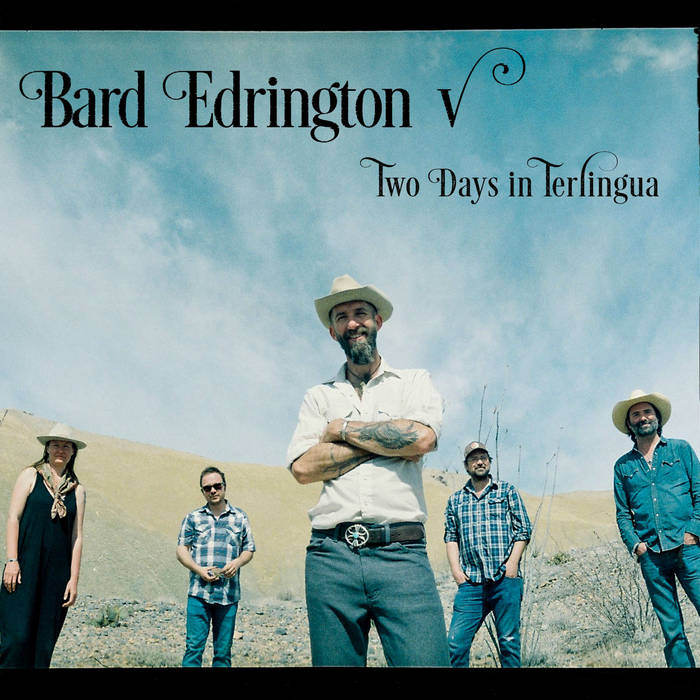
Bard Edrington V. Two Days In Terlingua.

Terlingua, situated in south Texas, might only have a population of 58 but it has featured in movies (including Paris, Texas) and has acquired the title of being Texas’ ghost town. Its abandoned mine works are a tourist attraction for hardy tourists, willing to endure the desert heat and, amidst its parched buildings, there’s a one hundred year old church still standing. This church was the location selected by Bard Edrington V to record this album in as live a manner as he could. The songs were all recorded live in a matter of two days, the band in a circle, playing to each other, no overdubs, the real deal.

Edrington has, over the past couple of years, proved himself to be quite a superior songwriter, both on solo outings and as one half of the Hoth Brothers. Here he excels himself. Having gathered a tremendous set of players to accompany him (Karina Wilson on vocals and violins, brothers Bill  and Jim Palmer on bass and drums, Alex McMahon on pedal steel, banjo and guitar and Zoe Wilcox on backing vocals) he digs deep into traditional American folk themes and comes up with a startling selection of songs. The band meanwhile gel so well it’s difficult to believe that this is a “fly on the wall” recording and, while there are moments which recall the likes of Townes Van Zandt, there are others where the band delve into electric folk blues as practised by The Cowboy Junkies on their acclaimed Trinity Sessions album.

Opening with Ramblin’ Kind, a title which surely nods towards to Hank Williams, Edrington leads the band on a jaunty folk number with twirling fiddle to the fore which introduces a character who seems to haunt much of the album. A drifter – jobs here and there, sleeping rough and prone to wallowing in booze. He’s an American Everyman, down on his luck, and much of the album is about his compatriots and their share of bad luck and struggle. The mood darkens on the grungy Dylan like Property Lines which has Wilson sawing away like Scarlett Rivera as the band plunge into muddy waters, guitars wailing and flailing away to keep from drowning. It’s an epic song and is given an epic treatment.

Similar tales of bad luck and trouble fall into place throughout the album such as on the bittersweet country styling of Shut The Screen Door, the loping country blues of A New Day On The Farm and the stark death rattle of Black Coal Lung. All of these are quite excellent but Edrington tops them with a couple of songs which just about defy description. Nevertheless, here we go. Bard And The Bears is an ancient sounding song of the type we are used to from Michael Hurley. The song scrapes along as Edrington inhabits the flora and fauna of his youth while the band slowly pile in with jagged guitar and an insistent fiddle motif gradually taking over. Strange Balloon meanwhile finds Edrington musing on the night sky and the possibility of life out there, over a quite intoxicating rumble of guitars, fiddle and percussion.

Coming back to earth, Masterpiece Of St. Mark’s Square seems to be an impressionistic painting of some happy times in Venice while Athena’s Gaze is a full blown flowing folk rock number which alludes to the power of ancient Greek myths. A more recent past is visited on Dog Tags 1942, a song written by Edrington’s grandmother about her son going off to war. It’s a fine front porch slice of Appalachian music and it’s followed by the album closer, No Reason, which meanders through its seven minute duration quite wonderfully as Edrington burrows into his very own happy place while the band expertly nudge him along. Their telepathic playing is a Texas equivalent of the groundbreaking sounds conjured by Fairport Convention when they unleashed A Sailor’s Life. It’s a perfect way to close a brilliant album.

Website

Hoth Brothers Band Tell Me How You Feel

This immensely talented and hugely enjoyable trio are a timely reminder of the recuperative powers of music. Tell Me How You Feel, the Hoth Brothers Band‘s second album, is not only a joy to listen to but leaves the listener in a much better place after listening, kind of like a back porch Zen session. It’s string band music – acoustic guitars, banjo, mandolin, double bass all to the fore, along with occasional percussion and some very impressive harmony singing. It’s also old time music despite all but one of the songs being written by band members Boris McCutcheon and Bard Edrington V. Absent from the writing credits but as much of a brother as her bandmates is Sarah Ferrell whose bass playing is impressive and who contributes hugely to the vocal interplay.

Hailing from New Mexico, the trio have been known to describe their music as “Salt Cured New Mexicana,” a term which works for us. Fittingly the album closes with a tribute to the late New Mexican songwriter Lewie Wickham on a cover of his autobiographical song, Rough Ragged Edge. Beautifully delivered on guitar and mandolin, the song evokes the old wild western spirit of this rugged landscape. However, while New Mexico pulsates throughout the album the trio roam freely throughout the States in various styles including acoustic blues, Appalachia and Child ballads while evoking memories of acts such as The Carter Family and The Band.

Just as New Mexico is the setting for the closing song, they open with another paean for the wide open spaces of their home state on Judith, which tells the tale of a New Mexico artist living in a mountain village who refuses to go to the city to be cared for when she falls ill. It’s a breezy introduction to the album, a wonderful ripple of acoustic instruments and Carter Family like harmonies and it nails firmly to the mast, the Hoth’s preferences for the wide open spaces where “every day is a holy day,” as opposed to a place where “people wearing dark clothes, looking down, (are) running to the subways underground.” The joys of nature and sunshine are evident in the delightfully delicate Cliff Fendler and the old time jollity of Honeyguide but the magnificent country rock of Slickhorn has a much more elemental feel coursing through its veins. Here the band sing of the rocks and canyons and mystery of the ancient Anasazi settlement of Slickhorn canyon in the Cedar Mesa with the same depth of feeling and sense of history one remembers from The Band.

Whether they are delivering a dust bowl ballad on Poor Man’s Light, recalling the river men of the frontier on Sam Hill or kicking up some Texas dust on the waltz time Dyin’ For Diane, the trio are ever impressive and the songs a delight. Ferrell has an opportunity to sing lead on Wilding Of Robby which is a prelude of sorts to the band’s outlaw ballad, Wild Robby, which appeared on their first album and which should surely point to her getting more opportunities to sing lead as the band progress. Elsewhere, Passage is a haunting and pataphysical rumination on freedom and fear which recalls John Hartford in its gentle delivery while Boogieman Mesa is a grand and cantankerous junkyard of jagged folk blues.

Finally, just as on their first album, Workin’ And Dreamin’, there is a dash of up to date social commentary. They ragged on Trump back then but on this occasion, their target is the Corona virus. One Hard Rain is delivered acapella, three voices in harmony as they sing of the virus flying over the world like Santa Claus and highlight our precarious position in nature’s pecking order.

Tell Me How You Feel, like its predecessor, is a lengthy album, but its 17 songs flow so well that before you know it, it’s over. That we felt compelled to listen again, not once or twice but oftimes, is a measure of how good this album is. And it is indeed, a solid balm for these troubled times.

Website