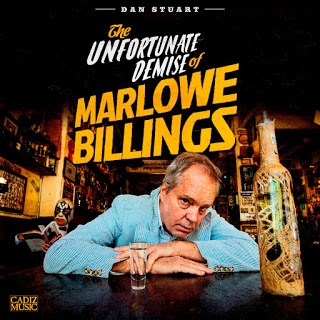
 Dan Stuart finally kills off his alter ego and supposedly his recording career with this third instalment of the strange and troubled tale of Marlowe Billings. Billings, the suicidal expat who travelled to Mexico to kill himself after his marital breakup and subsequent incarceration in a psychiatric hospital, has served Stuart well over three albums and two novels (the second book published to tie in with this album release and sharing its name). The origin of Billings’ himself is somewhat foggy but is believed to be associated with the writer B. Traven, author of The Treasure of the Sierra Madre and whose own identity is still something of a mystery these days. It’s a smoke and mirrors trick allowing Stuart to stand apart from himself as he entertains, releasing his records and touring, his profession surely but one which he has often debunked as when he wrote this regarding the response to an earlier album, “…some grudging critical respect, really a sympathy fuck for days gone by… well the planet could get along without Stuart’s morbidly self-righteous world view just fine. His inability to lighten-up and endure life’s little insults like the rest of us had grown old and tired, like Stuart himself.”
Who knows if this is part shtick or really how Stuart sees himself? He said in an interview some years back that, “the creative process is largely about trust and deception… two sides of the same coin,” What we do know is that since his arrival in Mexico he’s appeared, to fans at least, as revitalised, with the Marlowe recordings welcomed and acclaimed and on The Unfortunate Demise of Marlowe Billings he delivers what may be his best effort yet. The themes are familiar but they are delivered in a variety of styles – low key confessionals, pedal steel laced laments, sixties rock’n’roll rumbles and punchy Tex-Mex blues – his stellar accomplices playing their hearts out.
Stuart/Billings is still hurting from his cuckolding and several songs relate to this. He is despondent on Why I Ever Married You and then sneering on the Dragnet styled Joke’s on Me while You Were The Flower glistens with low slung guitar twangs recalling Johnny Rivers’ Secret Agent Man. The latter song introduces the one salvation of Stuart’s ruined relationship, his son, with whom he has remained in contact. The cycle of birth and death tops and tails the album. The opening March 5, 1961 is Stuart’s birth date and the song is a tender rumination on the emotions engendered when a child arrives (he later radiates a father’s pride on Here Comes My Boy). The closing song, Upon a Father’s Death is Stuart’s most nakedly autobiographical song to date as he reminisces about his own father and muses on the tangled twists of father/son relationships singing, “Just look at Jesus trying to live up to all that shit, impossible.” His troubled adolesence colours Tucson which is a splendid Tex-Mex riff of a song with parping Farfisa organ a la Doug Sahm which eventually disappears into its own rabbit hole.
In the midst of these rueful snippets of autobiography Stuart throws in some superb songs which are allied in the sounds but which roam further afield. Last Century Blues finds him singing of a Zelig like character who dodged the draft, roomed with Manson and Jim Jones and who ended up running coke for the Contras and selling it to the Crips. The Day William Holden Died is a sensitive bonding with the late actor and his sad demise while The Disappeared is an evil sounding song with rattlesnake percussion and Peter Green like Manalishi guitar solos as Stuart salutes the armies of South American mothers who still rally to this day to find the fate of their beloved long after the turbulent wars and coups which scarred the sub continent for far too many years.
Gathering this album together Stuart has relied on friends old and new. His Italian buddies Antonio Gramentieri and Christian Ravaglioli are present and correct while J. D. Foster and Tom Heyman also contribute with Heyman’s pedal steel an essential ingredient on many of the songs. However it’s producer, Danny Amis, a founding member of Los Straitjackets who is his right hand man here, co-writing several of the songs and adding guitar, bass and keyboards throughout.
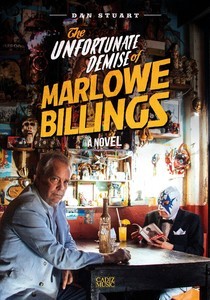
Stuart says this will be his last ever album citing the current preference for digital streaming and such as the death knell for this tradition. Again one hopes this is part of his mythologising but if not it’s a glorious swan song. The accompanying book is a more straightforward affair than his previous “false memoir” The Deliverance of Marlowe Billings. Whereas that came across like a collection of weird flashbacks to Stuart’s early days The Unfortunate Demise of Marlowe Billings is a conventional narrative for the most part with our hero escaping to Mexico and getting caught up in the murky and deadly intrigues of the cartels. While parts of it coincide with the album it stands on its own two feet, hardboiled fiction, akin to the current fascination with Narcos and El Chapo and even Breaking Bad although Stuart weaves his own story into the pages and allows himself some sweet mental revenge in the epilogue. He says the story is 65% true and there are several episodes which offer an insight into his thoughts as when he describes himself as, “a lazy writer, songs came easy and he didn’t take them too seriously. He didn’t have the courage or stamina to write serious fiction.” Well, he has done here. The novel has an introduction by Stewart Lee, the comedian, which suggests that the book is sufficient recompense for the lack of further songs from Stuart. We would respectfully disagree and hope that this is not the last we here from Stuart or even Billings.
