 What can one say about Joan Baez that hasn’t already been said? An icon of the folk and protest movement of the sixties, she moved into the seventies on a roll charting with The Night They Drove Old Dixie Down and releasing what was perhaps her most accomplished album, Diamonds & Rust, while reuniting with her old buddy Bob on The Rolling Thunder tour. Since then she’s continued to record and continued to be an activist, garnering awards and accolades across the globe. Her last release, Day After Tomorrow, from 2008, showed that she still had her finger on the musical pulse produced as it was by Steve Earle and featuring songs written by Tom Waits, Elvis Costello and Earle himself.
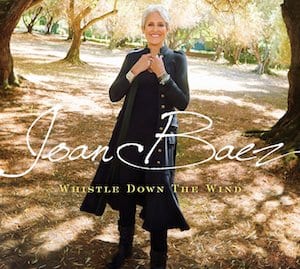
Ten years later and Baez is bowing out (at the age of 77) with what she says will be her final album (accompanied by a lengthy farewell tour). Whistle Down The Wind, if it is her final release, sees her leaving on a definite high note as it is an incredibly accomplished piece of work. Baez’s once piercing soprano voice is now a finely burnished thing of beauty, still recognisably her but a little bit weathered and worn and perfectly suited for some of the songs here. In addition, producer Joe Henry captures Baez and her players with astonishing clarity and warmth while the musicians are truly inspired with some of the playing and arrangements just breathtaking.
In the current political climate it would be easy for Ms. Baez to return to her roots and turn in a collection of protest songs, it would certainly be understandable. Instead, the album is a mature and reflective document with Baez still denouncing war and injustice while acknowledging that it’s time to pass the baton on. Her handpicked songs do include some which address issues directly but elsewhere there’s a valedictory feel.
The sense of a long life and one lived well is evident in the two songs here written by Tom Waits and Kathleen Brennan. Whistle Down The Wind maintains the hobo feel of Waits’ original while smoothing it out as the band play in slow waltz time with a wheezy organ and lonesome singing saw adding a fine patina. Last Leaf is given a stately old time delivery with Greg Leisz playing an antique Weissenborn and one wonders if Baez chose to sing this song just because it includes the lyrics, “I’ve been here since Eisenhower and I’ve outlived even he.” There are more reflections in the dappled version of Josh Ritter’s Be Of Good Heart and Mary Chapin Carpenter’s The Things That We are Made Of while her cover of Anthony & The Johnson’s Another World (with just Baez and her guitar with percussion from her son Gabriel) is a powerful performance.
More directly, Baez sings producer Joe Henry’s Civil War, a song which spans the ages and acknowledges those at home as well as those on the front while Eliza Gilkyson’s The Great Correction harks back to the grand tradition of the likes of Phil Ochs. Another Ritter song, Silver Blade, finds Baez visiting old time ballads as she sings of a maiden ravaged and taking her revenge, a nod perhaps to the current clime of #metoo and the closing song, I Wish All The Wars Were All Over, is another folk ballad with Celtic roots, which, aside from its excellent delivery, is a fitting farewell from this champion of the oppressed and downtrodden.
We can’t ignore the one song here which stabs to the heart and which nails Baez to her sixties civil rights roots while acting as a bit of a slap to the present POTUS. The President Sang Amazing Grace, written by Zoe Mulford, is a straightforward account of the shooting by a white supremacist of nine people in a church in Charleston and of Obama’s moving eulogy thereafter. Baez sings as if in a church, the band swelling behind her with an incredibly moving arrangement, the only pity here being that she still has to sing of events such as this fifty years after she first started to.
Whistle Down The Wind, aside from the legend, is a powerful and moving album, as topical as today’s weather and it bodes well for the singer’s farewell tour. Do give it a listen.