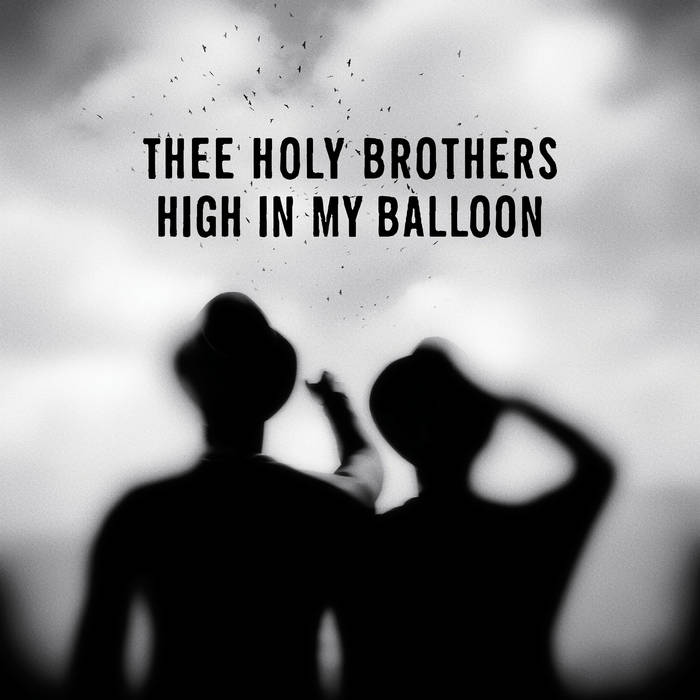
Thee Holy Brothers. High In My Balloon

Back in 2020 Thee Holy Brothers sparked into view with their excellent debut album My Name Is Sparkle. The duo -Marvin Etzioni (ex Lone Justice) and Willie Aron (of The Third Mind) – were so named by the rabbi at their local synagogue , Mordecai Finley, who described them thus, a moniker which was heartily endorsed by another member of the congregation, Leonard Cohen.  My Name Is Sparkle was kind of a psychedelic and trippy audio update of Candide, the protagonist an innocent in search of enlightenment, seeking Jesus but eventually finding Elvis instead.

High In My Balloon is the second instalment in a proposed trilogy of Sparkle’s adventures but it’s not perhaps the album thee brothers initially expected to record as the blight of cancer reared its ugly head during its recording. Etzioni was diagnosed with cancer and, sadly, Aron’s spouse died of the disease. Etzioni was eventually given the all clear after treatment and the album’s title is a nod to his reaction as he says that “I was so elated at the news, I felt like I was levitating, like I was high in a balloon. I did what I always do, I wrote a song about it.” Not just one song however as Etzioni takes Sparkle on a ten track odyssey from doubt, travails and eventual elation, approximating his own trajectory as he fought his illness.

Despite its harrowing gestation the album is quite uplifting, at times almost ecstatic. The pair’s vocals are brotherly harmonies of the first degree and they gleefully inhabit the cloaks of acts such as The Everlys, The Beatles and The Beach Boys on several of the songs. In addition, they cleave to the first album’s sometime off kilter approach giving the whole affair a singular identity, unique to these two somewhat battered brothers who have achieved a degree of excellence in the face of adversity.

The album opens with  a rousing, almost Spector like flourish, on the powerful chimes of Born Torn as our Sparkle, cognisant from the off, sees the world and his future as a series of binary choices and this black and white confusion is maintained in the Beach Boys like reverie which is The Holy In Everything. Here, daily dismal distractions such as war bulletins on TV lead to a sense of ennui but on occasion there’s an opening in which our protagonist can see what he describes as The Holy In Everything. There’s a cacophony of car horns tooting throughout the grungy Guru Honk, a song which is the flip side of George Harrison’s mysticism, the addition of a mellotron towards the end a nod perhaps to those vainglorious days.

Sunshine In My Veins is a startling pop song of the first degree but, such as is thee brothers wont, it’s slightly out of tune, creating a woozy feeling in the listener. It’s somewhat apt as Etzioni says he wrote it in an attempt to portray his experiences on chemotherapy. Magic Jacket meanwhile comes across like an undiscovered psychedelic Who track, left off The Who Sell Out. It’s the breakout song here, the protagonist, just like The Who’s Tommy, unbound and able to conquer all adversity, in fact almost in charge of all as is proposed on the philosophical thoughts contained on the following I Am Time, another glorious song.

Emily Parade comes across as a slight interlude, a whimsical song in the manner of Robyn Hitchcock, it meanders well before the horn ridden I Can See From My Window Now stomps into view, another song which swells with optimism, “A new day for everyone” they sing. Ode To Harry Cell is presumably a farewell to the cancerous cells which Etzioni conquered and is given a delightful almost bluegrass treatment and the album closes with the title song which, as mentioned above, Etzioni wrote on getting the all clear. Over a stabbing Hammond organ riff, the brothers get again all Beatles like on a triumphant song which has a wonderful coda.

Forget the concept and revel in the sounds here. Steeped in harmony history and given an idiosyncratic twist, High In My Balloon is, quite simply, quite brilliant and we sincerely hope that these Holy Brothers carry on and deliver the third instalment of their Sparkle trilogy.   

Website

Marvin Etzioni. Marvin Country!

Very occasionally an album comes along that stops you dead in your tracks, knocks the wind out of your sails and demands that you pay attention. Marvin Country! is one such album. The work of Marvin Etzioni, one time member of Lone Justice and producer of the likes of Counting Crows, Peter Case and Toad The Wet Sprocket (remember them?)it’s a double disc CD with various “star” names guesting which had our antenna twitching. After all aren’t such beasts often a recipe for disaster? All doubts were dispelled as soon as the virtual needle hit the grooves (and there is a vinyl release which I presume will be magnificent in its own grooviness) and as song after song tumbled out of the speakers, each and every one great in its own unique way we realised we were in the presence of an album which in its ramshackle and splattergun approach pretty much approaches the pinnacle of current Americana music.
While Etzioni plays much of the music himself including various keyboards, mandolin, mandocello, casio, bass, drums, porchboard, synthesiser, mellotron and some scintillating electric guitar he opens the borders of Marvin Country to the likes of John Doe, Steve Earle, Maria McKee, Buddy Miller, Richard Thompson, Gurf Morlix, Greg Leisz and Lucinda Williams. While it’s fair to report that they all add something special to the mix even without their presence the album would stand up on its own.

With his songwriting credentials pretty much confirmed via his tenure with Lone Justice Etzioni has at least one stone cold bona fide classic here with Lay It On The Table. A tear jerking duet with Lucinda Williams and weeping pedal steel from Greg Leisz you should be hearing it over any decent airwaves very soon. You Possess Me, the opening song and another duet (with Maria McKee this time) is almost as good. However any notion gained from the curtain raiser that we’re in for some sweet modern country is dispelled by the following song, The Grapes of Wrath. John Doe takes the vocal duties here on a turbo charged rocker that sounds like vintage Dylan delivered by a souped up Chuck Prophet with a great big fat guitar sound that humbbucks like hell. Speaking of Dylan Etzioni proclaims Bob Dylan Is Dead on a tremendous acoustic thrash that is exhilarating in its iconoclasm and clever in the allusions within the lyrics. Etzioni throws up several other tremendous songs throughout the album such as the Cash like A Man Without A Country and the country punk Living Like a Hobo while You are The Light with vocal accompaniment from The Dixie Hummingbirds is simply superb. If all of the above were to constitute the album then it would be highly recommended but there is more, so much more, to hear on the second disc. Much of the delight in listening to this is in the rollercoaster feel of lurching from thrash to country to gospel to folk but on disc two (or side three if you do get the vinyl) Etzioni throws a fine curveball with a suite of what might be best called “oddball” songs. Where’s Your Analog Spirit? is a synth drenched protest song reminiscent of Roger McGuinn’s space rock. Etzioni plays around with sound samples on Gram Revisited, a primitive sounding tribute to Parsons and the goofy sounding What’s Patsy Cline Doing these Days? He then slips in anther cracking song with Hard to Build a Home which could not only end up as a country classic but also refers back to a song on the first disc, Son of a Carpenter. Aside from any biblical possibilities this is just more evidence of the very keen mind that made this album. The run up to the end of the album is packed with gems. The guitar solo in the bluesy Trouble Holding Back (by Trevor Meanor) is audacious and ridiculously spellbinding while the mournful horns of There’s A Train is one of the album’s highlights. The simple God’s Little mansion could be an old Carter Family homily.
We haven’t even mentioned the fine lazy cajun Richard Thompson vehicle It Don’t Cost Much and Gurf Morlix’s turn on Son of a Carpenter but if we were to go on this review would never end. Suffice to say that this album sits up there with the likes of Terry Allen’s superb Lubbock (On Everything) as a great example of left field maverick Americana. In order to try and offer a sense of its reach there are two samples below which demonstrate the breadth of the album.

website

The Grapes of Wrath

What’s Patsy Cline Doing These Days? Pt. 1