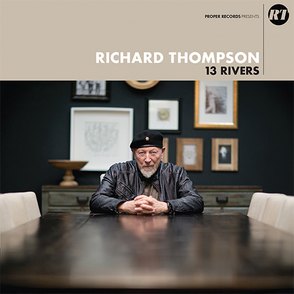
Richard Thompson. 13 Rivers. Proper Music

e2vm1pgoe7u36jzs7buw6lm9_11271It’s always a cause for celebration when a new Richard Thompson album comes out. An artist who has rarely put a foot wrong over a 50 year career,  he’s one of those touchstones (a bit like Nick Lowe or Loudon Wainwright) who constantly remind one of what great song writing is all about. 13 Rivers follows on from the two volumes of Acoustic Classics, which found Thompson revisiting his back catalogue, and the Jeff Tweedy produced Still which stands up as perhaps his best album over the past decade and a half.

13 Rivers doesn’t have the light and shade of Still, being more of a rock album with the sterling work of drummer Michael Jerome very much driving the songs along as bassist Taras Prodaniuk lays down solid bedrock. Meanwhile Thompson’s guitar slashes and burns on several of the numbers, sometimes duelling with guitarist Bobby Eichorn, and recalling some of the more fiery moments on 2013’s Electric. In addition, there’s a dark undercurrent flowing through the album with Thompson saying that he wrote the songs in “A dark time.” His troubles aren’t specified but from the portentous and roiling album opener, The Storm Won’t Come, to the closing Shaking The Gates, a melancholic number which recalls his very early works, there’s a sense of doom embedded throughout. It’s most pronounced on the excellent My Rock, My Rope where Thompson seems to be clinging by his fingernails over a bottomless abyss. Bones of Gilead, despite its spritely delivery, has a biblical like bloodiness to it while The Dog In You growls over a slow blues like beat as Thompson offers a damning exposition of the song subject’s failings.

Although there’s a great deal of bile and rancour here Thompson keeps a firm hand on the tiller as the band weld together creating some scintillating sounds. Perhaps the most savage song, Pride, sparkles with Eichorn’s guitar flourishes and there’s even a hint of Carry On comedy as Thompson sings the words, “Infamy, infamy.” It’s very tempting to consider 13 Rivers a break up album but overall it’s sufficient to appreciate that Thompson has always flourished when he’s down at the dark end of the street. When he can summon up such a perfect burst of rock music as on The storm Won’t Come –  a song which could have sat easily on Fleetwood Mac’s Then Play On – it’s maybe just best to sit back and let the storm burst over you.
Website


Richard Thompson. Acoustic Rarities. Proper Records

arRichard Thompson’s decision, back in 2014, to record some of his back catalogue with just him and his acoustic guitar (Acoustic Classics) might be one of the best of his career. Hailed immediately by fans and critics he recently followed it up with Acoustic Classics Vol. 2, another cracker, and now, just two months later, he unveils a third instalment.  Essentially, there’s no real need to read further on if you enjoyed the previous volumes. Rarities stands beside them, tall and proud.
The format is the same. Thompson, voice and acoustic guitar, revisits his catalogue. Here the bait (if any was needed) is six previously unreleased songs and a few recorded by others but not previously by Thompson. Alongside these he digs deep into his recorded past revisiting Fairport Days, his obscure solo debut, Henry The Human Fly, and two numbers originally recorded with Linda Thompson.

Sloth, originally a lengthy electric folk dirge on Fairport’s full House, is stripped back but still sends shivers down the spine with Thompson’s unique guitar style a triumph. Poor Will And The Jolly Hangman (a song that was recorded for Full House but which didn’t make the final cut, only emerging some years later) allows Thompson to stake, yet again, a claim to be one of our finest troubadours in the folk medium. From the duo years with Linda, Thompson selects the dark Never Again and the even darker, End Of The Rainbow, the latter given a magnificent reading and as relevant today as it was back when it was recorded, a bleak prophecy for a fresh faced bairn.

Henry The Human Fly (his first solo album in 1972) was, allegedly, the poorest selling album ever released by US label Warner Bros/Reprise and Thomson was reportedly dissatisfied with it. This reviewer still has his copy bought back then and still thinks that The Angels Took My Racehorse Away and Roll Over Vaughn Williams stand amongst Thompson’s best songs. Here he selects The Poor Ditching Boy for a royal makeover with accordion accompaniment, a version which begs the question as to whether, for a future instalment, Thompson could deliver the whole of the album acoustically.

As for the unreleased songs, some will be familiar to gig goers over the years such as the humorous Alexander Graham Bell, here given some Django like guitar runs, while Push And Shove was a live favourite some twenty years ago. Rainbow Over The Hill was offered to The Albion Band and it’s a neat reversal of the rainbow metaphor from The End Of The Rainbow with its optimism. What If is a fine example of a spiky Thompson diatribe while She Played Right Into My Hands rolls along with a fine pub session folk feel and They Tore The Hippodrome Down wanders down a nostalgic alley. Best of all however is the stark folk ballad Thompson offered to Blair Dunlop, Seven Brothers. Here he revisits his reimaging of classic folk ballads that helmed Liege & Lief and Full house with a song suffused with portents of doom.

So, number three in an excellent series. Wholly recommended to Thompson fans and hopefully not the last of them to surface.

Website


Richard Thompson. Acoustic Classics II. Proper Records

58Richard Thompson pleased a great many people with his 2014 release, Acoustic Classics, where he handpicked several of his songs and delivered them solo stating at the time,  “I really wanted something that would reflect the acoustic shows but we didn’t have anything like that, Just some old, slightly scratchy recordings of solo sets that I wasn’t really happy with.” It seems that he was happy with the result as he’s gone and done it again with this second volume where he again goes through his extensive back catalogue coming up with 14 gems and this time he’s included his Fairport Convention days with three of the songs taken from that period.

He opens the album with the acerbic She Twists the Knife Again which is perhaps the least successful of his renditions here although his staccato guitar runs reflect the jagged lyrics.  The Ghost Of You Walks which follows is more representative of the album as a whole as Thompson settles into his familiar melancholic mood while his guitar playing is expressive and tender as is his singing. The first of the three Fairport songs, Genesis Hall, follows suit with Thompson reining in the Fairport waltz arrangement unveiling it as a modern folk classic with the words (written about a raid on squatters with Thompson’s police officer father participating) allowed to ring free. Jet Plane In A Rocking Chair and A Heart Needs A Home, both from his partnership with ex wife Linda, follow with the latter particularly affecting.

It’s of note that Thompson can invest songs that were originally recorded with full rock band arrangements with as much power and drive using just his acoustic guitar. Here Pharaoh and Gethsemane (from Amnesia and The Old Kit Bag respectively) pack a punch with Pharaoh in particular stern and glowering, its message undimmed and particularly apt for these benighted times. Guns Are The Tongues, another powerful protest song is the one song here that has added instrumentation with a mandolin added to the guitar and again Thompson invests it with a powerful dignity.

He goes all the way back to one of his earliest and best known songs when he tackles Meet On The Ledge and while the original can probably not be beat it’s great to hear Thompson sing this. The biggest surprise on the album is with a song of similar vintage, Crazy Man Michael. Originally released on Liege & Lief when Fairport were digging deep into folk music it proved that Thompson and co-writer Dave Swarbrick were able to deliver songs that reeked of tradition and here Thompson is just perfect as he maintains the eerie folk magic that informed the original.

It’s another triumph then for Thompson and a must for his many followers. And for those wanting more there’s another disc of Acoustic Rarities available via his Pledge Music Page here.

Website


Richard Thompson. Still. Proper Records.

Most of the advance publicity for Still, Richard Thompson’s latest album has honed in on the producer being Jeff Tweedy of Wilco and we must admit that the thought of Thompson and Tweedy together was tantalising. The reality is that Tweedy has done what a good producer should do; he’s all but invisible here, apparently on some backing vocals but not ostentatiously so. Tweedy’s quoted as saying, “Richard’s been one of my favourite guitar players for a very long time. When I think about it, he’s also one of my favorite songwriters and favorite singers. Getting to work closely with him on this record was a truly rewarding experience” while Thompson adds, “Jeff is musically very sympathetic. Although some of his contributions are probably rather subtle to the listener’s ear, they were really interesting and his suggestions were always very pertinent.”

Obviously, we’re not privy to what went on in the Chicago sessions that formed the album but Still is probably the most satisfying Thompson album we’ve heard in several years. There’s a variety to the songs that captures Thompson’s various musical guises, the melancholic folk singer, the music hall entertainer, the pessimistic dissector of human emotion. In addition Thompson’s guitar, acoustic and electric, shines throughout the album and again his variety is well captured, bagpipe like drones, quicksilver tones and fifties inspired rock licks are all present and correct and if Tweedy has done nothing else he’s captured Thompson’s guitar sound with a deadly accuracy. The ringing clarity of Where’s Your Heart the primary evidence here. As for the writing Thompson has delivered a solid set of songs with a few that, given time, might be considered among his classics.

The album opens with one of these, the excellent She Never Could Resist A Winding Road. A song that recalls his early solo career with martial drums and a wonderfully corkscrewed guitar solo it’s a tremendous opener. Patty Don’t You Put Me Down is another song that perks up the ears, a solid four beats to the bar thump that allows plenty of space for Thompson to solo on several occasions while the aforementioned Where’s Your Heart just drips with melancholy as Thompson’s guitar rings throughout with a spectacular solo turn that is somewhat gob smacking. There’s an almost Byrds like chime to the guitars on the darkness of Dungeons For Eyes and Josephine has an almost medieval feel with acoustic guitars adorning the Tennyson like lyrics. His drollery is well represented with All Buttoned Up one of his back terraced tales, this time about a girl who frustrates her boyfriend with her refusal to go all the way while he closes the album with the lengthy and perhaps autobiographical Guitar Heroes. A bit of a throwaway song when considered against its peers Thompson sings of sitting home alone, rejected at school, losing jobs all due to his need to practice and learn from his heroes as he plays some famous riffs from the classics including The Shadows, Chuck Berry, Duane Eddy et al. It’s good fun with Thompson admitting at the end of the song that he still doesn’t know how they did it (despite the evidence to the contrary).

website

Richard Thompson. Acoustic Classics. Proper Records.

Universally regarded as one of the finest songwriters and guitar players of his generation Richard Thompson‘s latest release, Acoustic Classics, is just that, Thompson and his acoustic guitar revisiting some of his greatest songs from the past four decades. According to the man himself “I really wanted something that would reflect the acoustic shows but we didn’t have anything like that, Just some old, slightly scratchy recordings of solo sets that I wasn’t really happy with.” The result is a corker that should gladden the heart of any Thompson supporter as his excellent fretwork sparks fireworks throughout the 14 songs here while he is in very fine voice especially on the sizzling retooled 1952 Vincent Black Lightning which outstrips the ’91 original on Rumour And Sigh in terms of passion and fire.

It’s easy to compare a song like 1952 Black Vincent Lightning to the original as back then Thompson recorded it solo. The opening song, I Want To See The Bright Lights Tonight is a different beast with the original so firmly fixed in the psyche. Originally sung by Thomson’s then wife, Linda, and with a brass band arrangement ornamenting the Bash Street folk rock beat it remains one of his best known songs. However Thompson has been delivering this song for nigh on thirty years and here it makes a punchy album opener as he rips through it giving it a tough masculine bravado missing from the original while the guitar break is a welter of bass strings and lead picking, indeed his guitar playing intrigues and delights throughout with perhaps the best heard on Wall Of Death although the delicate Persuasion recalls the work of Bert Jansch on Rosemary Lane.

The album above all stands as testimony to Thompson’s status as a songwriter as he regales the listener with classics such as From Galway To Graceland, Walking On A Wire, Down Where The Drunkards Roll, Shoot Out The Lights, Beeswing and Dimming Of The Day. All magnificent and while this reviewer pulled out vinyl albums, CDs ( and a cassette) to listen again to the originals it was noted that they sat amongst a slew of other, just as vital, songs leading one to think that the only complaint one could level at this release was that it wasn’t a boxed set of Thompson originals reimagined though him and his guitar. And if you haven’t heard From Galway To Graceland before treat yourself to one of the best ever songs about the “King” below.
website

Richard Thompson. Electric

While no one in their right mind would say that Richard Thompson, solo, acoustic, is anything less than riveting it has to be admitted that when he straps on his electric guitar and cuts loose there’s a certain frisson of delight. Frequently cited in polls and lists of the “greatest guitarists” Thompson can rarely be mistaken for anyone else with his biting razor sharp playing which owes little to the usual blues roots and has a uniquely British sense despite him having lived in L.A. for the past two decades. News that his follow-up to 2010’s live album, Dream Attic was to feature a “power trio,” be produced by Buddy Miller and to be called “Electric” was tantalising to say the least and here, at last, is the beast.
Recorded in Miller’s home over a two week period and captured on analogue tape the album is another feather in Miller’s producer’s cap with a warm and crisp “live” sound heard to best effect on the one song that does sound a little like a power trio, Sally B, with drummer Michael Jerome almost aping Ginger Baker’s style. That the opening to the following Stuck On A Treadmill sounds dangerously similar to Led Zeppelin’s Kashmir is a red herring although it does allow Thompson to blaze away with an amazing solo of the type that he generally reserves for live performances. Album opener Stony Ground sets the scene well with Thompson’s guitar set to folk rock as he relates a sad tale of a toothless old man lusting for the widow next door. With lyrics reminiscent of those on Hokey Pokey Thompson describes his comeuppance at the hands of the widow’s sons
“Kicked him in the head, poked him in the eyes, shoved him in the gutter and there he lies, dripping with blood, dripping with snot, but he’s still dreaming of her you-know-what.”
Straight and Narrow takes Thompson almost into sixties garage territory with its Farfisa sounding keyboard and affords him another opportunity to solo with his notes dripping like quicksilver on a song that pulses with energy. As good as this is the highlight of the rockier songs here is undoubtedly the amazing Good Things Happen To Bad People. This is a stunning song with its muscular beat and ringing guitars that thrash and flail as Thompson (in fine voice) denounces a Jezebel who “cried the day I walked you down the aisle.” Presumably, the acoustic guitar here is by Miller but it lays down a fine challenge to Thomson who unleashes a wicked solo that tears and bites with a ferocity appropriate to the protagonist’s wounded anger.
There are some quieter moments on the album with Salford Sunday in particular standing out. An impressionistic take on a hung-over Sunday morning in a dreary northern town it has an incongruous jauntiness in its step. Another Small Thing In Her Favour is classic Thompson miserabilism, it details the end of a relationship with a tender vulnerability both in the lyrics and the playing. The Snow Goose reminds you of just how good Thompson is when solo as he picks his way through a typical slice of pessimism singing
“Northern winds will cut you, northern girls will gut you, leave you cold and empty Like a fish on the slab.”
Sparse, with only acoustic guitar and occasional accordion, it is cold and lonesome and the introduction of Alison Krauss on harmony on the chorus only serves to emphasise this. A wonderful song and a fine reminder that Thompson might be one of the finest guitarists around but more importantly he is one of the finest songwriters we have.

Buy “Electric” here

Richard Thompson album news

There are certain musicians who have accompanied Blabber’n’Smoke throughout the journey from adolescent to gray haired wisdom and Richard Thompson is one of them. From his days in Fairport Convention to the fabulous pairing with then wife Linda which produced classic albums I Want To See The Bright Lights Tonight and Shoot Out The Lights, followed by his lengthy solo career he’s always been one of our favourites. Perhaps the quintessential UK guitarist he’s been a beacon for an Anglicised rock and folk sound since the sixties so we were intrigued to hear that for his upcoming release, Electric, he’s teamed up with Buddy Miller, ace producer of numerous Americana icons. Miller produces and guests on the album include Alison Krauss who of course, with Miller and Robert Plant delivered the very fine Raising Sand album a few years back.
Electric’s not released until next February but here’s a sneak preview of one of the songs, Good Things happen To Bad People. which will be released as a single. Can’t wait to hear the rest of the album.

Thompson will be touring in support of the album release, no Glasgow date so far but he does play Edinburgh’s Usher hall on February 28th.

Marvin Etzioni. Marvin Country!

Very occasionally an album comes along that stops you dead in your tracks, knocks the wind out of your sails and demands that you pay attention. Marvin Country! is one such album. The work of Marvin Etzioni, one time member of Lone Justice and producer of the likes of Counting Crows, Peter Case and Toad The Wet Sprocket (remember them?)it’s a double disc CD with various “star” names guesting which had our antenna twitching. After all aren’t such beasts often a recipe for disaster? All doubts were dispelled as soon as the virtual needle hit the grooves (and there is a vinyl release which I presume will be magnificent in its own grooviness) and as song after song tumbled out of the speakers, each and every one great in its own unique way we realised we were in the presence of an album which in its ramshackle and splattergun approach pretty much approaches the pinnacle of current Americana music.
While Etzioni plays much of the music himself including various keyboards, mandolin, mandocello, casio, bass, drums, porchboard, synthesiser, mellotron and some scintillating electric guitar he opens the borders of Marvin Country to the likes of John Doe, Steve Earle, Maria McKee, Buddy Miller, Richard Thompson, Gurf Morlix, Greg Leisz and Lucinda Williams. While it’s fair to report that they all add something special to the mix even without their presence the album would stand up on its own.

With his songwriting credentials pretty much confirmed via his tenure with Lone Justice Etzioni has at least one stone cold bona fide classic here with Lay It On The Table. A tear jerking duet with Lucinda Williams and weeping pedal steel from Greg Leisz you should be hearing it over any decent airwaves very soon. You Possess Me, the opening song and another duet (with Maria McKee this time) is almost as good. However any notion gained from the curtain raiser that we’re in for some sweet modern country is dispelled by the following song, The Grapes of Wrath. John Doe takes the vocal duties here on a turbo charged rocker that sounds like vintage Dylan delivered by a souped up Chuck Prophet with a great big fat guitar sound that humbbucks like hell. Speaking of Dylan Etzioni proclaims Bob Dylan Is Dead on a tremendous acoustic thrash that is exhilarating in its iconoclasm and clever in the allusions within the lyrics. Etzioni throws up several other tremendous songs throughout the album such as the Cash like A Man Without A Country and the country punk Living Like a Hobo while You are The Light with vocal accompaniment from The Dixie Hummingbirds is simply superb. If all of the above were to constitute the album then it would be highly recommended but there is more, so much more, to hear on the second disc. Much of the delight in listening to this is in the rollercoaster feel of lurching from thrash to country to gospel to folk but on disc two (or side three if you do get the vinyl) Etzioni throws a fine curveball with a suite of what might be best called “oddball” songs. Where’s Your Analog Spirit? is a synth drenched protest song reminiscent of Roger McGuinn’s space rock. Etzioni plays around with sound samples on Gram Revisited, a primitive sounding tribute to Parsons and the goofy sounding What’s Patsy Cline Doing these Days? He then slips in anther cracking song with Hard to Build a Home which could not only end up as a country classic but also refers back to a song on the first disc, Son of a Carpenter. Aside from any biblical possibilities this is just more evidence of the very keen mind that made this album. The run up to the end of the album is packed with gems. The guitar solo in the bluesy Trouble Holding Back (by Trevor Meanor) is audacious and ridiculously spellbinding while the mournful horns of There’s A Train is one of the album’s highlights. The simple God’s Little mansion could be an old Carter Family homily.
We haven’t even mentioned the fine lazy cajun Richard Thompson vehicle It Don’t Cost Much and Gurf Morlix’s turn on Son of a Carpenter but if we were to go on this review would never end. Suffice to say that this album sits up there with the likes of Terry Allen’s superb Lubbock (On Everything) as a great example of left field maverick Americana. In order to try and offer a sense of its reach there are two samples below which demonstrate the breadth of the album.

website

The Grapes of Wrath

What’s Patsy Cline Doing These Days? Pt. 1

Two Wings Love’s Spring.

Staying in Scotland today for a preview of this album from impressive Glasgow band Two Wings. Impressive but very difficult to categorise (why categorise? I dunno, answers on A4 paper sent to Blabber’n’Smoke HQ please). You could call them psychedelic folk or weird folk or even if pressed make a case for calling them a folk band, but then you can’t impress all of the folk all of the time. Suffice to say that they gather in a lot of influences that certainly include the sixties San Francisco sound that produced Jefferson Airplane and H.P. Lovecraft and the myriad UK bands that clustered together under the folk banner in the early seventies teetering on the edge of prog rock. (see the excellent book Electric Eden). Add to this a dash of Richard Thompson, Kate Bush and latterly Joanna Newsome and Tuung and you might have an idea of what two Wings sound like.
Fronted by Finnish singer Hanna Tuulikki and guitarist Ben Reynolds (of Trembling Bells fame) and ably assisted by Kenny Wilson, bass, Owen Curtis Williams, drums and Lucy Ducombe, additional vocals, the band create a fairly unique sound that might be difficult for casual listeners but ultimately rewards anyone who enjoys listening to music that is off of the beaten track.
Kicking off with Eikon, the single from the album the first thing to strike the listener is Tuulikki’s voice. She sings like a cross between Kate Bush and Karen Dalton and with the added contribution of Ducombe the pair make some weird sisters. As stated earlier this is not easy listening but over the course of the album the voices make perfect sense especially when Reynolds’ is added to the mix. As for the music here it comes across somewhat like Kevin Ayers’ Whole World Band with the horns recalling David Bedford’s work. This continues on the gorgeous Feet which recalls Ayers’ more bucolic side. There’s a faux medieval feel initially to Love’s Spring courtesy of what might be a recorder but the song soon evolves into a trippy guitar solo with disembodied voices hovering close by. This is what a night at the Filmore West might have sounded like. The highlight of the album is Altars and Thrones which shimmers with a hazy sense of dread. The rippling guitar, sensitive percussion and tremendous vocals create an almost ethereal feel on a song that is tremendously reminiscent of the great Pearls Before Swine. The folky It Hurt Me owes more to English folk song but we are back in psychedelia with the closing Forbidden Sublime where Reynolds’ guitar playing is certainly electric music for the mind and body while Tuulikki caresses the words and a mournful horn section adds a sense of desolation. Extreme listening but well worth the endeavour.

website

Altars and Thrones