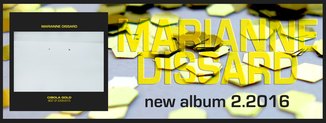
Marianne Dissard. Cibola Gold – Best Of 2008-2015

banner-website-site-2015_12-v2b

Marianne Dissard is probably best known as a sometime collaborator with several bands from the Tucson scene including Giant Sand and Calexico; most notably, she is the femme fatale on Calexico’s Ballad Of cable Hogue. A noted filmmaker and photographer in addition to being a chanteuse, Dissard recorded three albums in Tucson, the last being The Cat, Not Me along with two albums in what she calls her City Series, Paris One Takes and Cologne Vier Takes. Last year she relocated to Europe and this collection, culled from the above albums, is something of a farewell to her American years.

Blabber’n’Smoke reviewed L’Entredeux and The Cat, Not Me, albums that steered a course between European (and in particular French) pop tradition and American guitar rock. Despite the plethora of Tucson musicians the overall sense was of a continental bent, Serge Gainsbourg being an obvious touchstone, Dissard singing in French (and occasionally German), her voice usually somewhat sultry in the grand manner of the likes of Juliette Greco and Francoise Hardy.  Her lyrics (handily translated on her website) sensual, poetic, dark, a mix of Rimbaud and French argot. Above all her words were wrapped in a polyglottal musical language, Mariachi, twang guitars and Chanson all thrown into the pot and this collection is a fine reflection of that.

The 13 songs gathered here are each and every one reason to make the listener search out the albums they are taken from. Dissard roams from the opening accordion jollity of Les Draps Sourds, the Bal Musette setting disguising the lusty goings on in the lyrics, to the nightmarish claustrophobia of Tortue. She almost purrs on the magnificent Pomme, a song that initially recalls Parisian cobbled streets before a grand, almost prog, middle eight weighs in. On the rock side there’s some ferocious guitar squabbles on the driving The One And Only, another fine guitar solo on the thrilling Election and Trop Express oozes sensuality over a funky Hammond organ riff. However Dissard can also come across like a Gallic Nico back in her Chelsea Girl days on the string laden acoustic ballad Cayenne or conjure up a glistening bucolic world on the sublime Les Confetttis. The crowning glory perhaps is the meandering musical map of Un Gros Chat with its spooky bowed saw and splashing cymbals, the lyrics abstractly erotic, Dissard like a whispered siren drawing listeners into her realm.

The album is an excellent entree into the weird and wonderful world of Ms. Dissard, a dizzying potpourri of sensual frissons seasoned with some wonderful music. The package itself is worth delving into. Packed full of pictures , tributes, poems and snippets of correspondence from the Tucson days it gives a measure of Dissard’s time there. In addition, with the deluxe package, Ms. Dissard has liberally garlanded each CD with golden confetti, some of which is still cluttering up the keyboard here.

website


Sacri Cuori Delone Glitterbeat

From the moment Blabber’n’Smoke first heard Sacri Couri we were convinced that they were a very special band. They played a short set when backing Dan Stuart back in 2012 which we described as an “astounding palette of sounds that ranged from surf and Duane Eddy type guitar to Nino Rota cinematic whirls with Joe Meek electronica and superb percussion to take the audience on a trip through some weird places.”
Their album Rosario confirmed their wide range of influences and left no doubt that there is a “Sacri Cuori universe,” a strange and wonderful place where a cornucopia of delightful sounds coalesces to deliver a true Technicolor dream. Often described as purveyors of imaginary soundtracks (and very much influenced by the likes of Nino Rota and Ennio Morricone) Sacri Cuori actually delivered the soundtrack for a movie, Zoran, which won several European awards in 2014 and now we have Delone, an album that positively drips with aural delights and is indeed, as the press release claims, a kaleidoscopic road trip.

For an Italian band Sacri Cuori have long been associated with American music due to their association with the likes of Dan Stuart, Calexico, Richard Buckner and Giant Sand with their first album, Douglas and Dawn recorded in Tucson. Delone however sees them proudly reclaim their homeland with guitarist Antonio Gramentieri saying, “in every sound and feeling on the album, Italy is the heartbeat.” It’s an Italy that is viewed through the lens of Hollywood and Cinecitta, the Italy that was cool and hip in the sixties, land of Vespas, Gaggia, Mastrello Mastrianni and Virna Lisi. The band look to the music of Italian film composers, not only Rota and Morricone but lesser known artists such as Riz Ortolani, Armando Trovajoli and Piero Umiliani, composer of the song forever associated with the Muppets, Mah Na Mah Na. With a musical palette then that includes orchestral sweeps, funk, goofy humour and Euro pop they also toss in tango, surf music and a nod to the subversive pop genius of Serge Gainsbourg. Morricone’s spaghetti western whistling is married to the traditional sound of Secondo Casadei’s Romagna Mia and lit by a neon stream of vibrant Giallo colours.

Delone features Evan Lurie, Marc Ribot and Steve Shelley on additional instrumental duties while the vocals are handled by Howe Gelb (on Serge), Carla Lippis, an Italian diva they discovered in Australia and Emmanuelle Sigal with the songs variously in English French and Italian. The opening number, Bendigo is a turbo charged Mexican infused surftrash thrash that Quentin Tarantino really needs to hear. Delone, the song, tells the tale of the album’s anti hero, a man in the shadows , in a manner redolent of sixties spy thriller theme songs while Dancing (On The Other Side Of Town) is romance as danger, a David Lynch nightmare delivered with a deadpan sense of cool. With spoken word snippets between numbers, twanging guitars, deranged horns and fairground keyboards enlivening the instrumentals the entire album is a delight to listen to. It’s infectious, humorous and intelligent and marks Sacri Cuori as one of the coolest bands around.

p.s. watch the video below for a cameo appearance from Marlowe Billings, Toni Delone’s American friend.

Marianne Dissard. The Cat. Not Me. Vacilando ’68 Recordings.

Fans of Giant Sand and Calexico should need no introduction to French singer and cinema auteur, Marianne Dissard. Director of the Giant Sand flick Drunken Bees and Joey Burns’ femme fatale foil on The Ballad Of Cable Hogue Dissard moved to the States in her teens when her parents relocated eventually putting down roots in Tucson in 1985. Aside from her appearance on Calexico’s albums Joey Burns composed much of the music on her 2008 album L’Entredeux while L’Abandon was a reaction to the breakup of her marriage to Naim Amor, another continental import to the Tucson music scene. Both albums featured Dissard’s odd combination of French “chanson” and dusty Tucson Americana, odd indeed but a sound that reflected the European influences on the likes of Calexico with their Morricone inspired vistas and harked back to the kinship shared by Lee Hazlewood and Serge Gainsbourg, two artists who knew the alchemy of putting a sensual female voice over an impressionistic musical canvas.

Dissard decided to return to Europe last year but not before she recorded this, the third in her “Tucson trilogy.” On this occasion she recruited Sergio Mendoza from Tucson’s Y La Orkestra to write the music while Giant Sand’s Thoger Lund adds to the mix. The result is perhaps her most successful album to date, luxurious in its sumptuousness, molasses of music poured over her provocative voice as she bridges the Atlantic with some twang here and Bal-mussette there. There’s an analogue buzzing noise right at the beginning before Dissard leads us into the beguiling Am Letzen, a dreamy drifting ballad with multitracked vocals and a muted Nick Cave feel about it. With lyrics in French and German the European feel is also reminiscent of the Prague influenced Walkabouts. The spell cast is broken with Mouton Bercail, a neon lit rain slicked highway ride with spangled guitar bursts that sounds as if it sprang from a Davis Lynch movie. Loosely translated as Sheep Pen, O level French denies this listener the opportunity to understand Dissard’s urgent vocals here but the translation reveals lyrics that fit the lurid underworld suggested by the music such as ” I’ve done so many motels and basements/I’ve wasted so much time/so many dumps and shitholes/drooled so much blood/done so many fucked up things/made so many promises.”

Pomme lightens the mood somewhat with it’s childlike chorus before Je Ne Savais Pas hoves into view with vituperative lyrics and Gothic drama which would give the late Nico a run for her money. On Torture Dissard updates Serge Gainsbourg’s misanthropy singing “a tunnel with no lights, no smells and I walk barefoot in the mud under vaults that hang down. On the ground, soiled bodies, and cockroaches on the walls and rats that copulate under the drops.” Keyboard, horns and mellotron add to the melodrama. Election soars somewhat with snarly guitar solos and at the end a snapshot of La Marsaillaise on wheezy accordion. Salamandre is Gallic in the extreme, ponderous piano and accordion painting a doomed portrait, a Piaf in existential despair, a glorious and wounded sound that recalls the photographs of Robert Doisneau who captured the dying embers of Parisian decadence. The Lost Generation would dig this, its sensuality and despair as thick as Gauloise smoke. A parting gift from Tucson and a return to European roots The Cat Not Me bridges the divide with a handsome heft of Tucson musicianship and Dissard’s heritage.

website