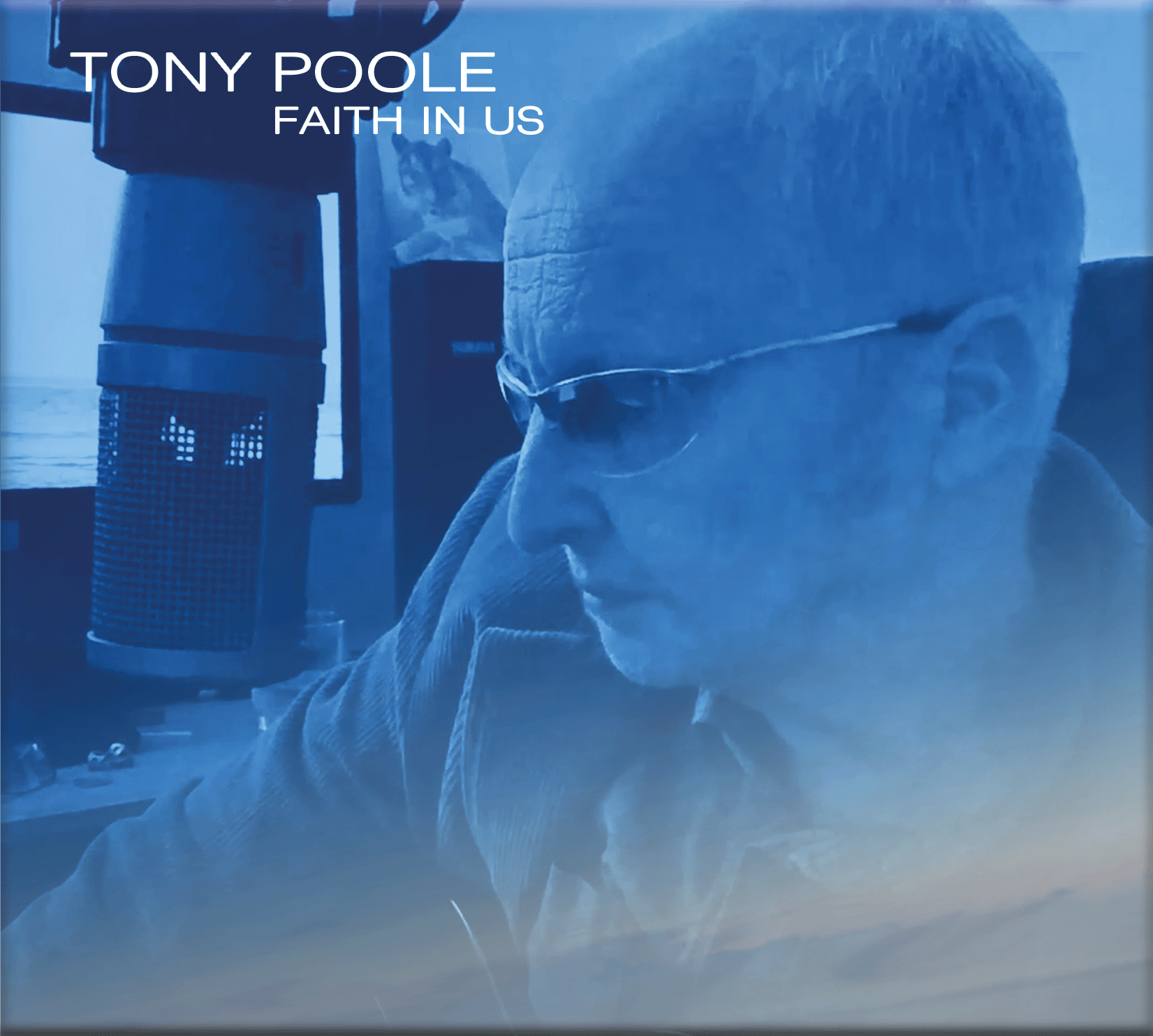
Tony Poole, Faith In Us, Aurora Records

Releasing your first solo album 51 years after you first committed to vinyl might not be worthy of a mention in The Guinness Book Of Records (or maybe it might) but Tony Poole’s “Faith In Us”,  recorded with Poole now in his eighth decade, is certainly worthy of celebration.

For those not in the know Poole was the jangly 12 string Rickenbacker player in the early 70s band Starry Eyed & Laughing, a band who inhaled of The Byrds and Crosby Stills Nash & Young and who delivered two superb albums, sadly never making the big time. Thereafter Poole was hidden from sight for a couple of decades, working behind the scene producing albums and gaining a reputation for his mastering and engineering skills before springing into prominence as one third of Bennett Wilson Poole, a band which took the UK Americana scene by storm in 2018. A revived Starry Eyed & Laughing (Poole paired with original member Ian Whitmore) released a long awaited third album in 2021 to accolades and now Poole has decided to wave his very own freak flag high on this superb outing.

The album opens with a Byrds like flourish on the title track, Poole’s jingle jangle Rickenbacker to the fore on a song which is joyous in its optimism and hope for the future generations. Next comes a hefty thump of nostalgia as Poole recalls his own youth on the 60s psychedelia of Chelsea Girls (1965) as he reimagines a bus trip in London’s swinging sixties, name checking the icons of the time and indulging in an unashamed pastiche which ropes in many of the tropes of the then nascent experimentation of bands such as The Beatles and The Yardbirds. Great fun.

It’s important to note that this is not an album suffused with nostalgia. On several of the songs Poole addresses current issues (as he did on the epic Bennett Wilson Poole song Lifeboat (Take A Picture Of Yourself)). Chief amongst these is the powerful Imagine This which addresses the plight of children separated by border controls and posits that such policies are a small step away from actual fascism with Poole referencing Martin Niemöller’s famous poem, First they Came. With hints of Indian drones amidst the driving beat along with several scorching solos the song soars with Poole’s multitracked harmonies lifting it to the heavens. In a similar vein is the ecological plea which is This Slice Of Time, chock-full of chiming guitars as Poole offers a new take on a song originally penned by Nelson Bragg which, with its lengthy coda reminds one of Crosby Stills Nash & Young. Going back to his own childhood, Poole recalls his yearning for the nirvana which was American culture as he suffered the (often brutal) public schooling meted out to kids back then on Dream Of Life but, on the baroque pop of Marcie Dancing, he is optimistic again (as on the title song) on a song dedicated to the children of some of his collaborators on the album.

While Poole’s 12 string guitar mastery always reminds one of McGuinn, there’s another Byrd who inhabits several of the songs contained here, the late David Crosby. His spirit looms large on Love Or Something, a languid note which amps up Crosby’s Everybody’s Been Burned  but it’s the slow burn epic album closer, Film Noir, which truly revives the hazy days of Crosby’s magnum opus, If  I Could Only Remember My Name. Full blooded crunchy guitars and organic sweeps on keyboards ebb and flow as Poole, uncannily, delves into that smog and dope fuelled miasma which Crosby laid down all those years ago, assisted here by a guest appearance from the legendary Glenn Phillips who adds some scintillating guitar solos.
Website

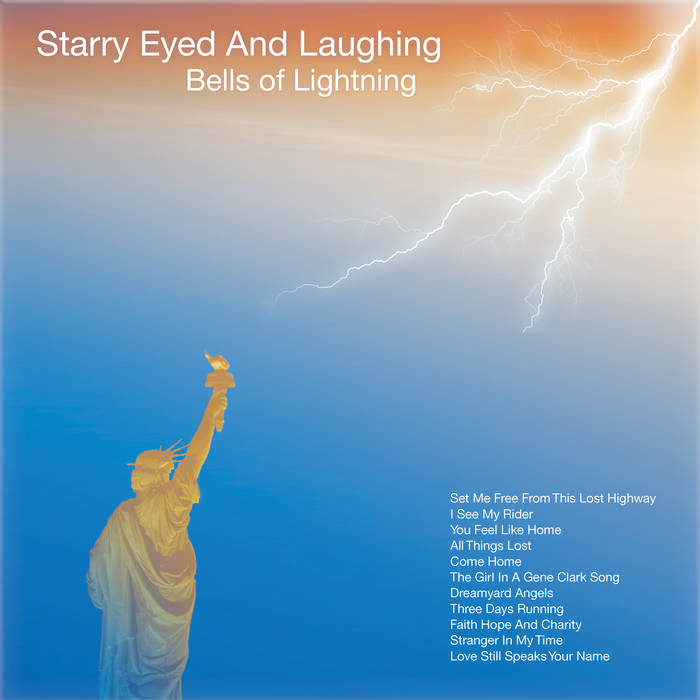
Starry Eyed & Laughing. Bells Of Lightning. Aurora Records

a1900855819_16

We wanted to kick off the New Year with a bang and what better way to do so than with the turbo charged bass and 12 string blizzard intro to Set Me Free From This Lost Highway, the opening song on Starry Eyed & Laughing’s long awaited third album. Initially fuelled by The Byrds’ Eight Miles High, the song soars mightily and then incorporates CSN like harmonies alongside Hugh Masakela like trumpet sounds and stinging sitar like guitars. It’s bang on as it revitalises these treasured sounds from the past. Tony Poole, the Rickenbacker wizard, hauls the song into the present day with pointed lyrics which rail against that disgraced human anus who still believes he is the President of the USA.

Starry Eyed & Laughing’s last album release was in 1975 and they have been consigned to “lost legend” status for a long while. While guitarist Poole has kept the flame alive via a judicious selection of reissues and occasional low-key appearances with Iain Whitmore, bassist in the best-known line up of the band, the pair resolved to record a new album some years back. But then, stuff happens. Poole was laid low with a chronic illness for a time before getting a bravura second wind as one third of the excellent Bennett Wilson Poole. Revitalised, he and Whitmore set to the task but then Coronavirus bit. As we said, stuff happens. Nevertheless, the duo persevered and the result is this brilliant reclamation of jangled sixties rock, all dressed up for a new frontier as it were, post Trump, post illness, post Corona hopefully, as they fully intend to play these songs live at some point.

Starry Eyed And Laughing were always in thrall to The Byrds and CSN, no bad thing of course, especially if you can leap from that launch pad to deliver fine goods of your own. Their first two albums did that and Bells Of Lightning does it in spades. The influences are there and, for this listener, they amplify the joy of listening. Aside from the obvious nod to Eight Miles High in the opening song (alongside a less obvious nod to Going Down, the first song on their own first album) and the gorgeous Crosby inspired psychedelia of All Things Lost, there’s a trickle of memories for those who do remember those halcyon days throughout. Whitmore’s Come Home and You Feel Like Home have that winsome Topanga Canyon wind in their hair while Poole’s Stranger In My Time is quite timeless given that listening to it is somewhat akin to getting a shot of adrenaline straight into the memory muscle.

At the core of the album there’s a trio of songs which allude to Starry Eyed And Laughing’s ill-fated trip to the States. Dreamyard Angels opens with a cheeky nod to Simon and Garfunkel’s America before Poole offers us his tour diary in his best McGuinn style while delivering the most fully-fledged blend of The Byrds on offer here- it’s a real blast. Three Days Running is a Bakersfield like country romp with Poole’s E bender adding pedal steel like licks while Faith, Hope And Charity is a total zinger with the guitars twisting and turning every which way but backwards. Aside from these star spangled and cosmic outings, there’s a delightful and reverential ode to the forgotten Byrd, Gene Clark. The Girl In A Gene Clark Song is self referential to the nth degree perhaps, but it has the appropriate blend of LA optimism and melancholic lyricism.

Bells Of Lightning may have been a long time coming and a long time in its recording but Poole and Whitmore have come up with quite a joyous and brilliant listen. It’s quite astounding that the pair of them can conjure such a full-blooded band sound and hats off to Tony Poole for his studio wizardry.

Bells Of Lightning is available on CD and download here and there will be a vinyl edition in the near future. For the full lowdown on the album, check out our interview with Tony Poole on Americana UK.

Starry Eyed And Laughing. Forever Young. Aurora.

It seems to be general wisdom that in 1974 rock was heading for the doldrums, caught in a downward spiral that was only ended when punk exploded in 1976. Some folk will have that all that was available was pompous prog rock or the ragged tail end of glam and that music listeners were a sorry lot of loon panted hippies wishing the sixties had never ended. Mick Farren’s infamous diatribe in the NME in ’76, The Titanic Sails At Dawn catches the mood of the time. I remember those years before punk as exciting times, albums I bought in ’74 included Grievous Angel, It’s Too Late To Stop Now, On The Beach, Pretzel Logic, Natty Dread, No Other and Veedon Fleece. All have stood the test of time. I’d read about most of the music I bought back then via Zigzag magazine and it was thanks to them that I heard about an English band who sounded like The Byrds and who were named after a line in a Dylan song. For someone grabbed by then by country rock (another album I bought that year was the superb Burritos compilation, Close Up The Honky Tonks) Starry Eyed And Laughing seemed like a no brainer and there was even an opportunity to see them live one night at the Queen Margaret Union in Glasgow. Their debut album was a stormer, seesawing between Byrds jangle and CSN&Y harmonies and seeing them live and up close (as opposed to Mr Young at the Apollo) was sheer heaven, one of the best shows I’ve ever seen. Unfortunately after a second album, Thought Talk in 1975, the band disappeared, consigned to the dustbin of history although I’ve continually listened to them particularly their debut which still thrills.

Forever Young, a collection of studio and radio sessions (14 of the 18 previously unreleased) is something of a treasure trove for anyone who has happy memories of Starry Eyed And Laughing. It also serves as a fascinating nugget for anyone interested in the evolution of country rock in the UK, a form that did go into hiding for a while but eventually re emerged with folk such as Elvis Costello, Robyn Hitchcock and Nick Lowe admitting to a fondness for some twang and jangling guitars. It captures early attempts by producer Dan Loggins to have the band perform covers of songs by Roger McGuinn, Steve Stills and Mike Nesmith and others, a plan that was nixed when the band demanded their album would be all their own work. In addition there are previously unheard originals along with radio sessions (sadly some of these only came to light following the death of their first manager).

The cover versions are an intriguing lot. There’s a Byrds’ type cover of Dylan’s Forever Young, a new song back then but delivered as if it were a 1965 follow up to Mr. Tambourine Man. The chiming guitars and McGuinn like vocals are spot on and a delight to listen to. McGuinn’s own I’m So Restless (from his solo debut) is more cosmic country than the original which had a folk base, here it sounds like The Byrds circa the Dr. Byrds and Mr Hyde album with a wee bit of cosmic rocking going on, similarly Steve Stills’ 4+20 has a psychedelic sheen to it. Listening to their version of Mike Nesmith’s Propinquity has the ability to transport the listener into an alternative reality where McGuinn and gang take over the Nitty Gritty Dirt Band’s mantle of champions of Papa Nez as the twelve string corkscrews thorough this magnificent song.

If the cover versions were all that’s here then it might be safe to relegate the album into the curio cabinet. However the band’s own songs, while undoubtedly indebted to The Byrds sound and in particular the 12 string eclectic guitar jangle, stand proud after all these years and one can see the time line from them to the likes of The Long Ryders, carrying a banner for sure but no mere copyists. With three writers on board (Tony Poole, Ross McGeeney and Iain Whitmore) they offered up some treasures of their own. Miles Away is a yearning dreamlike swoon, more Gene Clark than McGuinn here. Giving You The Blues visits another Byrd’s territory, this time David Crosby with its hypnotic scales and time changes, superbly sung it’s spine tingling. Jet Plane Rider has obvious links to Eight Miles High but it’s an exhilarating listen in its own right; it’s almost spooky mind you at how well the band were able to channel their influences. Their blossoming into their own right is portrayed on the barnstorming (Just Like) A Weepy Movie, the keening ballad So Tired, adorned by marvellous harmonies and well able to pass muster with contemporary songs by the likes of Poco and even the Eagles. Finally, the alternative version of In The Madness, a song on their first album, shows that by then they had transcended their influences and were able to mark their territory with a song that soared high on vinyl way back then.

On a personal level it’s been a joy to listen to this album. If you’re not familiar with the band but enjoy The Byrds, McGuinn, Crosby, Poco or early seventies country rock in general then you really should check it out.

Website