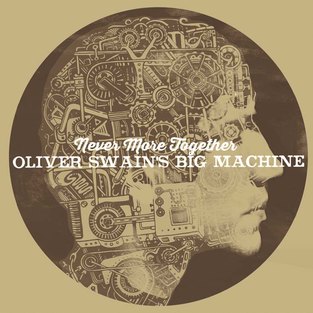
I know that British Columbia is a big place but it seems to be packed full of excellent musicians with Oliver Swain the latest to pop out of the woodwork. Apparently he’s big over there in folk circles but Never More Together, his second album, is our introduction to him. He plays double bass, banjo and guitar (his banjo a nineteenth century goat skin creation), sings and at times, whistles. His brief whistling here causing us to recall Andrew Bird but the fact is Swain is much more fun than Bird.
He’s paid his dues playing with early incarnations of The Bills and The Duhks and with Ruth Moody before setting out with Outlaw Social and then The Red Stick Ramblers. His debut album, incidentally called In A Big Machine, was a mixture of traditional and self penned songs and included a fine cover of Springsteen’s’ I’m On Fire which successfully transferred the Boss from his NJ streets to the Canadian pines.
So to Never More Together. It’s less folky than its predecessor and all songs are written by Swain who demonstrates a fine versatility here creating what one might call “chamber pieces” along with more regular fare. In addition to his instruments his voice is an important part of the jigsaw, a slight tenor, he can sound ethereal, swooping around like Rufus Wainwright at times and he uses this ability best on the closing eight minute Take Me Up, a richly textured piece.
The album opens however with the claw hammered banjo jaunt of the title song. Light and airy it occupies similar territory to fellows such as Pharis & Jason Romero or Morrison & West although instead of peering into the deep dark woods of Appalachia Swain is in a sun-dappled clearing. No Strange Thing sees Swain coming across as a sweet voiced soul singer duetting with Emily Braden on a string-laden swoon (arranged by producer Adrian Dolan) that is like a country cousin to Norwegian Wood. Maggie, Molly & Raul is an oddity indeed, a confusion of nursery rhyme like words and Beatlish chiming guitars it has a charm but might have been more suited to appearing at the end of the album with its coda extended as that does have a bracing, almost psychedelic, feel.
After this blip Swain really gets down to work. Gone is a tender and beguiling song, Swain’s voice enveloped by the gradual instrumental swell, a burbling woody swirl. The Moan is a short instrumental lead into Apple Sucking Tree, both sinister with cello and Swain’s double bass as evocative as any of the instruments on Peter and The Wolf, creating a dark wooded space, the song exploring a similar sonic ground as that commanded by Cam Penner, an atavistic response to the wildernesses these guys travel around in. There’s some brief respite on the gentle string driven caresses of Old Dreams, a song that ripples like a mountain stream before Swain wraps it up with the epic Take Me Up. Opening with a potpourri of stringed instruments somewhat akin to an orchestra tuning up Swains voice swoops in eventually as the strings coalesce and judder almost as if they were auditioning to play Stravinsky’s Rite Of Spring. There’s a delightful instrumental passage with Swain’s guitar picking to the fore before he and the strings hit a wonderful baroque folk swing and then the song eventually collapses back into its primordial shape, a last gasp from double bass bowed low bidding farewell. It’s an audacious song but it works and is a fine end to what is a fine album.
