Suzanne Jarvie

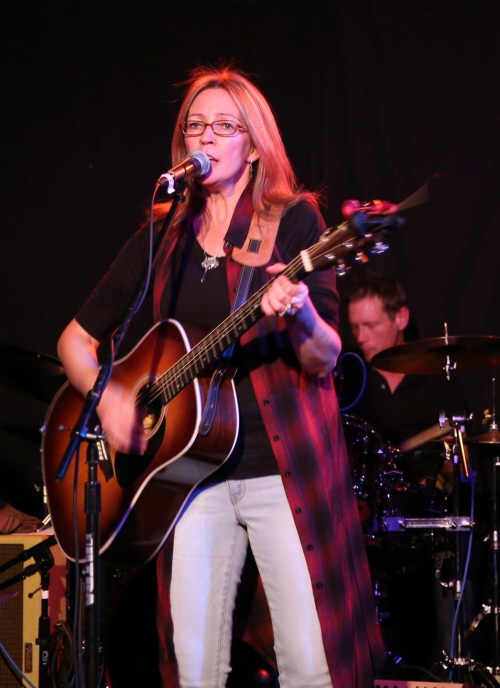
S Jarvie live pic
Spiral Road, the impressive debut album from Canadian Suzanne Jarvie has been universally lauded since its release in April. Compared by many to Emmylou Harris Jarvie delivers sweet country rock, lilting ballads and lowering country funk over the course of the disc’s 10 songs. The heady mix of Hammond organ, pedal steel and crunchy guitars on Never Gonna Stop is just short of monumental while Tears Of Love with its keening melancholy buoyed up by a joyful country arrangement would be right at home on Emmylou’s Pieces Of The Sky album, indeed it sounds as if it were written by a metaphysical Dolly Parton.
Jarvie, whose day job is as a criminal defence attorney, began to write these songs in the aftermath of a family tragedy, her son in a coma after a head injury. His road to recovery unlocked a creativity in Jarvie. While she had always dabbled in music she found herself “in a feverish fit of writing” until her songs were heard by producer Hugh Christopher Brown who eventually helmed the album setting Jarvie’s songs in crystalline and sparkling arrangements. The result is a triumph, a testament to the human spirit, uplifting, sad yet joyous with lyrics that recall the cosmic mysticism of Mike Nesmith and Gene Clark.
Ms. Jarvie is currently in the UK preparing for her first European appearances, several dates in the Netherlands throughout May. Prior to this she’s taping a session for Barry Everett’s House Of Mercy radio show and on Thursday 7th May has a free show (with Lynne Hanson) in West Hampstead, London, laid on by Locally Sourced, details  here. Just arrived in London and battling jet lag Suzanne was kind enough to answer a few questions from Blabber’n’Smoke.

Spiral Road has been unanimously praised in review after review here in the UK and the continent. Do you read the reviews and if so did you recognize yourself in them?
Yes and no. Sometimes it’s like reading about a stranger who is living the dream I wanted but could never quite reach. I do ask myself, who is the person who wrote those songs. Are they mine? Other times I recognize the artist in myself that was silent all these years, (thanks Tori Amos) which feels like a homecoming. Especially given my years working and developing as a litigator. There’s an element of poetry in advocacy, and I see now how that’s the well I was always drawing from. The realization of an artistic longing in a way that has integrity and honesty. Also, my son’s accident, which was the catalyst for these songs, was almost 4 years ago, so that experience is somewhat misted over, at least in terms of emotional immediacy. Sometimes because of that I feel detached from the reviews, which I am incredibly grateful for. They reflect so much on the amazingly collaborative aspect of the work and I am deeply honored by the response.
This is your first album, written as you say after your son’s accident. Prior to that were you playing music, singing anywhere or writing songs? It seems astonishing that an album as assured as this wasn’t in gestation for some time.
I have been playing and singing for years, but until this record, not creatively. When I was much younger I played the role of musical mimic. Even when I tried to write, which was almost never, it was either something contrived or hopelessly mawkish and 16 year old school girl diary-ish. While I had a deep longing to be more and do more creatively, I don’t think I even understood what that meant. I did not know then that creativity does not come from the mind per se. Similar to the ‘you don’t know what you don’t know’ problem. My son’s accident turned off my mind completely for a while and suddenly there was tremendous room. When the mind is quiet – a sudden awareness that something else is present. So I think the unformed essence of the record had been gestating for ages, but the trauma of the accident opened the door and fertilized the material. Getting a bit reproductive here.
Hugh Christopher Brown says that a friend of his told him about you, he heard you and was somewhat blown away which led to him producing the album. How much of a role did he have in the musicians who play with you, did you know some of them or did Chris open up his phonebook and call in some folk?
Chris’ role cannot be overstated. I had a couple of good friends who I wanted to play on the record, but other than that I had no one. No band and songs which had stripped down arrangements. I had general ideas about sonics but no specifics on how to achieve them. Chris has a pretty orchestral vision and a wide circle of wonderfully talented musician friends – so we built the record in layers, largely based on his various waves of inspiration regarding who to call on (like the Homes Bros., the Abrams Bros., Mickey Raphael, Tony Scherr etc).
While a couple of the songs (2458, Angel Of Light and Wait For Me in particular) can be seen to be about your children’s’ illnesses the remainder of the songs are highly allusive with you singing about stars, the universe, molecules and such. There are references to Navajo tradition and Enola Gay tackles nuclear destruction with powerful imagery without descending into an anti bomb diatribe. Having had some time to listen again to the album and study the words I’m wondering what authors or poets (or songwriters) might have been an influence here.
My influences are elusive. Some days I think Dark Side of the Moon, some days Gillian Welch, other days Joni Mitchell, or Tolkien or Jung. Some days I know it is meditating on death (I don’t mean that morbidly). It’s like trying to identify a spice in a dish made by someone else. I know it’s “my” imagination, but it doesn’t feel like that when it’s doing its thing. I had a transcendent experience because of my son’s accident. Something about that finally allowed me to draw on my influences without being a mimic, but also without being able to definitively identify them either. Maybe that’s the whole point!
I see that in the liner notes you credit Dylan Thomas, J.K. Rowling, Gene Roddenberry and George Lucas for inspiration. Care to elaborate on this?
My imagination is a pretty thick soup of science fiction, Victorian literature, escapist fantasy, children’s classics and random poets whose work hit me hard, like Dylan Thomas and Phillip Larkin. I like the high brow low brow mix up too. All four of my kids have a similar penchant, and so together we have spent hundreds of hours reading and watching the Harry Potter stories, Star Trek, Lord of the Rings, Star Wars etc. I got pretty wrapped up in the recurring metaphors and archetypes. I wonder at the endless capacity for the human imagination to reinvent themes relating to corruption and redemption. I hate clichés, but the question of hope’s endurance and resilience is mysterious and inspiring. When everything is getting pulverized it appears and guides, like the deluminator orb! How is that? Also, passivity versus the emotionally active life. The universe really does want you to go tearing down the street after your dreams. When you do, it will give you tail wind. I think Never Gonna Stop and Enola Gay contain those themes. Spiral Road for example, is partly inspired by my experiences with the Navajo and partly by the Tales of Beadle the Bard, J.K. Rowling’s story within the story. As for Dylan Thomas, it’s something about Fern Hill. I read that poem for the first time at age 15 and found it emotionally devastating. It’s never left me. Ultimately what you know about mortality in the abstract is irrelevant. Fern Hill gave me that epiphany on mortality, through art. I think about that all the time, about the existential power and fundamental role of art and artists.
You’re playing a few dates in the UK and The Netherlands in May. Is this your first time in Europe? Will you be playing solo or with a band?
This is my first time in Europe and I am beyond thrilled. Chris Brown is touring with me, so we will perform the tunes as a duo. In addition to his awesome keyboard stylings he gets to work his falsetto on the harmonies!

So, if you’re in West Hampstead tomorrow night you know where to go. In the meantime there’s the album to enjoy, guaranteed to astonish and delight.

Ags Connolly


Ags Connolly, from Oxford, released one of the finest country albums of last year with How About Now. Recorded outside of Edinburgh with producer Dean Owens and a fine cast of Scottish musicians (Stuart Nisbett, Kev McGuire, Jim McDermott, Andy May and Roddy Neilson) who sounded as if they were straight off the bus from Austin Texas, the album led to one reviewer calling Connolly “England’s Willie Nelson.” Connolly made his debut appearance in Glasgow last week and was kind enough to meet with Blabber’n’Smoke for a pre show beer and a chat. We started off by asking him about his recent trip to the Ameripolitan Awards in Austin.
Yeah I went out there. I spent ten days in Austin, three days in Albuquerque and I was supposed to spend five days in Nashville but because the weather was so bad flights were delayed so I missed two of the five days I was supposed to be in Nashville and that included the gig I was due to play at the Five Spot. There were loads of people supposed to come down. Will Kimbrough, Luke Bell, Pokey LaFarge and Ryan Koenig. It was a real shame. Flights were cancelled and delayed so it just didn’t happen.
The Ameripolitan Awards in Austin were great; I wrote a review of it for Country Music People. It was a great experience. I’m a recognised Ameripolitan artist but I wasn’t nominated or anything but it was just great to meet people. They didn’t know who I was at first, just the British guy hanging around but by the end of it they did saying “oh, I listened to your music” or whatever. I mean it just gives you sort of extra exposure, you know that networking thing that I’m never really good at but in that environment it was easy to do. I played a gig at the Rattle Inn and James Hand came in to watch the show just after he’d finished playing up the street at The Hole In The Wall. I’d just finished playing my song I Saw James Hand so I had to apologise to the audience and started playing it again. We caught up with each other after the show and we’re looking at ways of getting James over here to do a tour with me.
As for Nashville, well I’ve been to Austin loads of times but never Nashville so I did as much of the touristy bit as I could in the three days I had left, The Ryman Auditorium, The Cash Museum. And I saw the good and the bad side of Broadway, a lot of fairly rubbish covers bands but there are places that still have good traditional stuff and I met some really good people, just a shame I didn’t get to play the gig there.
Did you play in Albuquerque?
I was seeing family I have there, It’s a nice place, somewhat isolated and of course where they filmed Breaking Bad. I didn’t do the official Breaking Bad tour but my brother took me to a few of the places, actually better than the official tour which doesn’t go everywhere. It was pretty cool seeing the actual places but a lot of them are people’s houses so you can’t really hang around. I did one show there with Wildewood, a local band who’ve toured with The Handsome Family. It was a great little gig, held in a place that only opened for the show, opened at 8, closed at 11, but a great night.
And how has the album been doing?
It’s done well, been really well reviewed but as always it could do some more exposure. We’re going to release How About Now as a single in May to see if we can give it another push. It’s been out for about a year now so the next thing is to think about the second album and I’d like to do it up here again at Castlesound in Pentcaitland, the place was so good and all the musicians were so great.
There was a vinyl edition released
Yeah and I’ve got some with me tonight, I don’t always remember to bring them but it’s good to have them at shows because you never know who’s going to turn up and buy one. But it’s a great thing to have, it’s one of the things I’m most proud of, that record. It’s all my own thing and there’s a big picture of me on it, beautiful. My mum and dad threw out their record player years ago but my mum bought a record player because I had the vinyl out. It’s a lovely thing to have and that’s why we did it, a lot of people were asking if there was a vinyl edition so we printed up 500 of them.
What got you into country music?
I don’t really know. My dad’s not into country music, I listened to rock as a kid then I got into singer songwriters and that eventually led me to country. Bands like CSNY and the Byrds, I mean I like their albums and I listen to them but they’re not like core influences for me. I preferred writers like Leonard Cohen and Loudon Wainwright III, he’s my favourite songwriter. Some people think Gram Parsons is the essence but for me he’s the beginning, you should branch out and see why he did what he did. I’ve always had this thing where if someone references an artist or covers a song I’ve got to go and check them out. I bought a Hank Williams album before I had a clue what country music was as so many people talked about him as an influence. I loved it, not because it was country but because I really liked simple songwriting, again, like Loudon Wainwright or Ron Sexsmith, people like that and I thought there must be more of this simple songwriting and I found it in country music. It’s the home of it. I don’t mean stuff that’s really easy to write, in fact it’s really difficult to write it and make it sound really simple, that’s the genius of it.
Yeah, Hank Wangford says that when he was a rock’n’roll doctor in the late sixties he treated Gram Parsons who came into his surgery with a George Jones and Tammy Wynette album under his arm. Intrigued Hank listened to Jones and it turned his life around.
Yeah. Funny, I was talking to Hank a few weeks ago, he’s touring small villages, and I was talking to him. I gave him a copy of my album so it’s gone full circle for him from Gram to George to having an Ags Connolly record!
What are your plans for the future?
I’ll be touring with Jack Grelle in September in the UK and I’m really looking forward to that and then we’re hoping then to tour together in the States next year, that will be really cool. Jack tours around all over the States and for someone like me that would be a great experience. We’re also looking at maybe playing some dates in Italy and Croatia if we can set them up.
There seems to be an audience for Americana type music in Italy and Croatia and the like.
Yeah, Dale Watson has played a couple of festivals over there and I’ve got a couple of fans in Croatia actually, I think the internet makes it a lot easier for them to hear things.

Ags tour dates are here including some shows he’s doing with Cale Tyson on 23rd April and 9th May.

Johnny Dowd

The Dark Bard. That’s what one of the comments on our review of Johnny Dowd’s splendid album That’s Your Wife On The Back Of My Horse called the man. The commentator seems deeply immersed in Dowd’s music, witness his website here so  the Dark Bard it is. Anyhow, the DB himself was kind enough to take some time out from his preparations for his UK and European dates later this month to answer a few questions we winged over to him.

The new album, That’s Your Wife On The Back Of My Horse is pretty much a solo effort with you recording all of the instruments yourself, something you haven’t done since your debut, Wrong Side Of Memphis. Was there any particular reason for this?

There were reasons for this–financial and artistic–but mostly it just happened that way—one thing lead to another and presto chango the album was done—might have sounded better with a real drummer who wasn’t a machine-I hope this answers your question

I read that the title is lifted from a line in Johnny Guitar Watson’s Gangster of Love song where he’s baiting the sheriff. Is this a favourite song of yours?

I love that song, I even like the Steve Miller version–Johnny Guitar Watson is MONSTER talent, better than The Beatles

A lot of the album sounds electronic but the sleeve only credits guitar bass and keyboards. I presume a lot of the sounds came from a synthesizer or some such keyboard, can you tell us a bit about the equipment?

What you say is true. Matt Saccuccimorano mixed the record and put voodoo on the basic tracks–thus a guitar might end up sounding synth like–and of course I ran the bass, guitar and drum thru various mind altering pedals –so what might have begun as a Howling Wolfish tune became more King Crimsonish

White Dolemite is a fine and funky piece of braggadocio with references to hot pants and spanking. I take it it’s a tribute of sorts to the Blaxploitation movie Dolemite.

Absolutely —Rudy Ray Moore is a genius

Although you’ve stamped your authority on all of the songs it seems to me that at times you’re almost blatantly referencing influences, sixties TV themes in Cadillac Hearse, Iggy Pop on The Devil Don’t Bother Me for example. Am I making this up or do you have specific sounds, songs or genres in mind when you wrote these?

Now Paul, I’m not sure if blatantly is the way I would describe it but anyway–maybe I am being too sensitive —I don’t have anything much in mind when I am writing the songs but it’s true when I listen back the ghosts of all my influences is there—I don’t really hear the Iggy thang on Devil but that doesn’t mean it isn’t there–it’s not really important what my intention was because I don’t know or have forgotten–the train left the station without me
Why? is a glorious song that sounds cosmic and cornball at the same time. With some great absurdist lyrics ” somewhere in Oklahoma, just a few miles from the beach, stood a cowboy with a surfboard and unto me he began to preach…..” and with Anna Coogan’s lovely refrains it’s like The Man who Fell To Earth remade by David Lynch. Can you describe how a song like this comes together, where you get the idea and lyrics from?

Yea–Anna is killing on that song–she was a real important cog [along with Matt] in the machine–that song is probably as close to an autobiographical song as I will ever write–the last verse [about the spaceman] is a feeling that has haunted me whole life–I can’t describe any better than I did in the song

Can I ask about the hero of your last album, Do The Gargon. Is he still around or have you laid him to rest?

Gargon is retired and living in Key West Fla
You’re coming to Europe in April. What can we expect to hear and see?

I will be touring with Mic Edmondson on guitar and his wife [and my sister] will be doing the tour managing–Mic and i have been playing on and off for about 25 years so we have some good chemistry–I’ll have my drum machines, synths, and guitars–we will be playing mostly new arrangements of songs off the new record pus a bunch of golden oldies. A few covers [Louie Louie etc]—poems, stories—pretty much a free form wtf kinda show–plus my friend Mark Lotterman will doing the opening slot and there is not a finer singer-songwriter performer out there–! Hope to see you soon Paul—thanks -Johnny

Tour dates.

2015.04.09 Krefeld (DE) @ Kulturrampe
2015.04.10 Eeklo (BE) @ N9
2015.04.11 Nottingham (UK) @ Guitar Bar
2015.04.12 London (UK) @ The Islington
2015.04.13 Eye (UK) @ The Bank Eye
2015.04.14 Brighton (UK) @ Prince Albert
2015.04.15 Leicester (UK) @ The Musician
2015.04.16 Lille (FR) @ La Peniche
2015.04.17 Eindhoven (NL) @ Blue Collar Hotel
2015.04.18 Rotterdam (NL) @ V11
2015.04.20 Zurich (CH) @ El Lokal
2015.04.21 Frankfurt (DE) @ Dreikoningskeller
2015.04.22 Norderstedt (DE) @ Harksheide
2015.04.23 Amsterdam (NL) @ Paradiso Upstairs
2015.04.24 Zeist (NL) @ De Peppel
2015.04.25 Hengelo (NL) @ Heartland Festival

And here’s an oldie that is too good not to revisit.

Jeffrey Foucault Interview

Jeffrey Foucault has built up a solid reputation over the course of four solo albums with Uncut magazine describing his songs as “beat-up troubadour folk, whittled to dolorous perfection.” Along with his solo work he’s been involved in several collaborative efforts including Redbird (with his wife, Kris Delmhorst, and Peter Mulvey), Cold Satellite with Foucault setting poet Lisa Olstein’s lyrics to raucous rock music and an album of murder ballads with Mark Erelli. A firm live favourite he commences a UK tour this week in anticipation of his latest release, Salt As Wolves. Commencing in Perth on Thursday 29th January he then plays Glasgow’s Celtic Connections on Friday before heading south for several dates ending in London on February 8th. Before heading on his way he was kind enough to speak with Blabber’n’Smoke.

You’ve got a new album, Salt as Wolves in the pipeline and you’re coming to the UK for an eleven date tour later in January and February with Billy Conway accompanying you on “suitcase drums.” What can we expect to hear and see at these shows?

Billy plays a suitcase kit and I play electric and acoustic guitars. I handle the singing and talking, though occasionally he says something under his breath, or moans in the middle of a song. We’ll cover all the territory between country and blues and the music that came from those forms.

From the three songs I’ve heard Salt As Wolves has a blues feel, quite gritty with plenty of electric guitar. I read in an interview you did with Americana UK a few years back that you were listening to Rainer Ptacek quite a bit. Was this an influence on the album?

Rainer has been a deep and ongoing influence on me, though I came late to his work. It’s his approach and the feeling of complete openness and intention in his playing that I can’t shake. My song ‘Rico’, which is nominally about the bass player on my Ghost Repeater album, is also about Rainer, and all the real ones who die with nothing half of the time.

You and your rhythm section (Billy Conway and Jeremy Moses Curtis) teamed up with Bo Ramsey for the album. Was this the first time you’ve played with Bo since Ghost Repeater and what was it like playing with a basic four piece band? Was there a temptation to go all “Crazy Horse?”

I got the Crazy Horse out of my system on the Cold Satellite records, and anyway that’s not at all what Bo does. Bo is an economical player, and the older he gets the less he plays. There’s a lesson there. He creates a lot of negative space and the interplay between the players on this record was the whole point of the ensemble. It’s a blues record – lean, dark, and tough.

I’ve been wondering about the title, Salt As Wolves. It seems to be a quotation from Othello referring to animals in heat. Care to elucidate on this?

The next line, ‘hot as monkeys’ is a reference to animals in heat. ‘Salt As wolves’ is reference to boldness taken out of context for the music of the phrase, for a record that I wanted only to be bold and loose in the making. I came across it in a compendium of literary references to wolves in Barry Lopez’s fine book, Of Wolves and Men.

You seem to have been busy in the producers chair with albums from Hayward Williams, John Statz and Caitlin Canty under your belt. Is this something you plan to pursue and if so are there any other folk you’d like to produce?

I’m sure I’ll produce a record now and then, when I hear something that moves me or that I can contribute to. It’s a hard job and if you would do it well you can’t do it for the money. I’d like to produce a record for my wife Kris Delmhorst, but I don’t think she’ll let me.

What’s the situation regarding Cold Satellite? Cavalcade was a great rambunctious mess of Faces’ like rock and blues. Do you and Lisa Olstein have any plans for a further collaboration?

We don’t. I love that band and I love those records, and I was pleased to collaborate and expand my sonic footprint that way. We may resurrect the band to get out and tour again sometime, if someone has about 5k they don’t know what to do with, but I’m more interested in writing and recording my own songs for now. I have so many kinds of records I want to make and there’s never enough time.

Along with Cold Satellite you regularly appear as part of Redbird with your wife, Kris Delmhorst and Peter Mulvey and tour with a variety of folk. Do you ever take time out or are you always thinking about the next project or tour?

I only tour about 1/3 of the year, and while the rest of time I have some work to get done, I spend time fishing and reading and doing chores, just trying to live as normal and human a life as is possible in this country and century.

Finally you’ve mentioned on your website that you’ve crammed for the UK tour by reading all twenty of Patrick O’Brian’s Aubrey/Maturin novels in order to be primed to discuss the British Navy’s role in the Napoleonic wars. Is this something that often comes up in conversation in the UK or are you just taking the mickey?

Well, I am taking the mickey, as you say, though I did just re-read all those O’Brian novels in sequence. Historical fiction doesn’t get much better. But I doubt the topic will come up.

SALT AS WOLVES, Foucault’s fifth collection of original songs featuring his longtime rhythm section Billy Conway (Morphine) on drums and Jeremy Moses Curtis (Booker T) on bass and legendary electric guitar player Bo Ramsey (Lucinda Williams, Greg Brown), will be released later in the year.

Tour dates

01.29.15,Perth Inchyra Arts Club

01.30.15 Glasgow Tron Theatre Celtic Connections Festival

01.31.15 Bedford The Ent Shed

02.01.15 Nottingham The Maze

02.02.15 Cropredy The Brasenose Arms

02.03.15 Sheffield Greystones

02.04.15 Bristol The King’s Arms

02.05.15 Topsham The Bridge

02.06.15 Torquay Crown and Sceptre

02.07.15 Lewes Union Music @ Con Club

02.08.15 London The Green Note

website

RICO from Jeffrey Foucault on Vimeo.

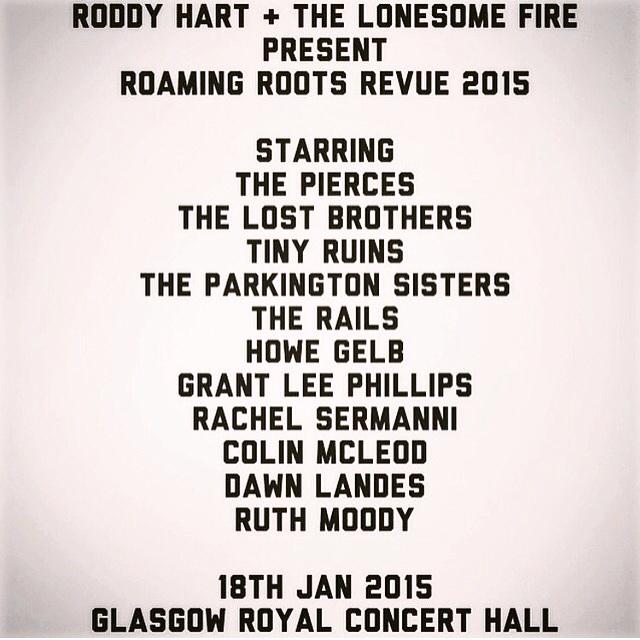
Roddy Hart on The Roaming Roots Revue at Celtic Connections

Celtic Connections is a beacon of light in the dark days of January in what is generally a cold and damp Glasgow. The festival started in 1994 in an attempt to fill scheduling gaps in the city’s Royal Concert Hall. Since then it has grown to the point that this year there will be 2,100 artists (at 300 events in 20 venues) with major artists from Folk and World music appearing. There’s always been a strong Americana presence at Celtic Connections over the years and this year is no exception with Jeff Tweedy, Calexico and Lambchop appearing along with a host of others. One of the delights of Celtic Connections is the connection element as it draws together numerous roots traditions and styles, matching and pairing unlikely combinations for some astonishing “mash ups” while musicians will tell you that the late night Festival Club and the local hotels are fertile breeding grounds for jams that can see Scots’ fiddlers and African tin whistlers cosying up to Zydeco musicians or Appalachian foot stompers.

Roaming Roots is a relatively new addition to the Festival growing out of a 70th birthday tribute to Bob Dylan four years ago. Now firmly established as a highlight it’s a musical revue hosted by Scots musician Roddy Hart and his band The Lonesome Fire as a variety of guests join them in a celebration of music with each year having a different theme. Last year’s tribute to the music of Laurel Canyon was a blast and with that in mind Blabber’n’Smoke contacted Roddy and asked him about the concept and what to expect this year.

As far as I can see, the prototype for The Roaming Roots Revue was the 2011 70th birthday celebration for Bob Dylan while 2012 saw a tribute to the late Gerry Rafferty. The format has been yourself and The Lonesome Fire acting as the house band for various artists to interpret the songs. Roaming Roots itself came about in 2012 with a concert in memory of Levon Helm. How did the Dylan venture come about in the first place and whose idea was it to continue with the format?

Musically, I was at a real crossroads back in 2010. I had released three solo records in almost as many years, but I was finding it hard to get noticed as an independent artist and was becoming a little despondent. The band as it is now (The Lonesome Fire) was in its early stages of forming, and one thing I had absolute confidence in was just how musically talented these players were. In a way, I wanted to show them off! I’m a lifelong Dylan fan, and had noticed that he was approaching his 70th Birthday in 2011, but that no one was mooting any sort of celebration for it. That felt wrong to me. A few years earlier I had been involved in a Leonard Cohen tribute in Canada, which used a house band to anchor the show and back the diverse array of artists taking part. That format struck me as perfect because logistically these shows can be a nightmare – the artists are almost certain to be arriving only a day or two before the show and so rehearsal time is limited. It’s also really expensive to fly a whole band in. So it struck me as a good thing to do for the band: we could invite artists over as a solo act or a duo and – with proper organisation and rehearsal – learn up the Dylan songs they felt like tackling. I pitched that show to Donald Shaw at Celtic Connections and he told me that if I could get some artists interested in doing it then we had a show. I got lucky straight away: I had opened for Rosanne Cash the previous year and so chanced my arm by sending her an email to ask if she was interested. She said yes immediately and the whole thing just took off. Other artists came on board, and the event sold out really quickly: we were really fortunate that people just connected with the idea straight away.
The Rafferty night in 2012 was different in that it was organised by Gerry’s friend Rab Noakes – who had been a guest, and one of the highlights, at our Dylan show – and he kindly asked us back as house band. That proved a really useful show in the end, because other musicians were added to the mix and it was a really complicated set to navigate both musically and logistically. I learned a lot from both of those shows.
As a result, I talked with the band and we decided that we wanted to create a new show that would be about more than just paying tribute to music of the past. Part of the show would still have artists covering songs that you might not get to see or hear elsewhere, but we felt particularly strongly that their own songs should be in there too – it felt a bit of a shame not to celebrate the incredible music that so many of them make. We also thought there should be an emphasis on making the show about lesser known younger emerging artists who might not get the opportunity to play these kind of concerts every day.

Last year was a celebration of the spirit of Laurel Canyon. Was this an attempt to widen the net somewhat as opposed to focussing on one artist and why was Laurel Canyon chosen?

Definitely. We adored doing the Dylan concert and, as a fan, I loved pulling it all together and coming up with a set list. But there are certain limitations to using the songs of only one artist for a whole show: there’s only one Bob Dylan, and only a handful of artists who can match that songbook. Our first Roaming Roots was the exception because Levon Helm had recently passed away, and that felt like such an important thing to pay tribute to. His daughter Amy wanted to be there for it, and so that pretty much set the tone for our inaugural show. Because it was a new type of gig no one really knew it was going on – we didn’t even sell out the downstairs part of the Concert Hall – but it was one of the most special shows we’ve ever played as band. Beth Orton, Low Anthem, LAU and many others playing and singing their own music and doffing their cap to Levon’s music with The Band really provided the blueprint for the event and proved to me that the odd combination of original music and something from a themed songbook could work together. That was something I worried wouldn’t compute with audiences, but the opposite was true: they completely got the link between the music of the past and the music of the future, and just how important it is to celebrate both.
We chose Laurel Canyon to try and widen the net, and because we were conscious that we’d played two tribute shows in two years that had marked the death of a musician. That can be a difficult and emotionally charged thing to be a part of, and so it felt right to settle on a songbook that wasn’t about one artist. Laurel Canyon was so emblematic of that feeling of unique collaboration and togetherness that Roaming Roots is trying to create that it seemed perfect and we all had our own favourite artists from that era so I knew we wouldn’t struggle for songs. Happily, the show connected with the audience too.

Presumably, the preparation for the shows is complicated with upwards of a dozen other acts involved. Who’s involved in the planning and do you wait to see who’s playing the festival and then start to plan or do you have a wish list of folk you want to invite? I know that Dawes came over specifically for four songs at last year’s show.

It’s very complicated! Essentially, I “curate” the show. So, I’ll do the initial ground work: deciding on artists who I think might work for the concert, enquiring about their availability, talking with the confirmed acts about song choices, pulling together a set list that I think has a good dynamic and would work on the night. There’s always a wish list of artists – ranging from the sublime to the ridiculous – and Donald Shaw and the Celtic Connections team are always totally brilliant at trying to make that list happen (within reason). Even if the artists are interested in the theme, there can be a million reasons actually confirming them might be complicated – scheduling, money, or management/agent difficulties understanding what the format of the show actually is, for example – but quite often it’s solved by simply speaking to them directly. Once we have our artists confirmed it then moves to the band rehearsal stage. Although I’m involved in the hosting and all the admin for the event, it’s no understatement to say that when it comes down to it it’s all about the boys in the band: I couldn’t do it without their innate skill and ability to tackle such a diverse and constantly changing set of songs.

How much opportunity do you have to rehearse the show? I guess some folk are just off the ‘plane or have their own gig to worry about.

We score up music charts together as a band and after I get word from the artists as to the songs they’re happy to perform and the keys they’ll be singing them in, then we have a few tentative rehearsals in December before work begins in earnest in January. Christmas is always a difficult time to get people together, so it’s pretty much a write-off. I try to get the Scottish artists on the bill in for rehearsals in good time in January, because it’s always completely mental when the overseas artists arrive. If we’re lucky we get them all for an hour the day before the show, and then for a brief sound check on the day (maybe 20 minutes) and then it’sshowtime! It’s stressful and tiring, but completely worth it in the end.
Any particularly scary moments when it looked as something might not happen as planned?
We’ve had plenty of near-misses with artists we really wanted to take part but couldn’t quite confirm in the end for whatever reason. That’s always frustrating, because you can spend a lot of time chasing ghosts, but you can’t get too hung up on it. We’ll get them for a show in the end I hope! Ben Knox Miller from the Low Anthem was one of the highlights of our first Roaming Roots, but he almost didn’t make it due to a mix up with the offer. Beth Orton told us the wrong key for a couple of songs she was due to perform and we only had an hour to relearn them in the new key (which has happened quite a few times!). But for all the stress and worry, it always seems to come together on the night, and it adds a certain excitement to the whole thing. Last year was a voyage into the unknown with Dawes simply because we’ve never had another full band on the show – logistically it’s pretty difficult. But I really wanted them there to represent what’s happening in Laurel Canyon in a modern context, and so we went for it with a two-band set up on stage: turning round to see two drummers (Dawes’ Griffin and The Lonesome Fire’s Scott) playing on the finale alongside nearly 30 other musicians was pretty special made up for the pre-show headache.

Celtic Connections has always been a very broad church and from the start has embraced artists from all over the world. The Revue has featured local artists such as Edi Reader, Rab Noakes, James Grant, Trash Can Sinatras, Siobhan Wilson, Kris Drever and Lau along with US acts including Roseanne Cash, Jerry Douglas, Thea Gilmore, Cory Chisel and Dawes. As curator do you have in mind a particular balance, thoughts of interesting pairings? What input do the artists have in the song selection and who they will be playing with?

The bottom line is I don’t want the artists to have to sing anything they’re not comfortable with, so there is always an open dialogue with them right from the start. But I also have to think about the dynamic of the night and have a responsibility to the audience to create a show that has moments of both discovery and familiarity. They need to be able to respond to the show as a whole. When we decided on Laurel Canyon as a theme in 2014 that meant we could go for the obscure stuff like Judee Sill, but I also knew that we had to tackle some of the big songs like the Eagles’ Hotel California. I had to convince Cory Chisel that it was a good idea, because he was the only one with the range to sing it, and I’m glad he agreed –ubiquitous as that song may be, he nailed it and it was a complete thrill to play on the night. We all had huge grins on our faces for that one. This year we have a couple of collaborations taking place, but because of the theme most of the artists are already established acts

This year’s theme is harmony, as in singing and we’re promised selections from the Everlys, Simon & Garfunkel, The Beach Boys, The Beatles, Big Star and Teenage Fanclub. Is there any particular reason this theme was chosen, does it guide you to ask certain acts such as The Lost Brothers to participate?

There were a few ideas in the pot (some that we may return to in future if we do it again!), but after the death of Phil Everly this year we talked a lot about the magic of close harmony singing and just how special it can be. It’s a dark art. I thought it would be interesting to investigate the idea of a kind of history of close harmony. So, instead of being about a specific time and place, this would be more about a style of music. It excites me that as well as hearing some of the artists sing classic songs from Simon and Garfunkel or The Beatles, you may also get to hear them taking on something more recent like Teenage Fanclub. I think it’s an interesting road to go down, but we’re also well aware that it’s a challenge and so it definitely dictated the type of artist we approached to be involved. I was mindful of making sure we booked artists already well versed in the art of singing harmony together, because things can go spectacularly wrong if you team up artists that look good on paper but don’t work so well when they finally meet to rehearse the day before the show.
So far the line up includes Grant-Lee Phillips, Howe Gelb, Rachel Sermanni, Colin MacLeod, The Pierces, The Lost Brothers, Ruth Moody. Dawn Landes and Tiny Ruins. It’s a tantalising prospect. Will there be more names to come and, without spoiling any surprises for those attending, is there anything in particular that you are looking forward to on the night?
I’m really pleased with the line-up so far, and we’ve just confirmed The Rails who are a great male/female harmony group from England fresh from being named as MOJO’s folk album of the year. There may be a few more names to come, but it’s still a little uncertain and dependent on a few different factors. We certainly have some of my favourite artists of recent years with us, so it’s shaping up to be an exciting show. I’m currently working my way through the set list to make sure the balance is right – although it’s always liable to change right up until the day of the show – but as with any Roaming Roots Revue anything can happen and I’m just looking forward to that post-show beer!

Roaming Roots Revue is at The Glasgow Royal Concert Hall on Sunday 18th January.

Here’s a snapshot of last year’s Roaming Roots Revue

The Rulers Of The Root


Debut albums are generally the domain of youth, pimpled adolescents unleashing pent up formative years of angst, doubt, unrequited love perhaps. So it’s strangely comforting to find that Glasgow band, The Rulers Of the Root, are, if not grizzled, at least able to recall when pubs were shut on Sundays and buying music meant a trip into town on a weekend. Their album, Porky Dreams, is released officially next Saturday with a launch gig at The Glad Cafe on the south side. It’s a tremendous album that showcases singer Patrick Gillies‘ excellent wordplay, a slightly absurdist take on life that comes across at times as stream of consciousness, at other times emulating the likes of Ian Dury with a fine feel for the shape and sound of language. Delivered with gusto in a manner reminiscent of Captain Beefheart, Tom Waits or Nick Cave the words are well matched by the band’s well-drilled and finely honed music. While they visit several styles on the album there’s a precision to the playing that has come from extensive rehearsals and a long history of listening to tight units such as The Blockheads and The Magic Band. Guitarist John Palmer and bassist Mick Murphy have a lifetime of playing in bands behind them while drummer Chris Quinn has a similar if less lengthy pedigree. With three of the band working in sound engineering there’s ears aplenty to fine tune the music and the end result is Porky Dreams, years in the making perhaps but with a spring in its step as well as its tail.

With the album pressed and plans well afoot for the launch Blabber’n’Smoke met up with three of the band and we started off by asking how they got together and past glories.

John: Three of us work together while Mick is an old friend of mine through my wife. He knew her brother, Malcolm Duffin, a drummer. Mick played in Glasgow bands in the eighties and for the past few years he’s been playing in Clash tribute bands. I played in several bands in the eighties.

Chris: I played in a few bands in the eighties but I’ve always been on the other side of the fence as a sound engineer. It’s a refreshing change to be on this side for a change.

Patrick: I’ve got no musical history. At the risk of boring you, about ten years ago, Nancy, my wife, bought me a guitar because I’d been wanting to play one for years. Like any teenager I could play Sunshine Of Your Love on one string but I started buying songbooks by the likes of Ray Davies and such and tried to play them in my ham-fisted way. Anyway, I eventually started writing songs and played them to John who thought they were quite promising. They were really like dead bodies these songs but John did his Dr. Frankenstein on them, revived them, put some glitter on them. After that, it was like a leaking tap. I just kept on writing songs to the point where we’ve got about 30. We put 15 songs on the album because I’m so old I was terrified I’d die before I’d get a record out. So it’s 15 songs but only 55 minutes so they’re not huge songs. The central core I suppose is country, a weird juxtaposition, a beginning and an end, some Blockheads type stuff.

Is it mainly songs from your live set?

Patrick: Yeah but we revived an old song called Elephant In The Room, which was one of the first songs I wrote, John did a really good job with it, it’s basically a country song but we’ve turned it into a Kevin Ayers type extravaganza.

John: Yeah, it’s quite dark, I was inspired by Ayer’s Song From The Bottom Of A Well which was one of my favourites when I was about 14. I love the guitar playing on it, that crazy, cranking guitar, just hitting it really. It’s an experiment I suppose but it came out quite well.

You say that a basic influence is country but while Charlie certainly fits that bill there’s some funk, Latin American grooves and noirish jazz on the album.

John: Yeah, every song’s been through about half a dozen different stages until we find a style that fits the song. We all listen to so much, we’ve been buying and listening to music from everywhere for a long time. It was quite funny when Chris was mastering the album and was trying to figure out which tags to put the songs under, we wanted to tick all of them.

Patrick: Yes, Loudon Wainwright maintains that his career was set back when someone said he was country and western so all his album were filed under that beside the likes of Sydney Divine.

The lyrics are quite striking, where do they come from?

Patrick: It never really follows a format I’m afraid. For example with Porky Dreams I came up with the name of the song (after some intense dreams one night) and just Googled American idioms and threaded them all together to make some sort of sense and to fit the sound of the G to G minor groove. Murdoch Browns also came with the sound of the original riff. It changed a bit over time and was written at the time News International was in the news a lot, I think it started from that phrase ‘Chipping Norton Set’. Elephant in the Room had a completely different tune originally but was written first and then the music came later. With Rose of Jericho I just wanted to write a story, a bit like Richard Thomson’s love story 1952 Vincent Black Lightning. Millport Cowboy was written after a visit to Millport …and it was full of Cowboys!! Neilston was written after a rail journey to Neilston in the rain and I wanted to convey a bit of that repetitive rail sound. Music and words came together. I’m sorry I can’t come up with a consistent formula! Charlie was about a friend of mine who fell out of a fourth floor tenement window and about my dad who was in Normandy. I wanted to write a traditional country song in A. I suppose words and music came together.
I’ve got good musicians and good sound engineers here. I write the songs and then take them to John and he does the rest and then the song will have three or four incarnations with the band before it finally pops up. Some of them are really close to the original, for others it’s been a really long process.

John: Some of the songs on the album were recorded years ago, really just as quick demos so we’ve had to go back to them and repair things, modify them and such. Patrick’s singing has changed since we started recording

Patrick: What he means is its improved a lot. We even had a soviet era, songs about the KGB; I was reading a lot of Solzhenitsyn at the time.

John: Yeah, we had a Ukrainian friend come into do a voice over on that. It comes across like a Zappa thing but what she’s reciting is a recipe for chicken soup! She was really good at it and we said you’ve done this before, turns out she records the voice messages for Ukrainian passenger ships, the evacuation instructions and such.

Unfortunately, there’s no Ukrainian chicken soup on the album, perhaps the next one. In the meantime Porky Dreams is a sublime trip into Patrick Gillies’ fevered imagination, an imagination that comes to life on stage where he adopts an almost atavistic persona and again one is led back to mesmerising performers such as Dury and Beefheart as Gillies grimaces and gestures utilising props at times and inhabiting the songs as one possessed. Meanwhile Palmer, a superb guitarist, in fact one of Glasgow’s most guarded secrets, lets rip with style, panache and a deep love and knowledge of rock riffdom.

Blabber’n’Smoke will have a review of the album in the next few days and the launch is at The Glad Cafe on Saturday 22nd November where they will be supported by Edinburgh’s Kings Of Cheeze, details here.

John Southworth.


Described at one time as “Canada’s best kept secret”, John Southworth has just released Niagara, an ambitious two album set which aims to bridge the two countries divided by the titular falls. Mojo and Uncut reviews have been very positive while Pitchfork described it as “familiar and comforting and vivid and strange, all at once.” Although it’s his 9th album release it’s his UK debut and in support of this he’s playing a short tour (along with Devon Sproule) starting today. Southworth has recruited Ben Reynolds and Kenny Wilson from Tin Angel label mates, Two Wings for the tour and was in Glasgow earlier this week rehearsing with them. A perfect opportunity to meet up and ask him a little bit about the album.

Niagara’s your first UK release. Prior to that you recorded an album of “failed commercial” jingles and a Kklezmer influenced musical. A pretty varied output.

I recorded all those in about a year. It was 2012 and there were a lot of Doomsday prophecies about, that the world would end in 2012. And I thought that just in case somebody’s right, I might as well do whatever I want for one year musically. So in that year I released Failed Jingles For Bank Of America And Other US Corporations which literally is what it is, rejected jingles over a period of about five years and Easterween, a very surreal cabaret operetta with an incredible arranger Andrew Downing, he’s fantastic. I also recorded an EP, West Coast Persona, an older record I had abandoned. Well, 2012 came and went and we’re still here but it was an interesting idea, an interesting exercise. It wasn’t just that however. I’m quite ambivalent about the music industry these days and rather than wait around for other people I just wanted to do what I wanted to do so I went ahead and did it. No commercial intent, just to do it.

Niagara sounds as if there’s some “commercial intent” to it.

Well, that’s a real record. From beginning to end, getting funding, recording, it’s been a four year effort, a real effort to make a real recording. During those years I’ve put versions of songs up on Band Camp, made a few copies for friends, sold them at shows but this was a real undertaking. My motivation stemmed in part from, well, If I was going to make another record, in part work with the industry, I wanted to make something special. Something that required a lot of forethought and it turned out to be a double album. There’s a lot of thought behind it, a lot of fruit within it and hopefully people can spend their time over the next few years really discovering all the gems within it. It is the kind of record where things are revealed with each listen. It’s designed like a book, take your time with it, it’s something that’s long lasting. For those who find it.

Parts of it remind me of Harry Nilsson while others recalled the Italian musician, Paulo Conte.

It could be something Nilsson would do, I’m a big Nilsson fan and on occasion you might hear something on a given song. As for Conte, way back when I put out my first record on a label called Bar None Records who released his albums also. The A&R man gave me all his records but that was a long time ago. I haven’t listened to any of his records for a while so I can’t legitimately say he’s an influence. When I was younger I was more conscious of my influences.

The Conte part, for me, is the arrangements, very rhythmic with some jazz influenced backing.

Well I definitely am coming from a pop background but the more I work with these musicians (the South Seas), I’ve worked with them for ten years now, the process is like making a jazz record. The initial recording of a song is very spontaneous and free with not a lot of constraints except the constraints of the chords and the feeling of the music.

The album is divided into a Canadian side and an American side. To my ears the American side is punchier, a little bit more powerful.

It is. In Canada we’re a little bit more introverted and withdrawn, we tend to go inside a bit more, a bit more nervous types perhaps. In America, it’s a yin yan thing, there’s more of a feverish quality to the energy.

Was there a different approach taken when recording the separate sides?

No. The musicians had no idea this was happening. We did the takes and it then later I was thinking about the feeling, what was more appropriate for each side. I wanted to make a journey on each side, something that intersected and kept balance with the other and it was a nice way to frame a double record. Niagara Falls is a landmark that literally divides the two countries so it’s a lovely metaphor, a starting place. It’s a little cheeky to do but there is some weight to it. It’s a whole lyrical journey that’s happening on the record.

Well, since colonisation started some 500 years ago Canada and the States have developed quite different identities.

Different music. To me I hear a difference. In general I hear more space in Canadian music, we have Leonard Cohen, Joni Mitchell and Neil Young. I wouldn’t say they are particular influences on me but it’s the space which has seeped into my own music whereas for America my big three would be Burt Bacharach, Bob Dylan and Jimmy Webb. There’s a different quality, a different energy to the way the song is constructed and I think it’s to do with the land in essence. I think land generates music. Canada’s colder and I think in northern countries people have more of an internal life.

You’re doing some UK dates, are you solo or with a band?

I’m playing with some members of a band called Two Wings who are also on Tin Angel (Southworth’s record label). They are based in Glasgow and when I was here in the summer we did a show and it works well.

And any plans for the future?

Well right after I get back I’m going to Banff, in Alberta, doing some lectures on music and then after that let the year unwind and then back on tour in February along the west coast of America. And then after that I’m hoping to get to Germany. And if Niagara’s getting discovered, bit by bit, it’s good to see the record get a life so I’m excited by that.

Niagara is available now on Tin Angel Records. John Southworth and Devon Sproule tour dates are :

oct 29 – cheltenham, uk – the strand
oct 30 – london, uk – jazz cafe – facebook event!*
oct 31 – coventry, uk – the tin
nov 2 – gateshead – caedmon hall
nov 3 – edinburgh – douglas studio
nov 4 – york – the basement

Website

Hanging out with The Wynntown Marshals

The Wynntown Marshals

The Wynntown Marshals‘ second full length album The Long Haul, review here finally gets its official unveiling on the weekend of 12-13 July with back to back launch gigs in Glasgow and then Edinburgh. Coming almost three years after its predecessor Westerner it subtly shifts the band’s sound from, for want of a better term, country guitar centric, to a broader canvas with the guitars more embedded in the sound and keyboard embellishment adding scope and colour. The result is still recognisably The Marshals with Keith Benzie’s signature voice still well to the fore while their admiration for their particular rock influences such as Neil Young and The Jayhawks remains apparent in the writing and delivery.

Westerner was an accomplished debut and was released to almost universal acclaim with AmericanaUK, No Depression, Maverick magazine and Dutch mag Heaven all praising it. In addition the band recorded sessions for the legendary Bob Harris and Radio Scotland’s Another Country with Ricky Ross championing them. However this was the prelude to a rocky two years that saw major line up changes that might have felled a lesser crew. It’s a tribute to the determination of the band that they have not only recorded a follow up album but one that marks a progression as noted by Scotland On Sunday who said “the sound is fuller, more imaginative and richly vocally harmonised.”

Blabber’n’Smoke had the opportunity to meet up with singer/guitarist Keith Benzie and guitar wizard Iain Sloan to chew over the album and enjoy a few drinks in Glasgow’s Merchant City. What followed was a freewheelin’ rap through our respective record collections, favourite musicians and why Americana was so popular in Holland (The Marshals are big in the Benelux countries). We did manage however to discuss the past few years and the genesis of The Long Haul and we started off by asking them about the departures of drummer Keith Jones and guitarist Ian Barbour.

Keith: Keith (Jones) and I formed the Sundowns and Keith in those days was very much the driving force, a role he carried on with when we started The Marshals. But latterly he was less keen on the songs I was bringing in. Eventually he decided to leave but as it was just before we were to tour Holland to promote the release of Westerner he helped us out with that. With Iain Barbour it was a different thing. Iain’s a teacher and he knew there would be times when he couldn’t commit to gigs, tours and such so he very nobly said he didn’t want to get to a time when he would let us down so he bowed out and allowed us to move on.
We got Owen Nicholson in from Southpaw. There’s not many folk around who can play country guitar as well as Ian but Owen was able to step in for a time. But when it came time to record the album, Owen lives a good bit away from the rest of us, he’s got another band so he couldn’t get to many sessions where we were developing the songs so when it came time to record it was easier for Iain(Sloan) to record the guitar parts.

And Murdoch McLeod came in on bass shortly after Westerner?

Keith Murdoch was in a band called The Cateran (1980’s Scots hard core grunge band who toured with Nirvana). He was the guitar player then he formed his own band the Joyriders, he’s really a lead singer, guitarist and songwriter.

So both of you and Murdoch were really the heart of the band over the past two years.

Keith Iain and I knew each other before Iain joined the Marshals. He was in a band called Slow Jet and my previous band The Sundowns had played some shows with them but it was only after Iain joined the Marshals that we talked about our record collections and realised we had so many similarities, quite obscure bands that not that many people are into but we both absolutely loved, people like Jim Bryson and The Weakerthans. They did an album with Jim Bryson, Falcon Road Incident and it’s a really nice album. A band like the Weakerthans, they’ve never played Scotland, if they did it would probably be to a crowd of about 50 people.

The album sounds as if it’s more of a collaborative effort than Westerner was

Keith For me it was great to have other people contribute, I don’t feel precious about someone saying “I’ve got this song.” On Westerner Thunder In the Valley was a real collaborative effect while Curtain Call (on the new album) was written by the two us (Keith and Iain) round about the same time. On Westerner we took a lot of songs into the studio and said “this is what we’re doing” to the band. This time Murdoch was around so something like Tide and The Submariner came into the mix. There was less of an Americana or Nashville sound going on and that was where the lead guitar, the bends, the telecaster stuff had come in before. I don’t think we’ve made an album that’s sweepingly contemporary, it’s still a country rock album but fairly early on in the process we decided that the more country aspect was not what we envisaged.

Iain Certainly, in terms of songwriting input and song development, Murdoch, Keith and I worked in a very collaborative manner from the period when Keith Jones left. And we developed a load of the The Long Haul tunes as a three piece with drum loops until we brought Kenny (McCabe, drums) onboard and began the recording process properly. Keith and Murdoch were bringing fairly well developed material into the room but the song structures, arrangements, vocal harmonies and instrumentation was a real collaborative effort and allowed us to go in a different direction from Westerner. Some of the mid sections like the ones on Low Country Comedown or Change of Heart take the songs to places that they never would have on Westerner. And a lot of it was to do with Andrew Taylor, the producer. I mean a lot of it was recorded on a thing the size of a book, it’s not even cutting edge stuff, just a portastudio but he knows what he’s doing with it.

Murdoch’s song, Tide has the makings of an epic

Iain Murdoch wrote that song back around 2000 with just a wee drum machine, it was quite trippy and we worked it up, The plan was to take it and go for that Neil Young/Crazy Horse vibe!

And why the title, The Long Haul

Keith We had a discussion about what the album should be called and I picked this little snippet out of Change of Heart which was “Life’s a journey and this is the long haul.”

Iain And maybe some folk might think that a long haul is a negative thing, suggesting it’s a drag but for us a long haul is a sense of commitment, there’s some kind of reward at the end of it

Keith Well, take the song Canada, That songs not particularly about Canada. It’s about place and family, the themes I think that are central to the long haul. Relationships, journey, travel, finding but I always get told to trim my songs down. Usually I’ve got about 16 verses and I have to cut them down to 4 or 5

Iain Otherwise it would be the Overlong Haul!

Keith I liken it to me bringing along a block of wood to the rehearsal and the band, the carpenters, hew it into something beautiful………..

Iain Oh that’s pretentious as fuck, ha ha ha ha ha

So the Wynntown Marshals in the long haul are pretty much like The Carpenters

Iain Oh we love the Carpenters, there’s some really good pedal steel on some of their songs……………………………………..

Bolstered by the addition of Richie Noble on keyboards the revamped Marshals previewed some of the songs from The Long Haul when they supported Chuck Prophet at Oran Mor back in April. A tantalisingly short set then but you can catch them in their full glory when they oficially launch the album with shows at Glasgow’s Broadcast on Friday 12th July and then Edinburgh’s Voodoo Rooms the following night. In addition and prior to the Edinburgh show they play a free in store slot at the capital’s best record store, Coda Music at 2 pm.

If you can’t manage the shows or Coda is too stuffed to get to the counter you can buy the album here

Dan Stuart

The great Dan Stuart is among us again. The voice of Green On Red and one half of the fabled bar band Danny and Dusty Stuart barnstormed and howled his way into our consciousness as part of the burgeoning California post punk roots movement back in the eighties. A bunch of young bucks, Green On Red crawled from Tucson to L. A. and released a crop of albums that owed as much to the sixties sound of The Seeds as it did to Hank Williams. Always teetering on the edge they fell over it when the band imploded with Stuart keeping a low profile for several years afterwards. Successful reunions of Green On Red and Danny and Dusty around 2006-7 saw him in fine fettle but again he retired from sight until now. Teaming up with Sacri Cuori who are very simpatico Stuart returns in the guise of Marlowe Billings on his latest release. Delivering a set of songs that may be autobiographical (although as with much of his mythology it’s cloaked in layers of mystery) his voice remains strained and compelling, second only to Jeffrey Lee Pierce. Who is Marlowe Billings and what is his relationship with the mysterious author of the Treasure of The Sierra Madre? We don’t know but Dan was kind enough to take the time to respond by email to a couple of questions we threw his way just before his Glasgow gig..

So who is Marlowe Billings and where do you fit in?

Me and Marlowe Billings? We try to accommodate one another, although we have competing narratives. He thinks he’s smarter than me… there’s a book as well with the same title for those that still can read. I’m lucky now cause I get to play a lot with a great band (Sacri Cuori) but I’m not actually in one. Bands are replacements for one’s family of origin which seldom are happy… bands are often worse.

What are your biggest influences and your most significant moment?

I could reply with a laundry list of the agreed upon canon but really “Blonde on Blonde” ain’t that big of a deal… or “Pet Sounds” for that matter. Of course I love Dylan and Brian but musicians are generally completely full of shit when it comes to what’s “good” or “bad”. Jimmy Cliff recently told an interviewer that he had been listening to Katy Perry… I thought that was hilarious. As for a significant moment, surviving when my brain broke…

What venue/gig do you most want to play?

The old places I used to play filled with sullen kids who hate the world. Now I have to play some roots venue with clean bathrooms of all things. How the mighty have fallen…

What is your favourite song you have written?

There’s a couple I’m proud of… Vivian Girls covering “Sixteen Ways” was a special treat.

What does the next six months have in store for you?

Playing Europe this fall, enjoying life and writing in Oaxaca, a west coast swing in the USA, maybe I’ll even get laid…

Where do you see yourself in ten years?

Either walking the streets of San Felipe Del Agua or resting in its panteón… whatever Juquila decides.

Any recent sounds you might want to recommend that would gladden our ears?

Both my old compadre Chuck Prophet and his buddy John Murry have released great records recently… Sacri Cuori has a record coming out next month called “Rosario” that is fantastic. “Venice Dawn” by Adrian Younge is intriguing…

And intriguing is one way of describing The Deliverance Of Marlowe Billings, Dan’s new album. Backed by the Italian band Sacri Cuori Stuart is in fine voice while the songs are for the most part superb with a couple of killers inside. I’ve reviewed the album at Americana UK while you can check out Dan’s website

Molecules, planets and Ian Hunter – A conversation with Howe Gelb

When Giant Sand played Celtic Connections Blabber’n’Smoke was fortunate enough to spend some time with Howe Gelb courtesy of Maverick magazine. After the band’s soundcheck at the ABC we found a quiet space in the CCA along the road where Howe spoke at some length on various topics. The Maverick piece was for a short feature on the band and the current re releases and will be in the March edition. In the meantime here’s some of the other topics we discussed.

The interview took place less than a week after the Tucson shootings and Howe was obviously affected by this. Initially he spoke about Gabby Giffords and his reflections on Barak Obama’s visit and speech in Tucson thereafter. This led us into some talk about his on line journal where he had reported on Obama’s visit and I asked him first of all if he had any thoughts on further writing, a book or some such.

“If I do it might be somewhere hidden in the tour journals but I don’t know if it would be a book I would want to read. That’s the problem and with the tour journals nothing is more banal or boring or routine than a tour journal so that’s why I allow that challenge to attempt to make the writing leaner and entertaining because it’s virtually the same thing every day. And you know when you’re younger you get into more trouble, you don’t know what will happen, you just go off in all kind of directions and its more lusty but when you’re older you kinda know what’s going to happen, so you’re wise enough to avoid that. So therefore the challenge is to make that writing in any way easier to swallow. I don’t know if my writing is clear enough so that folk understand what I’m saying and I don’t want to overindulge either and I also hate being the main subject matter, just that its convenient. That’s all because you’re aware of yourself mostly but then you’re still trying to step out of it now. It somehow has to relate to the world or other people. If you go by the fact that you’re a character read only by a fan base then you’re failing as a writer but if you make it so anyone can read it then it’s a good exercise.”

Have you read Ian hunters diary, a lot of it is about very humdrum day to day stuff

“Yeah, I only read it a year or two ago. I found it in John Parish’s house and I read it and it finishes with a show in Pennsylvania that I saw. I still remember that show, they opened for Edgar Winter and it’s really interesting now being in a similar situation as that guy. The full circle of him going to a gig and all of the stuff you put up with and then going to that gig in Scranton Pennsylvania.”

Half the time he’s most interested in whether the hairdryer’s working.

“He’s really a sensible cool guy in there way more than……. I don’t know. It sounded like it could happen today, the way he thinks and the way he went about things, I guess his values were sound. I saw them twice in Pennsylvania the second time they were headlining, I was 16 then, first time, 15, around 72. He said something about this in the book. First time they were opening for people, Edgar Winter had that hit Frankenstein and he was playing all those instruments on stage running around. But beforehand Mott the Hoople came out and man, for all these kids in Pennsylvania, to see those guys with those huge heels and those guitars and all those crazy shapes and shit it was fantastic. The next time I saw them, it was the same year I think ‘cos I don’t think I was able to drive yet. This was after the flood, the flood was in 72, they cleaned up after the flood so I went back there. I was there with my girlfriend and I remember it got so crowded some poor kid got pushed through the glass doors and the doors opened and my girlfriend lost her shoes and there was glass everywhere so I had to pick her up. It was all very exciting. And then the opening band was Queen and no one had ever heard of them, Brian May blew my mind that night, I kept thinking this was what Jimi Hendrix must have been like, the guy was amazing.”

Well some folk go all out for rock’n’ roll. Is that sad or silly?

“No, its necessary, I’m not sure why. It’s like some kind of sonic church where you don’t have to commit. It’s really without perimeters, it will embrace you if you want to embrace it but its not demanding at all. When you feel the surge of all those people, all that energy. And then reflecting off the people that are making the music back to the people who are sending it back to the band that’s when its at its best. And the people who are making the music are the same as the people in the crowd but they just found a way of crafting their workload the same as any carpenter or tradesman. The side effect of fame could be entertaining in itself but it could also just get in the way of the workload, there’s many trappings that can take you out of the game. ”

Well in the last two years we had the sad deaths of Vic Chesnutt and Mark Linkhouse

“Yeah there was also Jim Dickinson and Alex Chilton.”

Chilton was huge in Glasgow

“He was amazing, I only saw him live one time, we played with him in this tiny village in Italy and the way he constructed his songs was unlike anyone, really old school, a dying art. It was really cool how he set his melody outside of the box of the chords and songs and rhythms they used.”

Is that not something you do?

“No I wish, his was specific, mine is really non-specific.”

Well an album like Flies on Sherbet was primitive, not polished. not hit song after hit song. Some of your albums have been criticised for snippets of sound, sonic tomfoolery. Neither of you were looking for a number one hit.

“I don’t see anything in common but that’s OK if you do ‘cos the whole idea of any of this stuff is you put it out there. Just going by your own gut instinct and you’re trying to hand down something you think is good that someone else hasn’t got wind of yet. That’s how it seemed like it was when I was receiving that information from people when I was growing up and so when I didn’t get enough of it so I tried to overcompensate. Get more of it and that sustains a lot of the music, all those bits and pieces but there’s not enough time. Always seems like there’s never enough time. There’s all this stuff and I want to give all this stuff to as many people as possible in as little time as possible and that’s been what’s been dogging me since the get go. Especially as I thought when I was 28 and finally making a record that this should have happened four or five years before and now I got to catch up. There’s less time than I thought I had. Coming up with material never seemed to be a problem but within that material I wanted to season it with as many elements as possible that I thought was good, even if it was smaller moments and then switch it to this other thing. It wasn’t until way later that people started saying it was weird or all over the place or if I had any sense of where I was slotting in category wise. Its not what I call weird or strange so sometimes I pause to think about why people do but I don’t want to speculate. Doesn’t matter what I think.”

Well most folk expect an album to have twelve songs.

“If you take yourself way outside the orbit of a song, you know the orbit of a song can be molecular, could be as small as an atom especially in your world because your world is so cluttered with other stuff. So when you do hear a song it has to cut through all this other stuff. When you hear a song simply constructed with a chorus that you can hum by the second time you hear it now you’re involved with it, its allowing you in. If by the end if the song it seems shorter than it really was that’s a good sign, its easily and readily digestible and you want more. But if you look at it most of my stuff doesn’t do that. Because it’s molecular. It’s not as big as the universe. With the molecular stuff it’s the same thing goin’ on but just by application you have to go into the molecule, you’re not already in the molecule like you’re in the solar system. You got to now go into the molecule and if have the luxury of time to check out what’s happening then it will be just as effective. The bottom line, the end result is most people, the molecule whizzes by them . They don’t have the time or why should they dive into that thing when everything they need is going to hit them over the head like a solar system anyway. Waiting for a planet to hit them on the head.”

At that we had to call it a day as showtime was beckoning. The gig was tremendous with blistering renditions of older Giant Sand songs and some rip-roaring stuff from the latest album, Blue Blurry Mountain. On stage Gelb continued to be the gentleman, wooing the crowd with his unique mannerisms and elegant language. A fine night.